

In 2026, the price tag on a property is the least reliable indicator of its actual worth. You’ve likely felt the weight of market noise where every glass tower claims to be ultra-premium; this leaves even the most seasoned investors questioning if they’re buying a legacy or just high-priced square footage. It’s a common frustration to see the line between expensive and valuable blur as market volatility fluctuates. This guide provides the precise framework you need to distinguish between mere expensive assets and true luxury real estate that offers both generational value and a curated lifestyle.
We’ll explore the defining characteristics and investment dynamics that separate a simple transaction from a visionary acquisition. By analyzing the 2026 benchmarks of global hubs like Dubai and London, you’ll gain the clarity to secure properties that reflect your standard of excellence. We’ll examine how to evaluate these assets through a lens of rarity and precision, ensuring your portfolio remains resilient against shifting global trends. Prepare to look beyond the surface and master the art of the acquisition.
Key Takeaways
-
Identify the "Three Pillars" of rarity—Location, Architectural Vision, and Bespoke Utility—that distinguish a premium property from a truly visionary estate.
-
Uncover the 2026 trends in "Invisible Tech" and private wellness suites that are reshaping the anatomy of modern luxury assets.
-
Analyze the investment logic that positions luxury real estate as a critical safe-haven asset for preserving wealth during inflationary cycles.
-
Evaluate the global landscape to strategically position your portfolio between Dubai’s innovative branded residences and London’s enduring heritage.
-
Master the art of property curation by leveraging bespoke concierge services to access the world’s most exclusive off-market opportunities.
Table of Contents
-
Defining the Art of Living: What Constitutes True Luxury Real Estate?
-
Investment Logic: Why High-Net-Worth Individuals Choose Luxury
-
Navigating the Global Luxury Landscape: Dubai, London, and Beyond
Defining the Art of Living: What Constitutes True Luxury Real Estate?
True Defining luxury real estate in 2026 requires looking far beyond a property’s dimensions. While a 15,000-square-foot mansion might have once sufficed, today’s elite investors prioritize the intangible. Luxury is now a measure of rarity and the seamless integration of a visionary lifestyle. It’s the difference between owning a house and possessing a singular piece of history that reflects personal values and global prestige.
To better understand how these high-stakes acquisitions are managed, watch this helpful video:
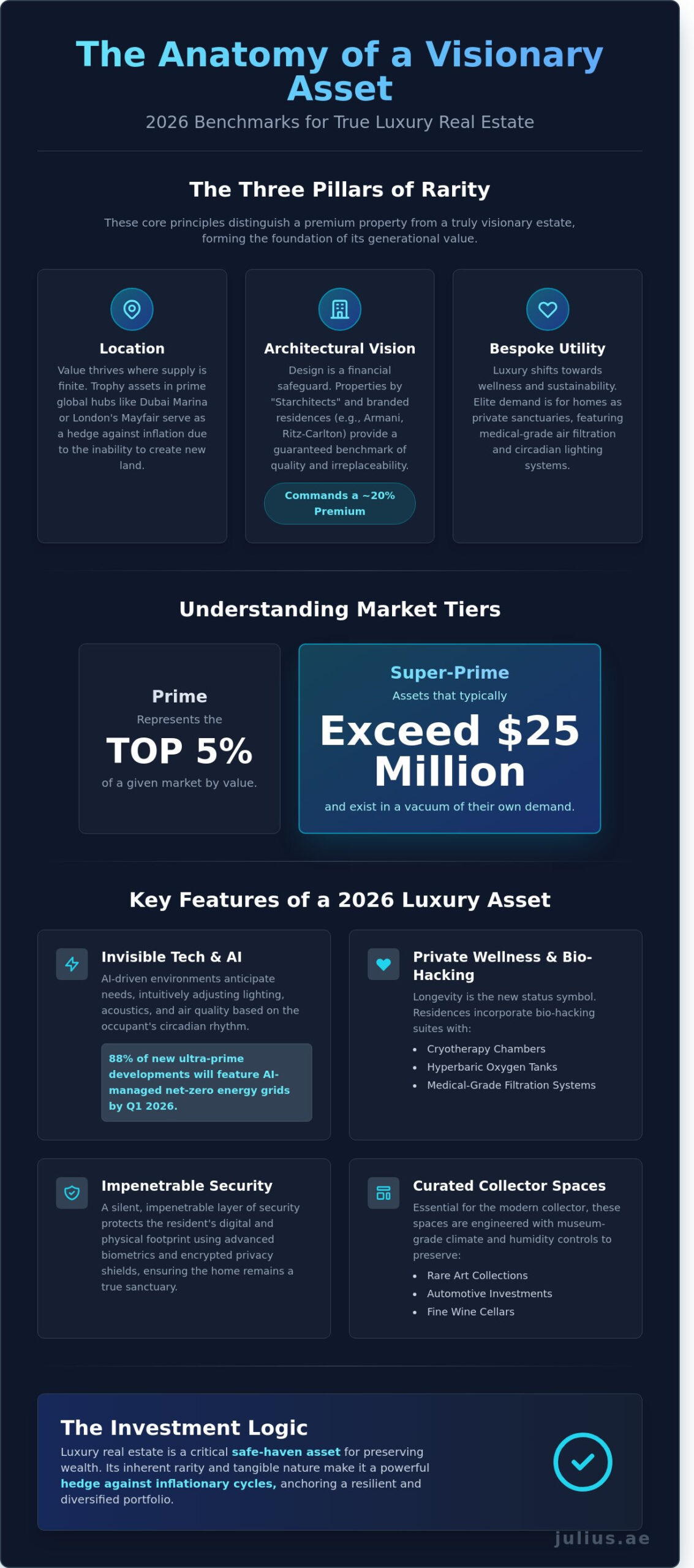
The market identifies value through three distinct pillars: Location, Architectural Vision, and Bespoke Utility. By 2026, the utility pillar has shifted significantly toward wellness and sustainability. High-net-worth individuals now demand homes that function as wellness sanctuaries, often featuring medical-grade air filtration and circadian lighting systems. We also distinguish between "Prime" and "Super-Prime" tiers. Prime properties represent the top 5% of a market, while Super-Prime assets typically exceed the $25 million threshold and exist in a vacuum of their own demand.
The Rarity Factor in Global Markets
Value thrives where supply is finite. In the Dubai Marina or London’s Mayfair, the inability to create new land ensures that existing assets appreciate. These trophy assets serve as a hedge against inflation within a diversified portfolio, often representing the crown jewel of an investor’s holdings. Rarity remains the ultimate currency in luxury real estate because it represents the one thing wealth cannot manufacture: more of the same.
Architectural Significance and Branded Residences
Design isn’t just aesthetic; it’s a financial safeguard. Properties designed by "Starchitects" often command a 20% premium over neighboring buildings. Branded residences, such as those by Armani or Ritz-Carlton, provide a guaranteed benchmark of service and quality that international buyers trust. These design-led assets hold their value during market corrections because their pedigree makes them irreplaceable to the next generation of collectors.
The Anatomy of a Luxury Asset: Key Features and Amenities
The modern definition of a luxury real estate asset has shifted from mere accumulation to the precision of curation. By 2026, the elite buyer views their residence as a high-performance vehicle for living. This evolution prioritizes "Invisible Tech," where screens and bulky hardware disappear in favor of AI-driven environments that adjust lighting, acoustics, and air quality based on the occupant’s circadian rhythm. It’s an intuitive experience that anticipates needs before they’re voiced.
Service-driven living has become the baseline for global standards. Properties now offer dedicated quarters for private chefs and 24-hour concierge teams trained in high-level logistics. Wellness has similarly transcended the standard home gym. Today’s visionary builds incorporate bio-hacking suites equipped with cryotherapy chambers, hyperbaric oxygen tanks, and medical-grade filtration systems. These features reflect a shift where longevity is the ultimate status symbol. Sophisticated investors often look to luxury housing market insights to validate the rising demand for these specialized wellness infrastructures in high-end builds.
Technological Sophistication
Automation has matured into true intelligence. By Q1 2026, 88% of new ultra-prime developments will feature AI-managed energy grids that achieve net-zero ratings without compromising on aesthetic grandeur. Security is now a silent, impenetrable layer. It utilizes advanced biometrics and encrypted privacy shields to protect the digital and physical footprint of the resident. This seamless integration ensures that the home remains a sanctuary, shielded from the complexities of the outside world. If you’re seeking a residence that masters this balance, exploring our curated portfolio of smart estates is the logical next step.
The Evolution of Amenity Spaces
Private galleries and climate-controlled showrooms are now essential for the modern collector. These spaces are engineered with museum-grade humidity controls to preserve rare art and automotive investments. We’re also seeing a rise in multi-generational "home-within-a-home" suites. These provide autonomous living quarters for guests or extended family, ensuring privacy remains paramount. Exclusive access adds the final layer of value. Many 2026 developments include deeded memberships to private clubs or offshore concierge services, blending the boundaries between private ownership and elite hospitality.
Outdoor-indoor fluidity serves as the connective tissue of these assets. Curated landscapes act as an extension of the interior, featuring "living walls" and thermal-regulated terraces that allow for year-round alfresco use. It’s no longer about a garden; it’s about a private ecosystem designed for reflection and connection. In the realm of luxury real estate, these meticulously planned details separate a standard residence from a generational masterpiece.
Investment Logic: Why High-Net-Worth Individuals Choose Luxury
Investors don’t view high-end property as a mere expense. It’s a strategic move. In 2026, luxury real estate serves as the cornerstone of a sophisticated portfolio. While paper assets face the volatility of high-frequency trading, a physical villa in a prime location offers a tangible sense of security. It’s a legacy asset that transcends market cycles.
History proves the resilience of this asset class. During the inflationary spikes of 2022 and 2023, prime property values in global hubs didn’t just hold; they climbed. High-net-worth individuals prioritize these acquisitions because they offer a "double-alpha" return. This involves the combination of strong capital appreciation and consistent rental yields, which in markets like Dubai, often reach 6.5% for premium apartments. It’s a rare financial instrument that provides both defensive protection and aggressive growth.
Sourcing property across international borders mitigates localized economic risks. By spreading capital across London, New York, and Dubai, investors insulate themselves from specific regional downturns. This diversification ensures that wealth isn’t just stored; it’s strategically positioned to benefit from global shifts in capital flow. However, as established markets show signs of saturation, savvy investors are increasingly turning their attention to emerging luxury real estate markets that offer superior growth potential and early-mover advantages.
Asset Protection and Wealth Preservation
Currency devaluation is a silent thief of wealth. Luxury property functions as a hedge, maintaining purchasing power across decades. Data from the 2024 Knight Frank Wealth Report showed that super-prime markets grew by an average of 3.1% globally, outperforming many traditional bond yields. Dubai and London remain the gold standard for this resilience; they offer legal protections that ensure your capital stays your capital.
The Lifestyle ROI
The return on investment isn’t always found on a balance sheet. We believe the true value of luxury real estate lies in the "Art of Living." This includes the proximity to world-class amenities and the organic networking that happens within exclusive enclaves. In the UAE, the 10-year Golden Visa provides a practical bridge to this lifestyle, linking property ownership directly to long-term residency and global ease of movement.
Navigating the Global Luxury Landscape: Dubai, London, and Beyond
Global capital is shifting. By 2026, the definition of a safe haven has expanded. Investors no longer settle for mere capital preservation; they seek markets that blend historical resilience with aggressive innovation. This evolution has created a fragmented yet lucrative map for luxury real estate acquisitions where timing is as vital as location.
Dubai: The Visionary Hub
Dubai remains the undisputed leader in branded residences. According to 2024 market data from Savills, the city hosts the highest concentration of these projects globally. This dominance isn’t accidental. The expansion of the 10-year Golden Visa has successfully transitioned the emirate from a high-yield investment hub into a primary residence for the global elite. It’s the reason why the demand for Luxury Apartments For Sale Dubai continues to break records. These properties offer a curated lifestyle where residents access services formerly reserved for five-star hotels. Julius identifies these off-plan innovations as essential pillars for any modern, diversified portfolio.
London and Istanbul: The Heritage and the Gateway
London’s Prime Central London (PCL) districts, specifically Mayfair and Belgravia, retain an emotional and financial gravity that newer markets struggle to replicate. The demand for heritage townhouses remains robust among international buyers seeking political stability and long-term capital growth. Istanbul has emerged as a strategic counterpart. It serves as a vital bridge between Eurasian economies. The Turkish citizenship-by-investment program, coupled with a 15% year-on-year increase in luxury transactions in 2025, makes it a gateway that cannot be ignored. Success in these mature environments depends on bespoke investment consultancy to navigate off-market listings and complex local regulations.
Riyadh is the newest contender on this global stage. Driven by Saudi Vision 2030, the city is undergoing a transformation that echoes Dubai’s early growth. With over $1 trillion in infrastructure projects currently underway, the luxury sector in Riyadh is projected to see a 12% valuation increase by the end of 2026. For the cross-border investor, several factors remain paramount:
-
Currency Hedging: Protecting assets against fluctuations in the Euro or Pound.
-
Management: Securing high-tier property management for non-resident owners.
-
Yield vs. Legacy: Balancing the high rental yields of Dubai with the legacy appreciation of London.
Acquiring property across these borders isn’t just a transaction. It’s an art. It requires a partner who understands that a home is both a financial asset and a visionary statement of one’s place in the world.
Secure your next international acquisition with our expert advisors
The Julius Standard: Curating Your International Portfolio
Sophisticated acquisition in 2026 transcends the simple exchange of capital for titles. It represents a deliberate shift from transaction-based buying to a philosophy of bespoke property curation. At Julius Property, we recognize that your portfolio is a reflection of your legacy. We operate as a luxury concierge, providing a gateway to off-market opportunities that never reach public listings. Statistics from Q1 2026 indicate that 35% of high-value transactions in the UAE occurred through private channels. Our role is to ensure you’re part of that exclusive percentage.
Transparency remains our cornerstone. We provide market authority through data-driven insights, ensuring every decision is backed by rigorous analysis. You aren’t just buying luxury real estate; you’re investing in a vision meticulously vetted by experts who understand the nuances of global wealth preservation. We’ve spent years cultivating a network that prioritizes discretion and precision above all else. For investors seeking to expand beyond residential assets, partnering with a specialized commercial property brokerage becomes essential to navigate the complexities of cross-border commercial investments and unlock institutional-grade opportunities.
Bespoke Property Sourcing
Our process begins with your lifestyle. We don’t just show properties; we match your daily rhythms to specific architectural movements. Whether it’s the sleek minimalism of a Dubai penthouse or the historic grandeur of a European estate, the fit must be precise. Julius Property maintains a dominant presence across the Middle East and Europe, offering a seamless bridge between these distinct markets. We simplify the complexities of international ownership by providing internal expertise in:
-
Global mortgage advisory across 12 different jurisdictions.
-
Comprehensive leasing strategies to optimize your annual yield.
-
Architectural vetting to ensure structural and aesthetic integrity.
Your Next Step in Luxury
The journey into the world’s most exclusive markets requires a partner who anticipates your needs. We invite you to a private consultation to review your current portfolio and identify growth avenues for the remainder of 2026. This session provides a first look at exclusive off-plan developments, often 6 to 12 months before their public release. Secure your position in the next generation of iconic skylines. It’s time to refine your approach to luxury real estate and embrace the Julius standard.
Explore our curated collection of luxury real estate
Mastering the Global Skyline in 2026
The acquisition of a trophy asset is a deliberate act of vision. As we look toward 2026, the global landscape demands more than capital; it requires a nuanced understanding of the art of living. You’ve seen how the definition of value has shifted toward rare amenities and architectural integrity in hubs like Dubai, London, and Riyadh. These markets don’t just offer square footage. They provide a stable hedge against volatility and a canvas for your personal legacy.
Navigating the complexities of luxury real estate requires a partner who operates beyond the public listing. Our team provides direct access to exclusive off-market trophy assets across these three primary global financial centers. By blending bespoke investment consultancy with an aesthetic eye, we ensure your portfolio reflects both your financial intelligence and your lifestyle aspirations. Every decision is backed by real-time data from the 2025 market cycle to prepare you for the year ahead.
The path to an unparalleled international portfolio starts with a single, refined conversation. It’s time to claim your place in the world’s most prestigious skylines.
Begin Your Curated Property Journey with Julius
Frequently Asked Questions
What qualifies a property as luxury real estate?
Luxury real estate is defined by its scarcity and a price point typically falling within the top 5% of a specific market’s value. In 2026, this category demands more than just a high price; it requires a prime location like Palm Jumeirah or Mayfair and bespoke finishes. Features such as integrated AI home systems and private wellness suites are now standard expectations for these elite assets that define the art of living.
Is luxury real estate a good investment in 2026?
Luxury real estate remains a premier vehicle for wealth preservation, with prime markets like Dubai projected to see capital value increases of 5% throughout 2026. High-net-worth individuals prioritize these assets because they offer a tangible hedge against inflation and consistent rental yields often exceeding 6%. The limited supply of ultra-prime inventory ensures that demand continues to outpace availability in global hubs, securing your financial legacy.
How do branded residences differ from traditional luxury apartments?
Branded residences provide a turn-key lifestyle managed by elite hospitality names like Four Seasons or Ritz-Carlton, distinguishing them from traditional high-end units. These properties often command a 30% price premium because they include 24-hour concierge services, signature spas, and global loyalty benefits. Investors choose them for the enhanced liquidity and the rigorous quality standards maintained by the associated brand, ensuring a seamless living experience.
What are the most expensive luxury real estate markets in the world?
Monaco holds its position as the world’s most expensive market, where $1 million typically secures only 17 square meters of space as of early 2026. Hong Kong and New York follow closely, while London and Dubai show the highest growth rates for ultra-prime transactions. These cities attract capital because they offer a unique combination of political stability, lifestyle prestige, and robust legal frameworks for property ownership.
Can foreigners buy luxury property in Dubai and Riyadh?
Foreigners can exercise 100% ownership of property in Dubai’s designated freehold zones and Saudi Arabia’s emerging premium developments. Dubai has offered this right since 2002, while Riyadh’s new regulations under Vision 2030 have opened specific zones to international investors. These markets provide a streamlined acquisition process designed to attract global capital into the region’s most ambitious architectural projects, making it easier than ever to build a Middle Eastern portfolio.
What is the role of a property investment consultant in a luxury transaction?
A property investment consultant serves as a curator of opportunities, providing access to off-market listings that account for roughly 40% of ultra-prime transactions. They analyze market data to ensure your acquisition aligns with long-term wealth goals and lifestyle requirements. Julius acts as a visionary partner, navigating the complexities of the 2026 market to secure assets that offer both aesthetic beauty and financial resilience for the discerning buyer.
How does the Golden Visa impact luxury real estate demand?
The Golden Visa significantly boosts demand by granting 10-year residency to investors who purchase property valued at 2 million AED or more in the UAE. This program has transformed Dubai into a primary residence for global entrepreneurs rather than just a secondary vacation spot. The security of long-term tenure encourages larger capital outlays, as buyers invest in permanent family homes and expansive estates that offer long-term stability.
What should I look for when buying off-plan luxury property?
Prioritize the developer’s historical delivery record and the specific escrow protections in place to secure your investment. You should examine the 2026 construction milestones and ensure the payment plan aligns with your liquidity strategy. Successful off-plan acquisitions often focus on emerging districts where infrastructure projects, such as new metro lines or marinas, are scheduled for completion within 24 months of the projected handover date.
Leave a Reply