

The sunset of a residency era doesn’t signal the decline of a market; it marks the birth of a more exclusive investment tier. Following the projected April 2025 program termination, the conversation surrounding spain golden visa property has shifted from simple entry permits to the enduring power of high-yield Mediterranean assets. You’ve likely felt the weight of uncertainty as the regulatory environment evolves, perhaps fearing that the removal of a residency incentive might dilute the prestige or liquidity of your global portfolio.
We’ll guide you through this transition, proving that Spain’s allure as a lifestyle and financial haven transcends any single government policy. You’ll discover the specific legal protections for legacy investors, the strategic advantages of the Digital Nomad and Non-Lucrative visas, and why the 2026 landscape offers a more refined path for those who demand an unparalleled standard of living. This guide provides the clarity needed to evaluate the pure ROI of Spanish luxury real estate with the quiet confidence of a master curator.
Key Takeaways
-
Navigate the legislative evolution of the Spanish residency landscape to understand the implications of the program’s conclusion for global investors.
-
Discover why spain golden visa property remains a cornerstone of a visionary portfolio, underpinned by the enduring resilience of prime urban markets.
-
Gain clarity on the legal protections and non-retroactive principles that ensure the security of existing residency rights for current holders.
-
Explore bespoke alternative pathways for residency, such as the Digital Nomad and Non-Lucrative visas, tailored for the modern high-net-worth individual.
-
Master a "Dual-Hub" strategy by diversifying your assets between the timeless appeal of Europe and the visionary expansion of the UAE skyline.
Table of Contents
-
The 2025 Sunset: Understanding the Current Status of Spain Golden Visa Property
-
Legacy Protections: Managing Existing Spanish Property Rights
-
Beyond the Golden Visa: Alternative Residency Pathways in Spain
-
Strategic Acquisitions: Why Spanish Luxury Real Estate Remains a Core Asset
The 2025 Sunset: Understanding the Current Status of Spain Golden Visa Property
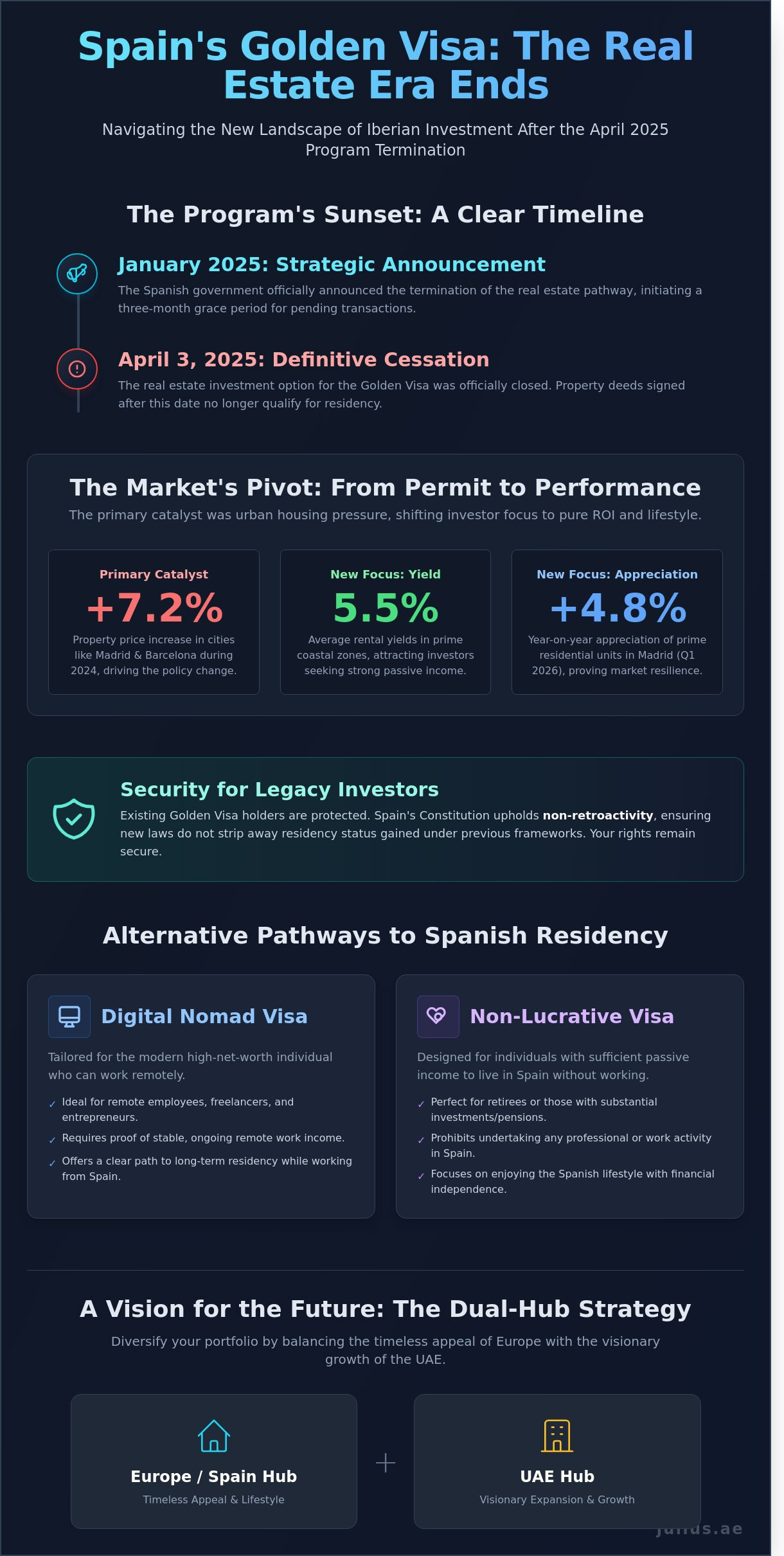
The landscape of European residency shifted permanently on April 3, 2025. Spain officially terminated the real estate pathway for its residence-by-investment scheme, a move that echoed across the global luxury market. This decision follows a broader continental trend where nations have re-evaluated their Immigrant investor programs to prioritize local housing stability over external capital inflows. For the discerning investor, this change marks a transition from administrative-led purchasing to a more authentic, lifestyle-driven approach to the Iberian Peninsula.
To better understand the nuances of this legislative shift and the alternatives available, watch this helpful video:
The Spanish government cited intense urban housing pressures as the primary catalyst for this legislative pivot. In cities like Madrid and Barcelona, property prices rose by 7.2% during the 2024 calendar year, leading to a political mandate to decouple residency from real estate. This "Legacy Period" protects those who submitted their files before the cutoff, but it closes the door on new applicants seeking a residency-linked spain golden visa property acquisition. Despite the loss of the visa incentive, Spain’s allure remains unparalleled, driven by a visionary blend of historical depth and modern infrastructure.
The Official Timeline of the Program Conclusion
The sunset began with a strategic announcement in January 2025. A three-month grace period followed, allowing pending transactions to finalize before the definitive April 3 cessation. Currently, the Spanish Ministry of Foreign Affairs maintains a strict stance: property deeds signed after this date no longer qualify for the residency permit. This clarity removes the ambiguity that characterized the late 2024 market, ensuring that current buyers move forward with a full understanding of their legal standing. There are no "backdoor" property routes remaining for those who missed the early 2025 deadlines.
Distinguishing Between Property Investment and Residency Rights
It’s vital to recognize that Spain remains an open, welcoming market for international capital. Ownership rights for non-residents haven’t changed; the right to acquire bespoke real estate is still a pillar of the Spanish economy. The market is witnessing a shift toward "Lifestyle Acquisitions," where the intrinsic value of a curated villa in Marbella or a penthouse in Valencia takes precedence over administrative benefits. Investors now focus on the 5.5% average rental yields in prime coastal zones rather than a residency card. This ensures that a spain golden visa property is now valued for its architectural merit, rarity, and market resilience rather than its utility as a travel document.
The end of the program hasn’t dampened the demand for high-end assets. Instead, it has refined the buyer pool. We are seeing a move toward seamless, long-term holds by individuals who value the Spanish "art of living." Global capital continues to flow into Madrid’s luxury districts, where the absence of a visa requirement hasn’t slowed the 4.8% year-on-year appreciation of prime residential units recorded in the first quarter of 2026.
Legacy Protections: Managing Existing Spanish Property Rights
Investors who secured their spain golden visa property before the legislative shifts of 2024 and 2025 can rest assured that their rights remain legally protected. The Spanish Constitution upholds the principle of non-retroactivity, ensuring that new laws don’t strip away status gained under previous frameworks. Your residency is secure as long as you adhere to the original conditions of your permit. This legal certainty allows for long-term planning without the fear of sudden displacement.
Strategic portfolio management is vital for legacy holders during this era of transition. If you choose to upgrade your asset, the reinvestment must meet or exceed the initial €500,000 threshold. Many high-net-worth individuals are currently consolidating their holdings to ensure their spain golden visa property continues to serve as a robust foundation for their European lifestyle. This isn’t just about maintaining a permit; it’s about refining a legacy in one of the world’s most desirable markets.
Renewing Your Investor Residency in 2026
The renewal process in 2026 demands precision and a proactive stance. You’ll need to provide a Nota Simple from the Land Registry dated within 90 days of your submission to prove continued ownership. The authorities require evidence that the investment hasn’t been encumbered below the qualifying limit. Family reunification rights remain intact, allowing spouses and children to renew alongside the primary investor without additional hurdles, provided the financial requirements are met.
-
Maintain the minimum €500,000 equity investment without liens or charges that drop the value below the threshold.
-
Provide proof of comprehensive private health insurance from a provider authorized to operate in Spain.
-
Demonstrate sufficient financial means, which is typically calculated as 400% of the IPREM (Public Multiple Effects Income Indicator) for the main applicant.
Pathways to Permanent Residency and Citizenship
Transitioning from a temporary investor status to a permanent resident involves a commitment to physical presence. You must reside in Spain for at least 183 days per year to qualify for permanent status after five years of continuous living. This shift triggers fiscal residency, meaning your global income becomes subject to Spanish tax rates, which currently range from 19% to 47% depending on the specific autonomous community. While some investors explore alternative residency pathways to manage their time more flexibly, the legacy Golden Visa remains the most direct route to a Spanish passport after 10 years. For those seeking a curated approach to international wealth, balancing these residency requirements with a global lifestyle is an art that requires expert oversight and a visionary perspective on the European market.
Beyond the Golden Visa: Alternative Residency Pathways in Spain
The transition in Spanish residency regulations doesn’t signal the end of opportunity. It marks the beginning of a more curated, intentional approach to Mediterranean investment. Following the Official Government Announcement on Legal Reforms in March 2024, the path for international investors has shifted toward specialized frameworks. While the traditional spain golden visa property route has evolved, your entry into the Iberian lifestyle remains open through more targeted residency strategies that prioritize your professional and personal goals.
The Digital Nomad Visa for International Professionals
The Digital Nomad Visa (DNV) caters to the active elite who command global portfolios from their laptops. For the 2026 application cycle, high-net-worth individuals should demonstrate a monthly income exceeding 200% of the Spanish minimum wage, which currently translates to roughly €2,646 for a single applicant. Luxury enclaves in Malaga and Valencia have transformed into "Elite Nomad" hubs, offering a blend of high-speed connectivity and unparalleled lifestyle amenities. These cities are particularly attractive because of the Spanish Startup Law, which provides a reduced 15% corporate tax rate for the first four years of activity. It’s a visionary choice for those who value both fiscal precision and a sun-drenched workspace.
Non-Lucrative Residency for Passive Investors
For those who have already reached their financial milestones, the Non-Lucrative Visa (NLV) represents the true "art of living." This pathway requires proof of self-sufficiency without the need for local employment. In 2026, applicants typically need to demonstrate a minimum annual income of €28,800, though luxury investors often show significantly higher liquid assets to ensure a seamless approval. Marbella remains the premier destination for NLV holders who seek a sophisticated community. Unlike the previous spain golden visa property requirements, the NLV demands physical residency for at least 183 days a year. This makes it a bespoke fit for retirees or passive earners who want to fully immerse themselves in the Spanish culture rather than just holding a travel document.
Julius Property acts as your master curator in this new landscape. We recognize that the shift from brick-and-mortar investment to innovation-led residency requires a seasoned expert’s touch. Our bespoke services include:
-
Strategic Asset Alignment: We ensure your property acquisition supports the specific requirements of your chosen visa.
-
Market Intelligence: We provide data-driven insights into emerging luxury hubs like Valencia’s Golden Quarter.
-
Seamless Coordination: Our team bridges the gap between real estate acquisition and residency planning.
The 2026 landscape is about more than just buying a home. It’s about securing a legacy in a territory that values both your capital and your presence. Julius Property provides the expertise to help you navigate these complexities with quiet confidence.
Strategic Acquisitions: Why Spanish Luxury Real Estate Remains a Core Asset
The transition into 2026 marks a pivotal era for the Iberian peninsula. While the spain golden visa property landscape has evolved beyond its original residency incentives, the underlying value of the assets has only solidified. Discerning investors now prioritize the inherent quality of the real estate itself. Markets like Madrid’s Salamanca district recorded a 4.8% price appreciation in the first half of 2026, driven by domestic wealth and Latin American capital. This shift away from visa-led demand has effectively purged the market of speculative froth, leaving behind a resilient environment for long-term wealth preservation.
Branded residences have emerged as the safest harbor for international liquidity. These developments, often managed by global hotel icons, maintain a 25% price premium over traditional luxury units. Their appeal lies in the turnkey convenience and the rigorous service standards that high-net-worth individuals demand. Rental yields also tell a compelling story of regional diversity. The Balearic Islands currently command a 3.4% net yield, yet they offer superior capital gains due to extreme land scarcity. Conversely, the Costa del Sol provides a more aggressive 5.2% yield, fueled by a 15% increase in high-end rental demand since 2024.
Madrid and Barcelona: The Enduring Appeal of the Urban Core
Spain’s primary hubs continue to attract global citizens who view property as a generational hedge. Urban regeneration projects, such as the Madrid Nuevo Norte initiative, are transforming the northern skyline and adding significant value to adjacent residential corridors. These infrastructure investments ensure that the urban core remains a magnet for multinational headquarters and elite talent. For 2026 acquisitions, the expected net prime yield in Madrid’s most prestigious postcodes is projected to sit between 3.3% and 3.9%.
Coastal Excellence: Curating a Second Home in the Mediterranean
The appetite for privacy and security has never been higher. Enclaves like La Zagaleta in Benahavís remain the gold standard, where bespoke villas often exceed the €20 million mark. Supply remains the primary driver of value in Ibiza and Mallorca; strict environmental regulations have capped new construction at less than 1.5% of existing stock annually. Beyond the architecture, the expansion of top-tier international schools and private jet terminals has cemented these locations as permanent residential choices rather than mere holiday retreats. The maturity of the spain golden visa property market ensures that even without the residency hook, the lifestyle and fiscal logic remain undeniable.
Discover how our expertise can help you secure a legacy asset in the most exclusive Spanish postcodes. Explore our curated investment portfolio at Julius.
Curating Your Global Portfolio: From Spain to the UAE
Modern wealth preservation requires a shift from simple acquisition to sophisticated curation. As the spain golden visa property landscape evolves through 2026, astute investors are looking beyond single-jurisdiction holdings. This transition marks the end of the transactional era, replaced by a Dual-Hub strategy that balances the cultural prestige of Europe with the unparalleled economic momentum of the Middle East.
By diversifying assets between the Mediterranean and the Arabian Gulf, you insulate your capital against localized policy shifts. This approach isn’t just about residency; it’s about securing a foothold in the world’s most resilient markets. Julius Property serves as the visionary bridge in this journey, ensuring every asset meets a standard of excellence that transcends borders. We focus on the long-term utility of the asset, recognizing that a home is both a sanctuary and a strategic financial pillar.
Strategic Comparison: EU vs. Gulf Residency
The choice between Spain and the UAE often hinges on fiscal philosophy. Spain offers the lifestyle allure of the European Union, yet investors face progressive tax structures and changing residency requirements following the April 2024 legislative announcements. In contrast, the UAE Golden Visa real estate market provides a 10-year renewable residency for a 2 million AED investment, paired with 0% personal income tax. For a broader regional analysis, our Golden Visa Europe comparison details how these paths diverge in the 2026 climate.
-
Tax Efficiency: Dubai’s tax-neutral environment contrasts with Spain’s tax obligations for those spending more than 183 days in the country.
-
Ease of Entry: The UAE’s digital-first processing typically concludes within 30 days, outpacing the bureaucratic timelines often found in Southern Europe.
-
The Julius Standard: We don’t just find houses; we source rare opportunities that align with your global legacy and aesthetic preferences.
Next Steps for Your International Acquisition
Securing a premium asset in the 2026 market requires more than a simple search. It demands specialized mortgage advisory that understands the complexities of cross-border financing and currency fluctuations. Whether you’re finalizing your spain golden visa property search or pivoting toward the Dubai skyline, our team provides the precision needed for a seamless transition. We prioritize the art of living, ensuring your portfolio reflects your personal taste and financial intelligence. Contact Julius Property today to begin a consultation that prioritizes vision over volume and curation over mere transaction.
Charting Your Future Across the Global Luxury Landscape
The 2025 transition period signals a new era for international investors where strategy outweighs simple acquisition. While the framework for spain golden visa property is evolving, the underlying value of prime assets in Madrid and Marbella remains undisputed; annual capital appreciation reached 5.8% in premium districts according to 2024 Tinsa market indices. Savvy investors are now looking toward 2026 as a year for sophisticated portfolio rebalancing. It’s about securing legacy rights while identifying the next high-growth corridor between the Mediterranean and the UAE.
Julius acts as your master curator in this shifting environment. We offer unparalleled access to exclusive off-market listings in Madrid and Marbella, paired with expert guidance on global residency-by-investment synergies. Our bespoke concierge service for high-net-worth acquisitions ensures every transaction is seamless and aligned with your broader financial vision. Success in the post-program landscape requires a partner who understands that luxury is a standard, not just a price point.
Consult with our international investment experts for a bespoke property strategy
Your journey toward a curated global portfolio begins with a single, visionary decision.
Frequently Asked Questions
Is the Spain Golden Visa still available for property investors in 2026?
No, the real estate investment route for the Spain Golden Visa was officially abolished following legislative changes enacted in late 2024. While the program previously allowed residency for a 500,000 euro purchase, the Spanish government transitioned toward alternative residency pathways to address domestic housing affordability. Investors now focus on the Digital Nomad Visa or the Non-Lucrative Visa to secure their Mediterranean lifestyle and long-term residency goals.
Can I still get residency in Spain if I buy a house worth 500,000 euros?
A property purchase of 500,000 euros no longer grants automatic residency rights under the discontinued Golden Visa framework. While owning a spain golden visa property was once a direct path, current 2026 regulations require investors to utilize different visa categories. You can still purchase luxury assets as a non-resident, but residency must be secured through business investment, remote work, or demonstrated financial self-sufficiency via the Non-Lucrative route.
What happens to my existing Golden Visa now that the program has ended?
Your existing Golden Visa remains valid and renewable under the acquired rights principle established by the Spanish Ministry of Inclusion. Holders who secured their status before the 2025 cutoff can renew their permits for five year periods without interruption. You’ll maintain your right to live and work in Spain, provided you continue to hold the original investment that qualified you for the program during your initial application.
What is the best alternative to the Spanish Golden Visa for non-EU citizens?
The Digital Nomad Visa has emerged as the premier alternative for high-net-worth individuals who work remotely or manage global portfolios. This permit offers a three year initial residency and requires a minimum monthly income of 2,646 euros, which is 200 percent of the Spanish national minimum wage. It provides a more streamlined application process than the traditional Non-Lucrative Visa, which strictly prohibits any professional activity while residing in the country.
Are property prices in Spain expected to drop after the Golden Visa abolition?
Property prices in prime markets like Madrid and Marbella haven’t experienced a decline since the program’s end in late 2024. Data from Tinsa shows that luxury residential values increased by 4.2 percent throughout 2025 despite the policy shift. Demand from domestic buyers and other European nationals continues to sustain high valuations in the premium segment; the scarcity of high-end inventory remains the primary driver of price resilience.
Can I include my family in the new Spanish Digital Nomad Visa?
You can include your spouse and dependent children in a single Digital Nomad Visa application for a seamless family relocation. The primary applicant must demonstrate an additional 75 percent of the minimum wage for the first family member and 25 percent for each subsequent person. This equates to approximately 992 euros extra per month for a spouse. It’s a sophisticated way to transition your entire household to a curated Spanish residence.
How much time must I spend in Spain to maintain my residency under alternative visas?
Alternative permits like the Non-Lucrative Visa require you to stay in Spain for at least 183 days per calendar year to maintain validity. This presence triggers tax residency status, making you liable for global income tax under Spanish jurisdiction. The Digital Nomad Visa offers more flexibility for global travelers, but spending over six months in the country still classifies you as a tax resident according to the 2026 Tax Agency guidelines.
Is it still a good investment to buy luxury real estate in Madrid in 2026?
Investing in Madrid’s luxury sector remains a visionary choice for capital appreciation and consistent rental yield. The city saw a 7 percent growth in ultra-prime property values during 2025, outperforming many other European capitals. Even without the spain golden visa property incentive, the city’s status as a global financial hub ensures a steady stream of corporate tenants. You’re securing a tangible asset in one of Europe’s most stable markets.
Leave a Reply