

Is your global real estate portfolio a legacy of wealth, or has it quietly become a full-time operational burden? You’ve likely realized that acquiring a masterpiece in the Dubai skyline is only the first step. The real challenge lies in the 365 days that follow. Whether it’s the 2023 rise in international regulatory compliance requirements or the constant threat of property degradation while you’re abroad, the pressure is immense. You deserve the rewards of ownership without the friction of daily logistics. This guide demonstrates how professional property management transforms a simple real estate holding into a high-performing, worry-free global investment.
You already understand that a luxury asset demands more than just a caretaker; it requires a visionary steward. We’ll show you how to secure passive income with zero operational friction while preserving your property’s as-new condition for decades. This exploration covers everything from bespoke maintenance protocols to the transparent financial reporting that keeps your global holdings tax-ready and pristine.
Key Takeaways
- Understand the evolution from reactive maintenance to proactive asset stewardship, ensuring your luxury portfolio remains a high-performing global investment.
- Master the operational pillars of financial transparency and tenant lifecycle management to secure seamless transitions and consistent, high-yield returns.
- Discover how a concierge-level approach to professional property management curates the “art of living” for elite tenants while justifying premium rental valuations.
- Navigate the complexities of cross-border ownership with strategic insights into the regulatory and logistical nuances of the Dubai, London, and Riyadh markets.
- Identify the essential criteria for selecting a bespoke management partner, from specialized luxury track records to advanced, real-time data technology.
What is Property Management? A Strategic Perspective for 2026
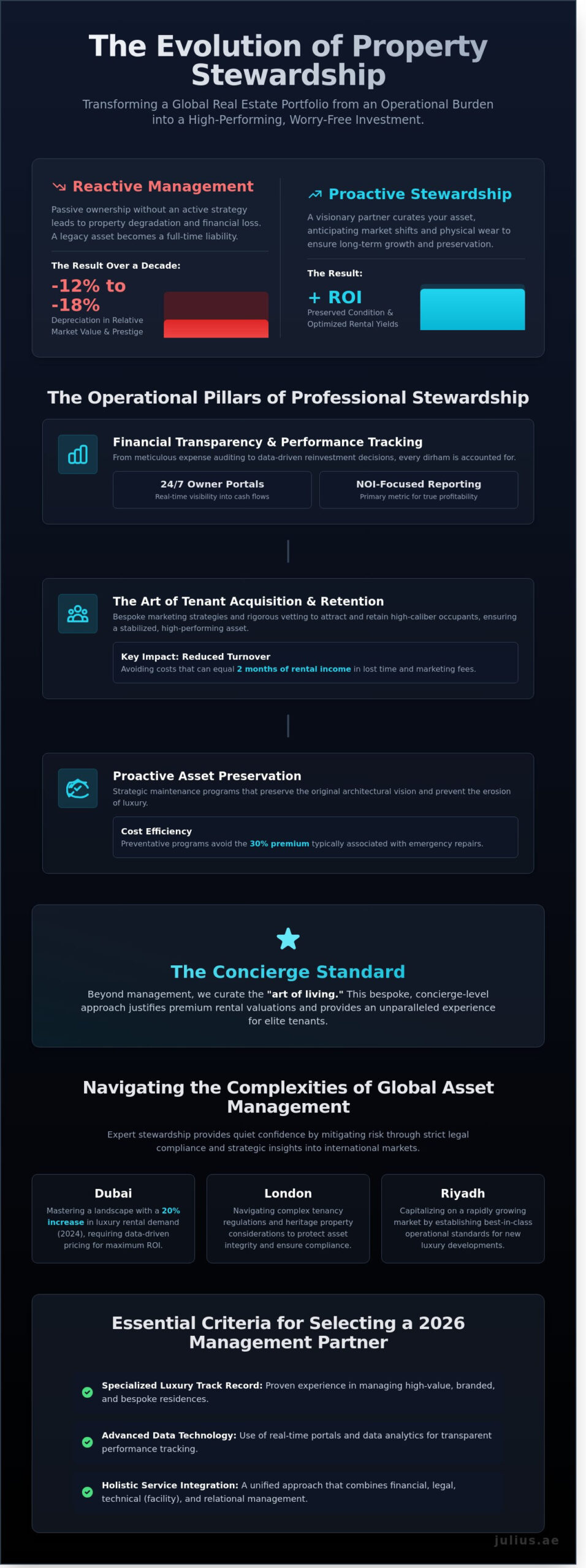
Property management is the professional oversight, control, and operation of real estate to achieve specific investment goals. As we look toward 2026, the definition has evolved into something far more sophisticated than simple rent collection. It’s the art of proactive asset stewardship. In the luxury sector, the traditional reactive model is obsolete. Owners now demand a framework where the asset is curated, not just maintained. Passive ownership without an active management strategy often results in a 12% to 18% depreciation in relative market value over a decade compared to professionally steered assets. This loss isn’t just financial; it’s a loss of prestige.
The distinction between a landlord and a strategic real estate investor is found in the depth of their approach. A landlord reacts to problems as they arise, often losing time and capital in the process. A strategic investor, supported by expert property management, anticipates market shifts and physical wear before they impact the bottom line. This level of foresight is what separates a mere building from a high-performing investment vehicle. It’s about transforming a transaction into a curated experience that reflects the owner’s global standard of living.
The Core Objective of Professional Management
Preserving the physical integrity and aesthetic value of a luxury asset is the first priority. It requires a commitment to the original architectural vision and a bespoke maintenance schedule. Beyond aesthetics, management focuses on optimizing rental yields through pricing strategies that reflect real-time demand. In high-growth hubs like Dubai, this data-driven approach ensures an unparalleled return on investment. Finally, mitigating risk through rigorous tenant vetting and strict legal compliance protects the investor from the complexities of international law. It provides the quiet confidence every high-net-worth individual deserves.
Property Management vs. Facility Management
Facility management is the technical heartbeat of a property. It focuses on the building’s physical systems, including HVAC, plumbing, and structural integrity. It’s about the mechanics of the space. Property management is the broader strategic umbrella. It encompasses the financial, legal, and relational aspects of the investment. For luxury residences, a holistic approach is mandatory. You can’t have financial success without technical perfection. Julius integrates both disciplines to ensure every asset remains a masterpiece of both form and function, providing a seamless journey for the visionary investor.
The Operational Pillars of Professional Stewardship
Financial Transparency and Performance Tracking
Modern investors demand immediate access to their portfolio’s health. Real-time owner portals provide 24/7 visibility into cash flows, service charge payments, and utility reconciliations. Transparent reporting ensures that every dirham is accounted for through meticulous expense auditing and monthly financial statements. Net Operating Income (NOI) is the primary metric for management success, reflecting the actual profitability of the asset after accounting for all operational costs. This data-driven approach allows for precise tax documentation and informed reinvestment decisions.
The Art of Tenant Acquisition and Retention
Sourcing occupants for branded residences requires a bespoke marketing strategy that emphasizes lifestyle over square footage. High-net-worth individuals expect a seamless transition, beginning with rigorous financial vetting and background checks to ensure compatibility with the property’s prestige. Building these relationships reduces turnover costs, which can often equal two months of rental income in lost time and marketing fees. A curated experience keeps vacancy rates low and ensures the property remains a stabilized, high-performing asset.
Operational excellence isn’t just about solving problems as they arise. It’s about anticipating the needs of the asset and its occupants before they manifest. By integrating sophisticated property management protocols, owners can transform a static investment into a thriving legacy. Explore how expert asset oversight can transform your portfolio’s trajectory.
Luxury Property Management: The Concierge Standard
Standard residential services focus on the functional. Luxury stewardship focuses on the experiential. High-net-worth individuals don’t just rent space; they acquire time and prestige. This level of property management requires a shift from reactive maintenance to proactive curation. It’s the difference between a landlord and a master curator who understands the art of living. To justify premium rents, every detail must be perfect. This includes everything from the scent profile in the lobby to the precision of the climate control systems.
Modern estates rely on specialized technology to maintain their exclusivity. We see a growing demand for integrated systems that manage private security, lighting, and entertainment from a single interface. These aren’t luxuries; they’re expectations. When a tenant pays a premium, they expect a seamless lifestyle where housekeeping, interior design, and private security are invisible yet omnipresent. This holistic approach ensures the asset remains a sanctuary rather than a burden. It’s about creating an environment where the resident’s only responsibility is enjoyment.
Stewardship of Branded Residences and High-End Assets
Assets carrying the hallmark of brands like Ritz-Carlton or Four Seasons demand adherence to global hospitality standards. In 2024, branded residence premiums in Dubai reached 25% to 35% over non-branded luxury peers. Maintaining this value involves managing private spas, 4K home cinemas, and complex automation systems with zero downtime. Every touchpoint must reflect the brand’s DNA. For a deeper dive into these standards, explore Luxury Property Management: The Art of Global Asset Stewardship in 2026.
Maximizing Value through Bespoke Curation
The link between management quality and capital appreciation is direct. Data from the 2023 Knight Frank Wealth Report suggests that well-managed prime assets see higher liquidity in secondary markets. Professional staging and aesthetic upgrades aren’t just cosmetic; they’re strategic financial maneuvers. By integrating private security and bespoke housekeeping, a property transforms into a turnkey sanctuary. This level of property management ensures that the asset doesn’t just retain its value but grows in prestige. Learn more about the financial benefits in Property Management ROI: Myth-Busting the True Value of Luxury Assets.
Navigating the Complexities of Global Asset Management
Managing a portfolio that spans the Burj Khalifa in Dubai, a townhouse in Belgravia, and a contemporary villa in Riyadh requires more than simple oversight. It demands a sophisticated understanding of disparate regulatory frameworks. For the high-net-worth individual, distance is often the greatest risk to capital preservation. A visionary partner acts as the essential “boots-on-the-ground” presence, ensuring that the asset’s prestige is maintained while the owner is thousands of miles away. This presence is vital for interpreting localized market cycles, where the timing of a renovation or a lease renewal can significantly impact the asset’s internal rate of return.
Compliance is the bedrock of modern property management. Anti-money laundering (AML) and Know Your Customer (KYC) protocols aren’t just administrative hurdles; they’re foundational to the security of a luxury portfolio. In 2024, global transparency standards have tightened, making rigorous compliance a non-negotiable aspect of professional service. This meticulous attention to detail protects the owner’s reputation and ensures the long-term viability of their international investments. It’s about creating a fortress around the asset, both legally and operationally.
Regional Spotlight: Management in the UAE and KSA
Dubai’s market relies on the Dubai Land Department (DLD) and mandatory Ejari registration for every tenancy. This system provides a transparent framework for dispute resolution and legal clarity. In Riyadh, the luxury sector is undergoing a transformation driven by Vision 2030. Management strategies there now prioritize high-spec maintenance and lifestyle amenities to meet the demands of a growing executive class. Investors must choose between the high-yield potential of vacation rentals in tourism hubs and the stability of long-term leases in established residential districts, a decision that dictates the intensity of daily operations.
Cross-Border Financial and Legal Considerations
Handling rental income across borders introduces the friction of currency volatility. Professional property management streamlines these transfers, ensuring that yields aren’t eroded by unfavorable exchange rates. While we don’t provide tax advice, local knowledge regarding non-resident landlord obligations is vital for maintaining a clean audit trail. Insurance also requires a bespoke approach. High-value assets need coverage that meets international standards, protecting against unique regional risks while ensuring the seamless replacement of rare materials or custom finishes if a claim arises.
Ensure your global assets receive the curated attention they deserve. Discover our bespoke management solutions for international investors.
Selecting a Property Management Partner for 2026
The landscape of global real estate moves rapidly. By 2026, the distinction between basic maintenance and sophisticated asset stewardship will define the performance of your portfolio. Choosing the right property management firm requires a meticulous audit of their operational depth. Look for a partner who demonstrates a history of managing assets in the top 2% of the market. High-value estates require specialized care that generalist firms cannot provide.
Demand a technology stack that provides 24/7 visibility. According to 2024 industry benchmarks, firms utilizing integrated AI for predictive maintenance reduce long-term capital expenditure by 15%. Your partner must offer a transparent portal where financial statements and occupancy data are accessible in real time. Beyond digital tools, verify their physical reach. A robust network of Grade-A contractors and legal specialists ensures that emergencies are resolved within a 4-hour window. This local agility prevents minor issues from escalating into structural liabilities.
Verify all credentials before signing. In Dubai, this means active RERA certification and compliance with the latest 2025 regulatory updates. Professional accreditations like RICS provide an extra layer of global accountability. Finally, scrutinize the fee structure. Elite property management thrives on alignment. Avoid opaque billing; instead, seek a model where the firm’s success is tied to the long-term appreciation and seamless operation of your asset.
The Checklist for High-Net-Worth Investors
Sophisticated investors require specific assurances before delegating their holdings. Does the firm provide a single point of contact for your entire global portfolio? Centralized communication eliminates the friction of dealing with multiple time zones. Ask for their audited average response time. Luxury tenants expect immediate resolution. Finally, review their formal dispute resolution framework. A structured approach to mediation protects your reputation and your investment.
The Julius Standard: Curated Asset Stewardship
Julius Property operates as a master curator of the Dubai skyline. We don’t just manage buildings; we preserve legacies through a framework of precision and transparency. Our approach combines local intelligence with an international standard of service that is truly unparalleled. Transitioning your assets to our professional stewardship begins with a comprehensive portfolio audit. Let’s refine your investment strategy for the years ahead through our bespoke management framework.
Elevating the Standard of Global Asset Stewardship
The landscape of property management is evolving into a discipline of high-level curation rather than simple maintenance. By 2026, the distinction between a functional asset and a thriving investment rests on the pillars of transparent stewardship and a concierge standard of service. Investors now require a partner who navigates the complexities of global markets while preserving the architectural integrity of their portfolio. It’s a shift toward visionary asset preservation across the world’s most competitive skylines.
Julius provides a team dedicated to bespoke asset stewardship with a proven track record of facilitating high-value luxury transactions in Dubai, London, and Riyadh. Our experts offer exclusive access to high-end developments that remain out of reach for the broader market. We focus on the art of living and the logic of investment; we ensure your properties are managed with the same precision used to acquire them. This level of expertise transforms a global portfolio into a curated legacy of excellence. You deserve a partner who understands that every square foot represents a standard of quality and a commitment to a global lifestyle.
Discover the Julius Standard of Property Management
Your journey toward unparalleled asset performance begins with a single, sophisticated choice.
Frequently Asked Questions
What is the typical fee for luxury property management?
Fees for the stewardship of high-end assets typically range from 5% to 8% of the annual rental income according to Dubai Land Department benchmarks. This investment covers the meticulous oversight of your residence, ensuring that every facet of the property maintains its prestigious standing and operational excellence. It’s a small price for the preservation of your asset’s capital value and the seamless handling of high-stakes tenant demands.
Can I manage my property myself if I live in a different country?
You can legally manage your asset from abroad, but the logistical complexities often compromise the property’s long-term yield. Effective property management requires an immediate local presence to handle urgent maintenance requests or quarterly inspections. Owners residing in different time zones frequently face a 15% increase in vacancy periods because they can’t respond quickly enough to prospective high-net-worth tenants who expect instant communication.
What happens if a tenant fails to pay rent in a luxury property?
When a tenant defaults, the process follows the strict legal framework established by local authorities like the Dubai Rental Dispute Centre. Your manager issues a formal 30 day notice via notary public to rectify the arrears immediately. Professional oversight ensures these delicate situations are handled with the necessary legal precision to protect your cash flow without escalating unnecessary conflict or damaging the brand of the property.
Does property management include finding new tenants?
Comprehensive property management services include a bespoke marketing strategy designed to attract high-caliber occupants for your vacant units. This process involves professional architectural photography, listing on premium international portals, and a rigorous 5 point vetting system to verify the financial standing of every applicant. A curated approach ensures your asset is occupied by individuals who respect the architectural integrity and the quiet exclusivity of the home.
How often should I receive financial reports about my property?
You should receive detailed financial statements on a monthly basis to maintain total transparency over your investment portfolio. These reports track every single dirham of income and expenditure, providing a clear view of your net operating income and tax liabilities. Regular reporting allows you to make informed decisions based on real time data rather than waiting for annual summaries that might hide emerging market trends.
Is professional property management worth the cost for a single apartment?
Professional oversight is highly beneficial for a single luxury apartment as it preserves the long term capital appreciation of the unit. Data from industry analysts suggest that professionally managed units retain 12% more value over a five year period compared to self managed properties. The cost isn’t just an expense; it’s an investment in your peace of mind and the total preservation of your personal leisure time.
What is the difference between a property manager and a real estate agent?
A real estate agent focuses on the singular transaction of selling or leasing a property, while a manager provides ongoing operational stewardship. The manager handles the daily nuances of maintenance, tenant relations, and financial reporting throughout the entire lifecycle of the tenancy. While the agent simply opens the door, the manager ensures the experience behind that door remains flawless for the duration of the contract.
Do property managers handle major renovations and interior design?
Many elite firms offer specialized project management services for significant renovations and bespoke interior enhancements. They coordinate with award winning architects and contractors to ensure that all upgrades meet the high standards expected in the luxury market. This service transforms a standard renovation into a curated evolution of the property’s aesthetic value, ensuring the work is completed on schedule and within the specified budget.
Leave a Reply