
The geographic center of global luxury capital is no longer a fixed point. While the Dubai skyline has long defined regional prestige, the horizon is expanding as the 2026 property reforms transform the Kingdom into an essential pillar of the modern portfolio. You recognize that the scale of Vision 2030 is unprecedented, making real estate investment in Saudi Arabia 2026 a primary focus for the world’s most discerning families. The transition from the 2021 speculative phase to secure ownership requires a level of detail that traditional market reports often overlook. It’s natural to feel a sense of caution when comparing these emerging yields against established markets or questioning the readiness of the most ambitious Giga-projects.
This article provides the clarity you require, moving beyond the headlines to examine the legal frameworks of foreign title acquisition. You’ll discover how to identify investment-ready districts like Diriyah and the Red Sea while mastering a strategy that balances KSA’s growth potential with the stability of your UAE assets. We’re curating a roadmap that moves from regulatory uncertainty to a sophisticated, data-driven entry into the most visionary market of the decade.
Key Takeaways
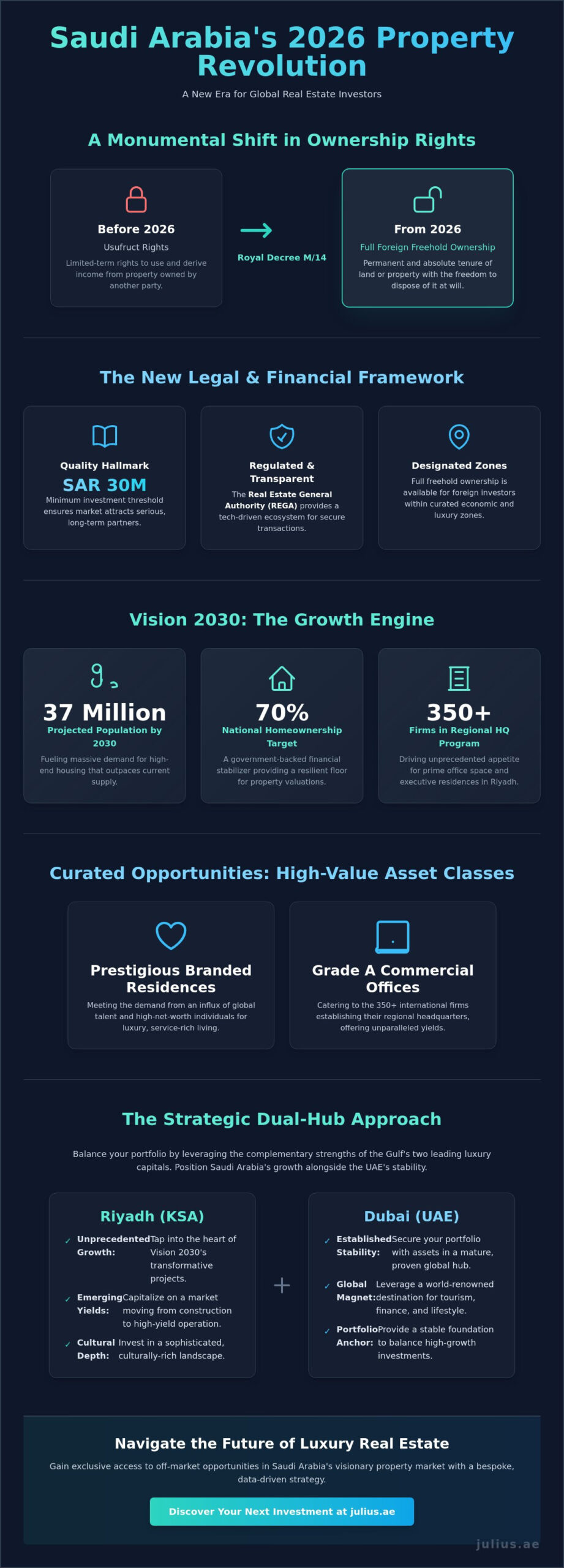
- Understand the monumental shift in property rights as Royal Decree M/14 transitions the market from usufruct rights to full foreign freehold ownership in premier designated zones.
- Discover how Saudi Arabia’s projected population growth to 37 million is pivoting the landscape from infrastructure construction toward high-yielding, operational luxury assets.
- Learn to master a strategic dual-hub approach that positions real estate investment in Saudi Arabia 2026 as a sophisticated, culturally-rich complement to your Dubai portfolio.
- Identify the most resilient asset classes for the coming era, from the rise of prestigious branded residences to the unparalleled yields of Grade A commercial office spaces.
- Gain exclusive insight into the Julius bespoke methodology for securing off-market opportunities within the Kingdom’s rapidly maturing and visionary property market.
The 2026 Landscape: Understanding Saudi Arabia’s New Property Era
For the global elite, 2026 represents more than just a calendar year; it marks the definitive arrival of a sophisticated property era in the Kingdom. Royal Decree M/14, which became effective on January 21, 2026, has fundamentally rewritten the rules of engagement for international capital. This landmark legislation facilitates a historic transition from traditional usufruct rights toward full foreign freehold ownership within premium designated zones. It’s a visionary move that aligns the Saudi market with the world’s most prestigious investment hubs, offering a level of security and permanence previously reserved for citizens.
The market’s evolution is governed with surgical precision by the Real Estate General Authority (REGA), which now provides a transparent, tech-driven ecosystem for every transaction. As we reach this maturity point for Vision 2030 initiatives, the Kingdom has successfully moved from a phase of construction to one of curation. For those seeking real estate investment in Saudi Arabia 2026, the landscape is no longer one of speculation, but one of proven structural integrity and unparalleled luxury potential.
To better understand these historic shifts in ownership rights, watch this helpful video:
The Legal Framework for Foreign Investors
Navigating the new legal landscape requires an appreciation for the SAR 30 million minimum investment threshold applied to specific high-value commercial and residential activities. This figure acts as a hallmark of quality, ensuring that the market attracts serious, long-term partners who value excellence. Non-Saudi entities must adhere to a refined notarisation process and strict compliance requirements to ensure every acquisition is seamless. While full freehold title is the new standard in specific zones, investors should still distinguish between individual ownership and usufruct (easement) rights, which remain relevant for specific industrial or time-bound projects.
Designated Investment Zones: Where Can You Buy?
The geography of opportunity is now clearly defined through curated economic and luxury zones designed to host international capital. The King Abdullah Financial District (KAFD) in Riyadh has emerged as the strategic heart of this expansion, offering a bespoke blend of visionary architecture and commercial utility. Beyond the capital, “Religious Tourism” zones present a rare and prestigious niche for Muslim investors. These zones offer a unique intersection of spiritual heritage and high-yield potential, ensuring that real estate investment in Saudi Arabia 2026 caters to both the financial intelligence and the lifestyle aspirations of the global elite.
Vision 2030 Growth Drivers: Beyond the Giga-Projects
The transition from heavy infrastructure construction to operational luxury is the defining theme of real estate investment in Saudi Arabia 2026. What were once ambitious architectural renderings are now tangible assets generating yield. This shift is fueled by a population projected to reach 37 million by 2030, creating a massive requirement for high-end housing that outpaces current supply. It’s a market where the narrative has moved from “if” to “when,” and for the sophisticated investor, that time is now.
Investors find security in the Kingdom’s 70% homeownership target. It isn’t just a social goal; it’s a financial stabilizer that provides a resilient floor for property valuations across the country. This momentum is further accelerated by the Real Estate Sector Strategy, which formalizes market transparency and maturity to international standards. On the commercial front, the Regional Headquarters (RHQ) requirement has turned Riyadh into a magnet for global talent. Over 350 international firms have already obtained licenses to move their hubs to the capital, driving an unprecedented appetite for prime office space and executive villas.
- Demographic Surge: The drive toward 37 million residents creates a structural deficit in luxury multi-family units.
- Institutional Stability: Government-backed homeownership targets ensure long-term liquidity for residential assets.
- Commercial Scarcity: RHQ mandates have pushed Grade A office occupancy rates to record highs in central business districts.
NEOM and The Red Sea: The New Global Standard
By 2026, Sindalah will be fully operational, marking NEOM’s first physical foray into luxury island tourism. This isn’t traditional hospitality; it’s a curated experience designed for the global elite. Institutional investors are increasingly drawn to regenerative tourism models here. These projects offer a unique ESG-compliant asset class that combines high-tech urban regeneration with environmental restoration, a combination that’s incredibly rare in the current global market.
Riyadh’s Urban Transformation
Riyadh is undergoing a metamorphosis that rivals the world’s greatest capitals. The integration of the Riyadh Metro and the expansive Green Riyadh project has already begun to command property premiums in connected districts. With the Expo 2030 win acting as a catalyst, the city is accelerating its 2026 preparations to ensure infrastructure meets the coming influx. The Riyadh Premium represents the distinct capital appreciation and rental yield gap that separates high-specification districts within the city’s inner core from its rapidly expanding secondary peripheries. For those looking to diversify their portfolio across the region, exploring luxury opportunities in the UAE offers a sophisticated counterpoint to the Saudi growth story.
Riyadh vs. Dubai: A Strategic Dual-Hub Investment Approach
Smart capital doesn’t choose between Riyadh and Dubai; it embraces both. These cities function as a strategic dual-hub, offering a balanced portfolio that spans the entire maturity spectrum of the Gulf. While Dubai remains the established global playground for mobile professionals, Riyadh represents the rising heart of a domestic transformation. Investors looking at real estate investment in Saudi Arabia 2026 recognize that these markets don’t compete. They complement. Dubai provides high liquidity and a seasoned regulatory environment. Riyadh offers the aggressive entry-point gains associated with a G20 economy in its most rapid phase of expansion.
The yield differentials highlight this synergy. Dubai’s market has reached a level of maturity where yields are predictable and secondary markets are robust. Saudi Arabia is in an early-stage growth cycle where capital appreciation often outpaces rental income in the short term. Holding assets in both GCC powerhouses allows for a sophisticated diversification strategy. It balances the high-velocity, dollar-pegged stability of the UAE with the massive, untapped domestic demand of the Kingdom. This dual-presence ensures that an investor captures the full breadth of the Middle East’s economic renaissance.
Market Dynamics and Correction Cycles
Dubai enters 2026 following a period of intense activity, navigating a necessary supply adjustment that ensures long-term health. This phase allows the market to absorb the record-breaking inventory launched in previous years, creating a stable floor for prices. Conversely, Riyadh faces a supply-constrained prime market. The appetite for high-end residential space consistently exceeds current construction rates. The five-year rent freeze implemented in 2025 provides a unique layer of stability. It prevents the erratic price swings typical of emerging markets and fosters a secure environment for long-term tenancy. For those seeking a deeper analysis of the UAE side, our Luxury Apartments for Sale in Dubai: The 2026 Investor’s Curated Guide offers essential context on market timing.
Investor Demographics and Cultural Alignment
The demographic landscape in Saudi Arabia attracts a specific profile that differs from the typical Dubai buyer. While the UAE is a magnet for the globally mobile, the Kingdom is the primary destination for affluent Muslim families and GCC nationals. These investors prioritize cultural alignment, privacy, and long-term legacy. The “Art of Living” in Riyadh focuses on expansive private villas and exclusive gated communities that reflect traditional luxury. The Real Estate Sector Strategy underpins this growth by modernizing regulations to protect these high-value investments. Real estate investment in Saudi Arabia 2026 is not merely about square footage. It’s about securing a place within a society undergoing a historic cultural shift. Serious investors can explore these nuances further in our The Definitive Guide to Buying Property in Riyadh.
Curated Opportunities: High-Value Asset Classes in 2026
The landscape of real estate investment in Saudi Arabia 2026 has evolved into a sophisticated arena where quality dictates returns. Investors no longer settle for generic developments. They demand assets that carry the weight of global prestige and architectural excellence. This transition has birthed a new era of curated opportunities across Riyadh, Jeddah, and the holy cities, moving the needle from simple residential units to lifestyle-centric assets.
Branded Residences and Ultra-Luxury Villas
The appetite for branded living has reached an all-time high in Riyadh and Jeddah. High-net-worth individuals are moving away from traditional mansions in favor of residences managed by elite hospitality brands like Four Seasons and the Ritz-Carlton. These projects offer a seamless lifestyle defined by 24-hour concierge services, bespoke finishing, and uncompromising security. The “Branded Premium” in Riyadh represents a 25-30% uplift over standard luxury assets, reflecting the market’s appetite for globally recognized excellence. This segment isn’t just about a home; it’s about securing a visionary lifestyle that holds its value through market cycles.
Commercial and Mixed-Use Potential
Grade A commercial office space remains the highest-yielding asset class in the Kingdom. The scarcity of prime space within the King Abdullah Financial District (KAFD) has pushed occupancy rates toward 98% as of early 2026, driving rental yields to levels rarely seen in other global hubs. Mixed-use developments are redefining the “Live-Work-Play” model, creating self-contained ecosystems that attract international corporations and top-tier talent. Understanding these shifts requires expert navigation. You can explore The Strategic Role of a Commercial Property Brokerage in 2026 to see how professional advisory maximizes these commercial gains.
Religious Tourism and Fractional Ownership
A significant shift in the real estate investment in Saudi Arabia 2026 is the emergence of fractional ownership for premium assets in Makkah and Madinah. This model allows investors to own a portion of high-value hospitality assets near the Holy Mosques, providing a gateway into the lucrative religious tourism sector without the capital burden of full acquisition. It’s a precise, accessible way to tap into the consistent demand generated by millions of annual pilgrims who seek luxury accommodations during their journey.
Evaluating Off-Plan Growth Corridors
For those seeking capital appreciation, the northern expansion of Riyadh offers the most compelling narrative. Locations like Al Malqa, Al Yasmin, and Al Narjis have become the focal points for savvy investors who prioritize infrastructure and connectivity.
- Al Malqa: Known for its proximity to KAFD and high-end residential demand, it attracts those looking for immediate prestige.
- Al Yasmin: Offering a balance of modern infrastructure and lifestyle amenities, it’s a favorite for long-term lease stability.
- Al Narjis: Rapidly developing as a hub for young professionals, this area shows the highest potential for off-plan capital gains.
Investing in these districts requires a sharp eye for developer track records and master-plan integration. The winners in 2026 are those who look beyond the structure and evaluate the community ecosystem.
Navigating the Acquisition: The Julius Bespoke Experience
Entering the Saudi market requires more than capital; it demands a sophisticated lens. As real estate investment in Saudi Arabia 2026 reaches its zenith, the landscape becomes increasingly nuanced. Julius Property acts as your master curator, bridging the gap between high-net-worth expectations and the Kingdom’s rapid transformation. We facilitate a seamless transition for investors accustomed to the precision of London’s Mayfair or the dynamism of Dubai’s luxury districts. Our bespoke approach ensures you aren’t just buying property; you’re securing a legacy. We provide exclusive access to off-market assets that never reach public listings, leveraging deep-rooted relationships within the region’s elite circles to find the rarest opportunities.
Managing a cross-border portfolio involves balancing the high-yield potential of Riyadh with the established stability of international markets. Our consultancy service provides the rhythmic oversight necessary to navigate these distinct regulatory environments. We treat every acquisition as a piece of fine art, requiring careful placement and constant preservation. This level of expertise is vital for those seeking to capitalise on the 3.5% GDP growth projected for the Kingdom. As you refine your strategy for real estate investment in Saudi Arabia 2026, our role is to act as your visionary partner, ensuring every decision is backed by intelligence and an unparalleled understanding of luxury standards. We bridge the distance between your home base and your Saudi assets with absolute precision.</
Mastering the Future of Gulf Wealth
The Kingdom’s transformation isn’t just a distant vision; it’s a rapidly maturing reality. By 2026, the convergence of the Riyadh-Dubai dual-hub strategy will redefine how global capital flows through the Middle East. Investors who recognize the synergy between these two powerhouses gain a strategic advantage that transcends traditional borders. This era demands a sophisticated approach to real estate investment in Saudi Arabia 2026, focusing on high-value assets like off-plan branded residences that align with the rigorous standards of the Vision 2030 framework.
Julius Property provides the essential bridge between these markets. We offer exclusive access to Riyadh’s most prestigious developments and expert consultancy on the evolving regulatory landscape. Our team ensures a seamless experience, managing your cross-border portfolio with the precision of a luxury concierge. You aren’t just buying property; you’re curating a legacy within the world’s most ambitious economic expansion. The opportunity to secure a position in this new era of prosperity is unparalleled. We’re ready to guide you through every nuance of this historic shift.
Begin your curated Saudi investment journey with Julius Property
The path to visionary wealth starts with a single, informed decision.
Frequently Asked Questions
Can foreigners buy property in Saudi Arabia in 2026?
Foreigners can indeed acquire property in the Kingdom through the Premium Residency program and expanded ownership laws enacted in 2023. You’re permitted to own residential and commercial assets in designated zones; however, Makkah and Madinah remain restricted to Saudi nationals. This shift marks a pivotal moment for international capital seeking a foothold in the region’s most ambitious growth story through curated real estate portfolios.
What is the minimum investment for Saudi real estate in 2026?
The specific threshold for real estate investment in Saudi Arabia 2026 depends on your residency goals. To qualify for the Property Owner track of the Premium Residency, you must invest a minimum of SAR 4 million in residential assets. This investment must be free of existing mortgages and appraised by accredited valuers to ensure the asset meets the Kingdom’s rigorous luxury standards.
Which cities in Saudi Arabia offer the best rental yields for 2026?
Riyadh and Jeddah currently lead the market with the most compelling returns for investors. Riyadh’s residential sector is projecting yields between 6% and 8% as the city prepares to host the World Expo 2030. Jeddah follows closely; its coastal developments and tourism-focused infrastructure are driving a 5.5% annual increase in luxury rental demand as the skyline continues its visionary transformation.
Is it better to invest in Riyadh or Dubai in 2026?
Selecting between Riyadh and Dubai depends on whether you prioritize market maturity or raw growth potential. Dubai offers a seasoned, highly liquid market with a 20 year track record of international excellence. Riyadh presents a frontier opportunity where Vision 2030 infrastructure spending creates a unique entry point. Both cities serve as essential pillars for any sophisticated Middle Eastern real estate investment in Saudi Arabia 2026.
What are the risks of investing in Saudi real estate?
Primary risks include market liquidity and the rapid pace of new supply entering the capital. With over 500,000 residential units planned for Riyadh by 2030, investors must focus on rarity and location to avoid future saturation. Navigating the evolving regulatory framework requires a partner who understands the nuances of local law; this ensures your capital remains protected against shifts in regional policy.
How does Saudi Arabia’s Vision 2030 affect property prices?
Vision 2030 acts as the definitive catalyst for price appreciation by funneling $1 trillion into infrastructure and giga-projects. This master plan aims to double Riyadh’s population to 15 million; it’s creating an unprecedented demand for high-end housing. As these projects reach milestones in 2026, the scarcity of finished, premium assets is expected to drive significant capital appreciation across the Kingdom’s most prestigious postcodes.
Can I get a residency visa by buying property in Saudi Arabia?
You can secure residency by purchasing property worth at least SAR 4 million through the Premium Residency Center. This specific visa category grants you the right to live in the Kingdom, sponsor family members, and conduct business without a local sponsor. It’s a seamless bridge for high-net-worth individuals who want to pair a sophisticated lifestyle with a secure, long-term presence in the region.
Are there taxes on property investment in Saudi Arabia?
Saudi Arabia applies a 5% Real Estate Transaction Tax (RETT) on the total value of most property sales. While there’s no personal income tax on rental returns for individual investors, you should account for the “White Land Tax” if you hold large, undeveloped urban plots. These fiscal policies are designed to encourage active development and maintain a healthy, transparent market for all global participants.
Leave a Reply