

The most expensive mistake a sophisticated investor can make in 2026 isn’t overpaying for a view; it’s miscalculating the very foundation of their ownership. While the market recorded 2,148 luxury transactions exceeding AED 10 million in the first quarter of this year alone, the distinction between a perpetual asset and a long-term right of use remains the ultimate pivot point for wealth preservation. Truly understanding freehold vs leasehold in Dubai is no longer a matter of basic property law. It’s a strategic necessity for those curating a visionary global portfolio. You’ve likely felt the weight of uncertainty regarding asset expiration or how specific zones impact your family’s inheritance rights under UAE law.
We’ll provide the absolute legal clarity you require to secure your investment legacy and align your acquisitions with the AED 2 million Golden Visa threshold. You’ll master the nuances of land rights in elite districts like Palm Jumeirah and Downtown Dubai to ensure your capital is positioned for maximum security. This guide explores the essential differences in control, costs, and long-term appreciation that define the Dubai skyline in 2026.
Key Takeaways
- Discover how to transition from simply purchasing property to curating a strategic financial instrument that secures your investment legacy through 2026 and beyond.
- Achieve total legal clarity by understanding freehold vs leasehold in Dubai, ensuring you select the ownership structure that offers perpetual rights to both land and asset.
- Evaluate the tactical advantages of leasehold usufruct rights for specific portfolio goals, including the nuances of tenure as long-term terms approach their conclusion.
- Align your property portfolio with the latest residency requirements to seamlessly secure your 10-year Golden Visa through qualified ownership types and investment thresholds.
- Learn how a bespoke consultancy approach uncovers exclusive off-market opportunities that harmonize aesthetic rarity with visionary market positioning.
The Evolution of Ownership: Why the Freehold vs. Leasehold Choice Defines Your Dubai Legacy
Dubai’s property landscape has transformed from a speculative frontier in 2002 to a sophisticated global hub in 2026. This evolution isn’t merely architectural; it’s structural. In the early 2000s, the concept of foreign ownership was a novelty. Today, it’s a refined legal framework that demands a nuanced approach. Understanding freehold vs leasehold in Dubai has become the primary filter through which high-net-worth individuals view their commitment to the emirate. It’s the difference between holding a temporary key and owning a piece of the skyline for generations.
The legal bedrock of this confidence is Law No. 7 of 2006, which formally opened the door to foreign ownership in designated areas. This legislation, supported by the diligent oversight of the Dubai Land Department (DLD), ensures that every transaction is a matter of public record and legal certainty. As the UAE’s real estate sector matures, the DLD’s role as a master curator of ownership rights provides the transparency needed for institutional-grade investments.
To gain a deeper perspective on how these legal frameworks operate in practice, view this expert analysis:
The Shift Toward Permanent Residency in 2026
The 10-year Golden Visa has fundamentally altered the investor’s psychology. In 2026, property isn’t just an asset; it’s a gateway to a long-term lifestyle. The previous ‘leasehold mindset,’ where buyers were comfortable with finite terms, has given way to a hunger for perpetual security. As global economic shifts drive capital toward safe havens, international family offices are prioritizing freehold assets. This trend is evidenced by the 62.6% year-on-year increase in luxury transactions exceeding AED 10 million during the first quarter of 2026, signaling a definitive move toward permanent anchoring in the region.
Defining the Modern Investor’s Intent
Strategic investment requires distinguishing between legacy assets and tactical yield plays. Freehold ownership offers the ‘art of living’ without an expiration date, while leasehold can occasionally offer high-yield opportunities in specific commercial or older residential contexts. At Julius, we move beyond the simple transaction. We view ourselves as master curators, helping you identify properties that aren’t just buildings, but visionary extensions of your financial intelligence. Our philosophy prioritizes the curation of assets that align with your long-term vision for wealth and lifestyle.
Freehold Ownership: Securing Perpetual Rights in Dubai’s Prime Districts
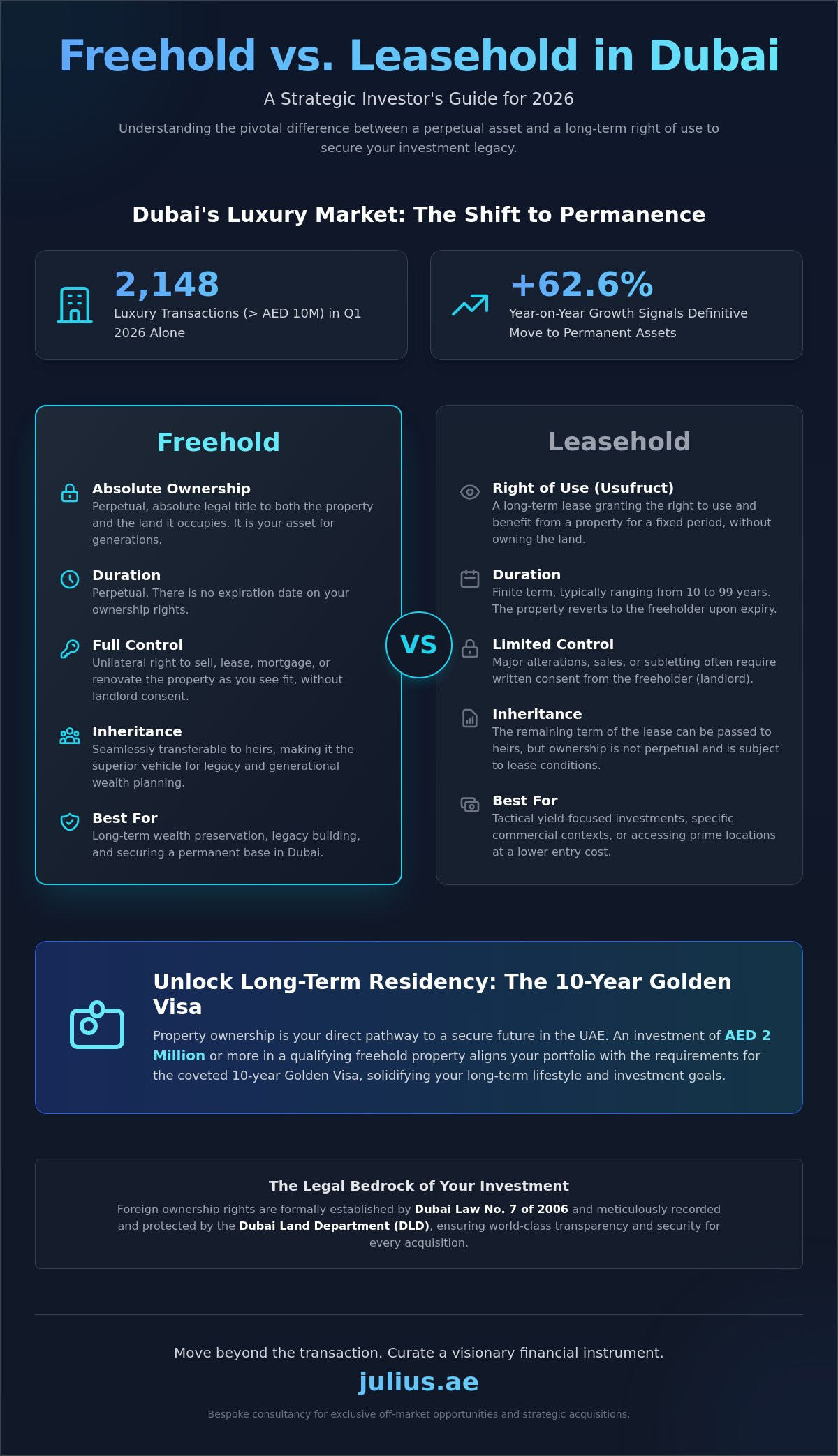
Freehold ownership represents the pinnacle of property rights in the Emirates. It’s a perpetual, absolute legal interest that grants the owner total dominion over both the building and the plot it occupies. Crucial to understanding freehold vs leasehold in Dubai is the recognition that freehold is the gold standard for permanence. Unlike other structures, there’s no expiration date on your investment. This status is codified by the Title Deed, a document issued directly by the Dubai Land Department that serves as the ultimate safeguard for your capital. For the visionary investor, this isn’t just a purchase; it’s the foundation of a legacy.
The autonomy provided by freehold status is unparalleled. You possess the unilateral right to sell, lease, or renovate the property as you see fit, free from the constraints of a superior landlord. This level of control is why understanding freehold vs leasehold in Dubai is so vital for those planning for future generations. Freehold assets are easily passed to heirs, making them the superior vehicle for wealth preservation in a global portfolio.
Exclusive Freehold Enclaves for the Visionary Investor
Districts like Palm Jumeirah, Downtown Dubai, and Dubai Marina remain the crown jewels of the freehold market. In 2026, we’ve seen a surge in “Branded Residences,” where the art of living is curated by elite global fashion and automotive houses. These enclaves drove the 62.6% year-on-year increase in luxury transactions during Q1 2026. This trend disproves the common misconception that freehold is limited to villas; many of Dubai’s most prestigious apartment towers offer absolute ownership. If you’re seeking to anchor your portfolio, you can view our curated selection of luxury apartments for sale in Dubai.
The Financial Mechanics of Freehold Assets
The financial logic for freehold is compelling. These properties have seen a price increase of 9% to 10% over the past 12 months, outperforming many global benchmarks. Banks also show a clear preference for freehold collateral. This is especially relevant since the February 2025 Central Bank rule mandates that all transaction fees, including the 4% DLD fee, must be paid upfront and cannot be financed. Since there’s no ground rent to erode your returns, the net yields, which currently average between 6.7% and 7% for apartments, remain exceptionally robust. This structural advantage ensures your asset appreciates in value while providing consistent, unencumbered cash flow.
By aligning your intent with the right ownership structure, you secure more than just real estate; you secure a future. Our team can help you identify off-market freehold opportunities that match your specific investment criteria.
Leasehold Structures: Strategic Flexibility and Long-Term Tenure
While freehold ownership provides perpetual security, understanding freehold vs leasehold in Dubai requires an appreciation for the tactical agility that leasehold structures offer. Often categorized as a “Usufruct” right, leasehold grants the investor the right to use and occupy the property for a fixed duration, typically up to 99 years. In this arrangement, the legal title to the land remains with the freeholder, often a government entity or a local family office, while the investor holds the rights to the structure and its utility.
This structure is common in established, heritage districts such as Deira and Bur Dubai, or on specific government-owned lands. The freeholder, or lessor, retains the ultimate ownership of the land, while you act as the temporary custodian of the asset’s value. As the lease approaches expiry, the right of use typically reverts to the land owner, unless a renewal is negotiated under the prevailing market conditions of the time.
When Leasehold Becomes a Strategic Advantage
Leasehold assets often present a lower entry price point compared to their freehold counterparts in adjacent districts. For investors focused on immediate cash flow rather than multi-generational legacy, these properties can deliver exceptional rental yields. In certain sectors, leasehold yields can outperform the city’s average residential apartment yields of 6.7% to 7%. For commercial visionaries, the “Musataha” right offers a specific legal framework to build and operate bespoke developments on leased land for up to 50 years, providing a structured window to maximize industrial or retail utility. This makes leasehold a powerful tool for tactical market positioning.
Navigating the Renewal and Extension Process
As of May 2026, the process for lease extensions has become increasingly formalized. However, investors must remain vigilant. Unlike the absolute autonomy of freehold, leasehold requires a meticulous review of the contract terms regarding maintenance and service charges. For instance, service charges in areas like International City remain around AED 7 per square foot, but these costs are often managed differently in leasehold agreements. Potential risks include:
- Limited control over long-term land use changes by the freeholder.
- Variations in mortgage eligibility for leases with less than 30 years remaining.
- Upfront payment requirements for 4% DLD fees as per the February 2025 Central Bank rule.
Selecting the right asset requires a curated perspective that balances yield against tenure. If you’re exploring the nuances of the UAE property market, our consultancy provides the bespoke guidance needed to identify high-performing assets that align with your financial intelligence.
The Investor’s Comparison: Evaluating ROI, Residency, and Portfolio Impact
Deepening your understanding freehold vs leasehold in Dubai reveals that the choice isn’t binary; it’s intentional. For the global elite, real estate isn’t just shelter; it’s a high-performance vehicle for capital preservation. While earlier sections defined the legal boundaries, we must now analyze the structural impact these choices have on your balance sheet. Liquidity is the lifeblood of any sophisticated portfolio. Freehold assets generally command higher resale velocity in the secondary market, whereas leasehold positions often require a more nuanced exit strategy as the remaining term diminishes.
| Feature | Freehold Ownership | Leasehold Structure |
|---|---|---|
| Duration | Perpetual | Fixed (typically 99 years) |
| Land Ownership | Absolute title to land and building | Right of use (Usufruct) |
| DLD Transfer Fee | 4% of property value | 4% of property value |
| Mortgage Ease | High (standard collateral) | Moderate (tenure dependent) |
| Resale Value | High appreciation potential | Yield-focused; price sensitive |
Operational costs also vary across the skyline. In 2026, service charges in Downtown Dubai range from AED 17 to AED 40 per square foot, while Palm Jumeirah averages approximately AED 25. While both owners are responsible for these fees, the freehold investor enjoys the long-term benefit of these costs maintaining an asset they own forever. It’s a commitment to quality that mirrors the Julius philosophy of curation.
Residency and the Golden Visa Framework
The link between ownership and residency has never been more vital. As of May 1, 2026, the AED 750,000 minimum for a 2-year investor visa has been removed for sole owners of a completed property. However, for those seeking the prestigious 10-year Golden Visa, the minimum investment remains AED 2 million. Freehold property is the most seamless path to this status, providing a permanent anchor for your family office. You can explore the specific requirements in our Dubai Golden Visa Guide to ensure your next acquisition aligns with your global mobility goals.
Taxation and Global Reporting
Dubai maintains a compelling 0% personal property tax environment, though we don’t provide formal financial or tax advice. For high-net-worth individuals, freehold assets serve as robust pillars for international inheritance planning. Unlike leasehold rights, which can complicate succession in certain jurisdictions, a freehold title deed is a clear, globally recognized mark of ownership. Managing these assets within a multi-jurisdictional portfolio requires the precision and expertise of a dedicated partner. To begin curating your Dubai legacy, consult with our investment specialists today.
Navigating Your Acquisition: How Julius Curates the Ideal Ownership Path
Acquiring property in Dubai is a statement of intent, yet the path to a secure legacy requires more than a signature. Truly understanding freehold vs leasehold in Dubai allows you to move beyond the paperwork and into the realm of bespoke asset stewardship. At Julius, we don’t just facilitate transactions; we curate experiences for those who demand the absolute best in both service and investment. Our approach is unhurried and thorough, mirroring the refined consultation our clients expect from a master curator of the skyline.
Our role begins with identifying off-market freehold opportunities that never reach the public eye. We conduct rigorous vetting of Dubai Land Department registrations and developer track records to ensure your capital is protected. In a market where over 120,000 new units are scheduled for delivery in 2026, this expert verification is the thin line between a visionary investment and a tactical misstep. We bridge the gap between your aesthetic desire for a prestigious home and the cold logic of global market dynamics.
A Visionary Perspective on Off-Plan Freehold
2026 has emerged as the definitive year of the branded residence, where the architectural beauty of the property is as vital as its financial intelligence. While the pace of property price growth is moderating to a sustainable 5% to 8%, the demand for high-value off-plan assets remains robust. We help you manage the complexities of future developments through expert brokerage, ensuring your Off-Plan Property Investments are anchored in quality and rarity. This curated approach minimizes reliance on speculative activity and focuses on long-term value growth.
Your Journey with Julius
From the initial curation of your portfolio to the seamless coordination of your mortgage and 10-year Golden Visa, our team provides a global perspective. With an international presence spanning London, Riyadh, and Dubai, we speak the language of high-net-worth investors who value transparency and expertise. We understand that your time is your most precious asset. Our concierge-level service ensures every detail, from the AED 580 title deed issuance fee to ongoing property management, is handled with quiet confidence. It’s time to elevate your expectations of what a real estate partner can achieve. Begin your curated acquisition journey with a partner who masters the nuances of the Dubai skyline.
Securing Your Visionary Future in the Dubai Skyline
Navigating the complexities of the 2026 property market requires more than just capital; it demands a refined strategic intent. By understanding freehold vs leasehold in Dubai, you’ve moved beyond surface-level ownership to master the nuances of asset stewardship. Whether you’re prioritizing the perpetual security of a freehold title deed or the tactical high-yield potential of a leasehold usufruct right, your choice defines the longevity of your global portfolio. The market’s maturity, evidenced by the 62.6% increase in luxury transactions in Q1 2026, proves that Dubai remains the ultimate safe haven for discerning wealth.
Your acquisition journey deserves the precision of a master curator. At Julius, we provide expert guidance on Law No. 7 and DLD compliance to ensure your legacy is built on a foundation of total legal clarity. We offer exclusive access to 2026’s most prestigious branded residences, seamlessly integrating your property acquisition with bespoke Golden Visa advisory. Don’t leave your investment security to chance in a landscape of over 120,000 scheduled handovers this year. Secure your Dubai legacy with a curated property consultation at Julius Property. Your future in the Emirates is waiting to be curated with the excellence it deserves.
Frequently Asked Questions
Can foreigners buy freehold property anywhere in Dubai?
Foreigners aren’t permitted to buy property anywhere in the city; they must invest within specific zones designated by the Dubai government. These areas include the most prestigious districts like Palm Jumeirah and Downtown Dubai. Outside of these freehold enclaves, property ownership is generally reserved for GCC nationals, making it vital to verify the zone’s status before initiating a transaction.
What happens to a leasehold property after 99 years?
When a leasehold term concludes, the right of use and the structure typically revert to the freeholder or land owner. While investors can often negotiate a lease extension under the market conditions of that future date, there’s no inherent legal right to renewal. This finite nature is why many visionary investors prefer the perpetual security of freehold title deeds for long-term wealth preservation.
Is it possible to convert a leasehold property into a freehold one?
Converting a leasehold asset into a freehold one isn’t a standard administrative process for individual owners. Such a shift only occurs if the Dubai government formally rezones the entire area or changes its legal designation. While these transitions have happened in specific historical cases, investors shouldn’t purchase leasehold property with the expectation of a future conversion without official government decree.
Does freehold ownership automatically qualify me for a Golden Visa in 2026?
Freehold ownership is a powerful tool for residency, but it doesn’t grant a visa automatically. For the 10-year Golden Visa, you must maintain a total property investment of at least AED 2 million. Understanding freehold vs leasehold in Dubai is essential here, as freehold assets provide the most seamless path to securing this long-term residency for your family and global portfolio.
Are service charges higher for freehold or leasehold properties?
Service charges are determined by the community’s location and the building’s luxury amenities rather than the ownership structure itself. In early 2026, annual charges range from AED 7 per square foot in International City to approximately AED 40 in Downtown Dubai. Both freehold and leasehold owners are responsible for these costs, which cover the maintenance and curation of the building’s common areas.
Can I pass my freehold property to my heirs if I am a non-resident?
Non-residents possess the full legal right to pass their freehold assets to their heirs. Because freehold ownership is perpetual, it’s a recognized vehicle for generational wealth that remains unaffected by the owner’s residency status. The Dubai Land Department facilitates this process through registered wills, ensuring that your investment legacy is protected and transferred according to your specific wishes.
What are the additional costs (DLD fees) for freehold vs. leasehold?
Both ownership types incur a 4% Dubai Land Department transfer fee, which buyers typically pay in full. For properties valued above AED 500,000, you’ll also pay a registration fee of AED 4,000 plus 5% VAT. Under the February 2025 Central Bank regulations, these transaction costs must be paid upfront and can’t be financed as part of a mortgage, requiring careful capital planning.
Which areas are designated as freehold in Dubai as of 2026?
Major freehold enclaves in 2026 include established districts like Dubai Marina, Business Bay, and Jumeirah Village Circle. Newer waterfront master-plans such as Palm Jebel Ali and La Mer have also joined the ranks of absolute ownership zones. These areas provide the legal framework necessary for international investors to secure perpetual rights to both the land and the architectural beauty of their property.
Leave a Reply