

A global property portfolio is only as resilient as the capital structures supporting it. You’ve likely discovered that while the allure of a Parisian pied-à-terre or a coastal estate in Marbella is timeless, the path to financing it often feels clouded by opaque regulations and currency volatility. Learning how to secure a mortgage for overseas property in 2026 requires more than just capital; it demands a synthesis of local credit mastery and international fiscal foresight to ensure your acquisitions remain agile and secure.
We’re here to provide that clarity. This guide demystifies the complexities of international lending, from navigating host-country requirements to securing competitive leverage in the world’s most exclusive markets. You’ll gain the insights necessary to align your debt with your broader investment strategy, transforming a complex cross-border transaction into a seamless expression of your wealth. We’ll examine the current lending climate and the refined procedures required to move from initial inquiry to a successful, high-value acquisition with quiet confidence.
Key Takeaways
- Understand why 2026 is a pivotal year for international leverage and how to align your debt structures with a sophisticated global investment philosophy.
- Evaluate the most efficient path for your capital by learning how to secure a mortgage for overseas property through a comparison of home-country equity and in-country non-resident loans.
- Overcome the “Credit Gap” by mastering the specific KYC and AML requirements that define high-end cross-border transactions in today’s regulated environment.
- Implement a strategic framework for property acquisition that prioritizes financial pre-qualification and expert sourcing to ensure a seamless transition into new markets.
- Gain insight into the exclusive world of off-market financing products and how specialized advisory acts as a steward for your international property aspirations.
The Landscape of International Property Financing in 2026
The definition of an overseas mortgage has evolved. It’s no longer merely a means to an end for a holiday retreat. Instead, it serves as a sophisticated instrument for wealth preservation and capital growth within the globalized luxury market. Investors now view these financial arrangements as a way to secure a premium global asset while maintaining liquidity. Understanding how to secure a mortgage for overseas property is essential for those who wish to move beyond domestic borders and capture value in high-growth jurisdictions.
The current environment is defined by a few key regions that offer distinct advantages for the selective investor. While the previous decade focused on simple acquisition, 2026 prioritizes fiscal agility and the selective assembly of assets. Prime markets like the UAE and the United Kingdom continue to offer robust frameworks for non-resident lending. Meanwhile, the Kingdom of Saudi Arabia and Turkey provide unique entry points for the visionary investor seeking high-growth potential. These jurisdictions have matured, offering sophisticated legal protections that mirror the expectations of an elite metropolitan property market.
To better understand the logistical nuances of international ownership and management, watch this helpful perspective:
The Strategic Motivation for Overseas Debt
Strategic debt serves as a powerful hedge. By diversifying the currencies in which you hold liabilities, you protect your portfolio against domestic economic volatility. Many investors utilize a foreign currency mortgage to align their debt with the income generated by the asset. This alignment minimizes exchange rate exposure and stabilizes cash flow. Leveraging low-cost debt in specific jurisdictions can significantly boost your total return on investment. While we don’t provide tax advice; it’s widely recognized that certain regions offer interest deductibility benefits. This can further refine your net yield and enhance the overall efficiency of your global holdings.
Current Global Lending Trends
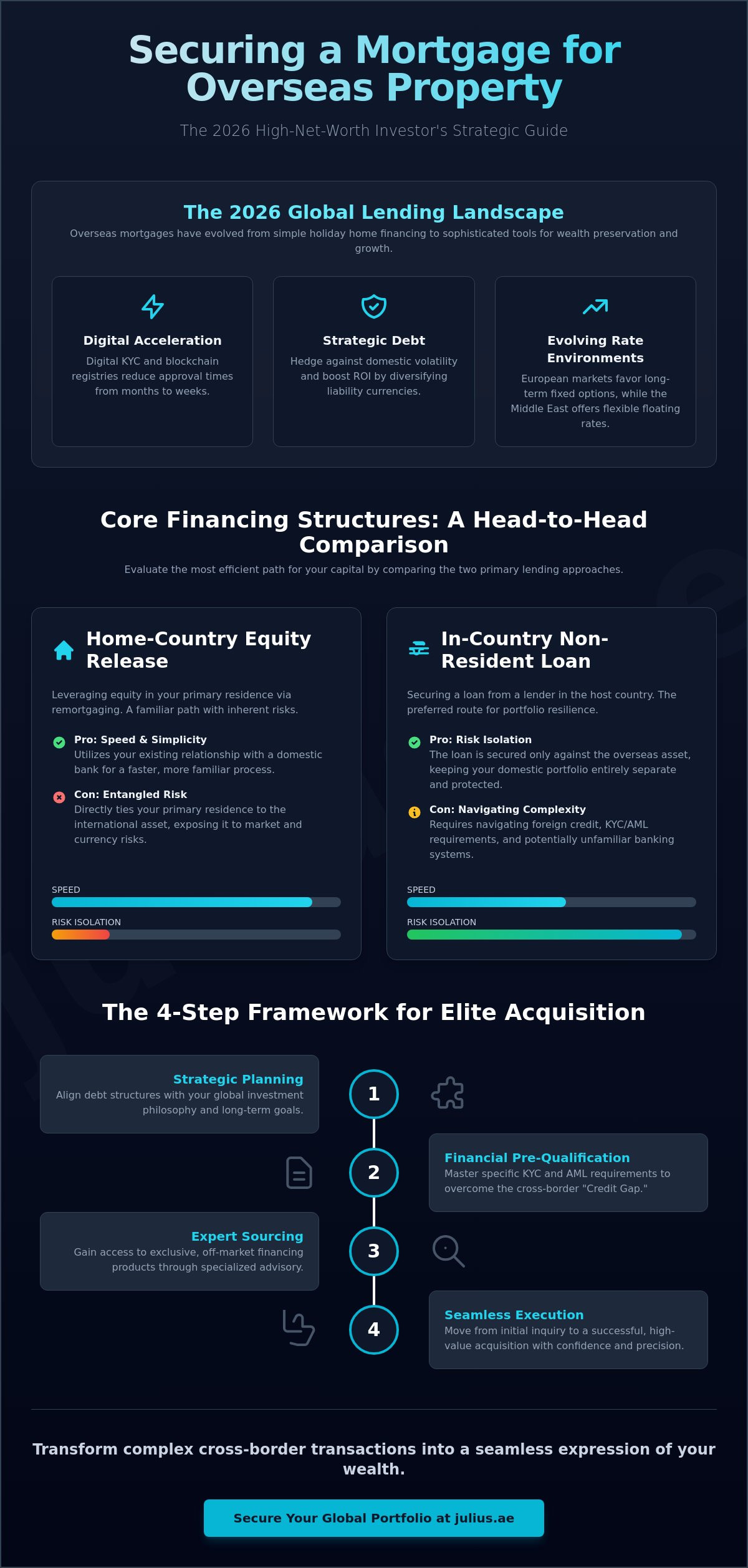
The lending environment is becoming increasingly efficient. Digital KYC protocols and blockchain-based title registries are accelerating cross-border approvals. These technologies reduce what used to be months of paperwork into a matter of weeks. In 2026, we’re seeing a stabilization in interest rate cycles that favors long-term fixed options in European markets; the Middle East often benefits from more flexible floating rates tied to specific benchmarks. Navigating the nuances of how to secure a mortgage for overseas property in 2026 allows you to leverage these digital advancements to secure a signature standard of living. The focus remains on precision. Every loan must be a deliberate part of a larger, globalized financial architecture that respects both investment logic and lifestyle aspirations.
Financing Structures: Home-Country vs. In-Country Lending
Sophisticated investors don’t just look at interest rates. They look at capital efficiency. Leveraging equity in your home country via remortgaging offers speed. It’s a familiar process with your domestic bank. However, it ties your primary residence to an international venture. For many, the preferred route for how to secure a mortgage for overseas property involves a non-resident loan from a host-country lender. This isolates the risk to the specific asset and jurisdiction. This structure ensures that your global portfolio remains modular and resilient.
Private banking represents the pinnacle of international property sourcing. For high-net-worth individuals, global private banks offer bespoke financing that transcends standard retail products. These institutions evaluate your entire global balance sheet rather than focusing solely on monthly income. This tailored approach often unlocks higher LTVs or cross-collateralization options that retail banks cannot match. It’s a signature standard of service for those who demand precision in their fiscal arrangements.
In-Country Lending: The Host Nation Advantage
Borrowing in local currency provides a natural hedge. In the UAE, for instance, borrowing in AED aligns your debt with the currency of the property’s future rental income or resale value. In 2026, non-resident LTV ratios typically sit between 60% and 70%. This means you’ll usually need a deposit of 30% to 40%. When considering luxury apartments for sale Dubai, this local leverage allows you to keep your domestic capital liquid for other high-value opportunities. It’s a visionary move that balances growth with security.
Developer and Alternative Financing
Off-plan investments offer unique alternatives to traditional bank debt. Post-handover payment plans have become a hallmark of the luxury markets in Riyadh and Dubai. These plans often allow you to pay 40% to 50% of the property value over two to five years after you’ve already received the keys. Some developers offer 0% interest plans during the construction phase. This can be an excellent way to bridge the gap before transitioning to a long-term mortgage. If you’re exploring these elite opportunities, our team can help you identify the most fiscally responsible path through international property sourcing tailored to your specific portfolio requirements.
Understanding these structures is the first step toward mastery. The choice between domestic equity and host-country debt depends entirely on your long-term liquidity needs and your appetite for currency exposure. By selecting the right framework, you ensure your international acquisition is a strategic asset rather than a financial burden.
Navigating Cross-Border Credit, Compliance, and FX
Capital is only half the battle. Institutional trust is the other, and it’s often the more elusive component in a cross-border transaction. Many investors are surprised to find that a flawless domestic credit score doesn’t automatically translate across borders. This “Credit Gap” exists because international lenders often lack a standardized way to pull your history from another jurisdiction. When you’re solving the puzzle of how to secure a mortgage for overseas property, you aren’t just applying for a loan; you’re building a Global Income Profile from the ground up. This dossier must present your worldwide assets and liabilities with absolute transparency to satisfy conservative credit committees.
Compliance in 2026 has become a digital gauntlet. KYC and AML protocols are more rigorous than ever, focusing heavily on the “Source of Wealth.” Lenders don’t just want to see the funds in your account; they want to trace the narrative of how that wealth was created. Whether it’s through corporate dividends, property divestment, or inheritance, every dollar must have a verifiable history. This meticulous level of detail ensures that your acquisition stands on a foundation of total legal integrity.
Strategic Currency Management
Currency volatility is the silent predator of international investment yields. If your income is in GBP but your mortgage is in EUR, a 15-year term exposes you to significant fluctuations that can erode your ROI. In the UAE, the AED’s peg to the USD offers a unique sense of stability for those with dollar-linked portfolios. For other regions, using FX hedging tools like forward contracts can lock in exchange rates for future payments. It’s also vital to move away from retail banks for your transfers. Specialist providers offer much tighter spreads, ensuring that more of your capital goes toward the principal rather than disappearing into bank fees.
The Regulatory Hurdle: Compliance and Documentation
The documentation required for a non-resident mortgage is extensive and varies by nation. Expect to provide at least three years of certified tax returns and a comprehensive schedule of your global real estate holdings. In certain jurisdictions, the rules are even more specific. For instance, lenders in Portugal strictly enforce that monthly mortgage payments cannot exceed 35% of your gross monthly income. Navigating these nuances requires a specialized partner. Engaging a real estate investment consultancy London can be the difference between a rejected application and a successful closing in the UK’s highly regulated market. They act as a steward for your interests, ensuring every document meets the exacting standards of the host nation’s financial regulators.
A Step-by-Step Framework for Elite Property Acquisition
Acquiring a high-value asset in a foreign jurisdiction is a journey that demands clinical precision. It’s a lifecycle that extends far beyond a simple bank application. Mastering how to secure a mortgage for overseas property involves a rhythmic progression through five distinct phases. This framework ensures that your capital is deployed with foresight and that every legal safeguard is firmly in place. The process begins with jurisdiction selection, where you weigh the LTV ratios of Spain (typically 60 to 70%) against the stricter 50% benchmarks often seen for non-EU nationals in France. From there, you move through sourcing, securing an Agreement in Principle (AIP), and navigating the final valuation before closing.
Success in this arena requires more than just a lender. It requires a specialized steward who understands the architectural and investment nuances of the assets you seek. If you’re ready to begin this journey with a partner who prioritizes your long-term fiscal agility, we invite you to explore our international property sourcing services today.
Pre-Qualification: Knowing Your Numbers
The first step is a cold, hard look at your Debt-to-Burden Ratio (DBR). International lenders are exceptionally conservative. In Portugal, for instance, your monthly mortgage payments generally cannot exceed 35% of your gross monthly income. You must also calculate a “Real” budget that accounts for more than just the purchase price. In Spain, you should budget an additional 10% to 15% for local taxes and notary fees. Preparing for a bank audit means having your global income profile ready for intense scrutiny. Lenders will examine your liquidity, existing debt, and the stability of your primary income source with a level of detail that can feel invasive without proper preparation.
Due Diligence and Valuation
Valuation is where many international deals falter. A bank’s appraised value often differs from the market price, especially in exclusive metropolitan pockets where rarity drives premiums. If the bank appraises the property lower than your purchase price, you must be prepared to bridge that capital gap. Independent legal counsel is a non-negotiable requirement. You need a representative who is untethered from the seller or the developer to verify title deeds and local zoning laws. Finally, you should integrate property management into your financial plan from day one. Ensuring your asset is maintained and tenanted is the only way to safeguard the yields that justify your leverage. This holistic approach transforms a mere transaction into a cornerstone of a prestigious global portfolio.
How Julius Property Facilitates Seamless Global Transactions
Julius Property operates as a specialized steward for the discerning investor. While retail banks offer standardized products, we provide access to exclusive, non-public mortgage products tailored specifically for high-net-worth individuals. Our expertise ensures that the question of how to secure a mortgage for overseas property is answered with a solution that respects both your financial intelligence and your desire for a prestigious environment. We bridge the gap between aesthetic appreciation and investment logic. This is particularly vital when financing branded residences where the premium for the brand name must be balanced against the lending bank’s valuation.
Our global network, stretching from the metropolitan heart of London to the visionary skyline of Dubai, allows us to offer a signature standard in international property sourcing. We don’t just find assets; we assemble them into a cohesive global portfolio. This perspective allows us to view your financing not as an isolated loan, but as a strategic component of your total wealth architecture. We understand the nuances of 2026 market dynamics and use this foresight to position your capital where it remains most agile.
Bespoke Mortgage Advisory
Our team simplifies the buy property in Riyadh process, navigating the unique regulatory landscape of the Kingdom with local authority. We leverage long-standing relationships with top-tier international financial institutions to secure competitive LTVs and interest rates that aren’t available to the general public. For those exploring off-plan property investments, our advisory extends to specialized developer financing and bridge loans. We ensure your debt is structured to maximize capital appreciation during the construction phase while preparing for a seamless transition to long-term bank debt upon handover. This level of precision is what separates a mere purchase from a visionary investment.
The Path Forward
A tailored experience always outperforms a standard transaction. In the world of high-end real estate, the nuances of how to secure a mortgage for overseas property can be the difference between a successful acquisition and a missed opportunity. We invite you to a private consultation where we can discuss your aspirations and the specific fiscal architecture required to achieve them. Whether you’re looking for a primary residence or a strategic addition to your portfolio, our UAE Property Experts are ready to act as your trusted partners in the global landscape. Secure your next legacy asset with a team that commands respect in every market we enter.
Architecting Your Global Legacy with Strategic Leverage
The journey to a prestigious international portfolio requires a synthesis of local credit mastery and visionary fiscal foresight. By understanding the nuances of debt-to-burden ratios and the strategic advantages of host-country lending, you transform a cross-border transaction into a cornerstone of wealth preservation. Managing currency risk and navigating the digital compliance gauntlet of 2026 ensures your capital remains agile and your assets secure. Every decision must be a deliberate part of a larger, globalized financial architecture that respects both investment logic and lifestyle aspirations.
Mastering how to secure a mortgage for overseas property is not a mere administrative task; it’s a refined act of selective assembly. At Julius Property, we act as the specialized stewards of this journey. We provide bespoke access to Tier-1 lenders in Dubai and London, specifically for high-value transactions exceeding $5M. Our approach seamlessly integrates Golden Visa consultancy with sophisticated mortgage advisory to ensure your residency and investment goals are perfectly aligned. Your next acquisition deserves the quiet confidence that only expert stewardship can provide. We invite you to Consult with our International Mortgage Specialists to refine your strategy. The global landscape is rich with opportunity for those who demand the absolute best in both service and investment.
Frequently Asked Questions
Can I get a mortgage for a property in Dubai as a non-resident in 2026?
Yes, non-residents can certainly access financing in Dubai. Most lenders offer loan-to-value (LTV) ratios between 60% and 75% for international buyers. The market’s maturity ensures a streamlined process for those who meet the rigorous income verification standards. It’s a signature standard for the region’s banking sector to support high-value acquisitions by global investors who seek a prestigious urban presence.
What is the typical deposit required for an overseas property mortgage?
Expect to provide a deposit between 30% and 40% of the purchase price. In European markets like Spain and Portugal, the maximum LTV for non-residents is generally 60% to 70%. You’ll also need to budget for an additional 10% to 15% of the property value to cover local taxes, notary fees, and legal costs. This initial capital ensures you maintain a healthy equity position from day one.
How do interest rates for international mortgages compare to domestic rates?
International mortgage rates for non-residents are typically slightly higher than those offered to local citizens. In May 2026, non-resident fixed-rate mortgages in France range between 3.50% and 4.25%, while Australian rates for foreign citizens can reach 8.00%. These variations reflect the lender’s perceived risk in cross-border lending and the specific economic climate of the host nation. Precise rate selection is vital for your portfolio’s long-term yield.
Is it better to mortgage in my home country or the host country?
Securing a mortgage in the host country is often the more strategic choice for long-term investors. It creates a natural currency hedge if you plan to generate rental income in that local currency. This approach is a critical component of how to secure a mortgage for overseas property while maintaining a modular and resilient global portfolio. It protects your domestic equity from international market fluctuations and provides fiscal agility.
Can I use rental income from the overseas property to qualify for the mortgage?
Lenders vary on this, but many prioritize your existing, verifiable global income over projected yields. French and Portuguese banks are particularly strict; they often cap total debt repayments at 35% of your current gross monthly income. While rental potential adds to the asset’s allure, your primary income remains the cornerstone of the bank’s credit assessment. A visionary investor prepares their dossier to reflect this reality.
What are the additional costs associated with securing an international mortgage?
You should budget for significant transaction costs beyond the deposit. These typically include local stamp duty, property survey fees, and legal expenses. In Spain, for example, these costs often amount to 10% or 15% of the appraised value. Specialist mortgage broker fees and international transfer spreads should also be accounted for in your initial capital allocation to avoid any unhurried delays during the closing process.
How long does the approval process take for an overseas property loan?
The approval timeline generally spans four to eight weeks. While digital KYC protocols have refined the experience, the verification of international income and “Source of Wealth” remains thorough. Securing an Agreement in Principle (AIP) early in your search can significantly accelerate the final approval once you’ve selected a signature property. This foresight allows you to move with the quiet confidence that defines an elite investor.
Do I need a local bank account in the country where I am buying property?
A local bank account is an essential requirement for almost every international property transaction. Lenders require it for the automated collection of mortgage repayments. It also serves as the hub for settling local taxes and property management fees. Establishing this account is often the first step in demonstrating your commitment to the host jurisdiction’s financial ecosystem and ensures a seamless experience for your property management team.
Leave a Reply