

The era of the monolithic commercial market has ended, replaced by a landscape where secondary office prices in Dubai have surged past AED 2,000 per square foot while legacy hubs face a quiet reckoning. Understanding the commercial real estate market trends 2026 requires more than a glance at a spreadsheet; it demands a visionary approach to what we call selective assembly. You’ve likely felt the exhaustion of high interest rates and the unpredictability of traditional office footprints. It’s a common sentiment among those who demand excellence but find themselves stalled by market volatility and the difficulty of spotting the next regional powerhouse.
We provide the clarity needed to transform this uncertainty into a refined strategy for capital allocation. You’ll master the shifting dynamics of global commercial property to secure high-yield assets in an evolving 2026 landscape. This analysis previews the shift toward institutional-grade transactions in Dubai, the impact of Riyadh’s five-year rent freeze, and the sharp divergence of London’s prime office rents as they reach for £200 per square foot in the West End core.
Key Takeaways
- Discern the nuances of the “New Normal” for interest rates and how cooling inflation is recalibrating commercial property valuations worldwide.
- Analyze the essential commercial real estate market trends 2026 to distinguish high-performing “Trophy” assets from increasingly obsolete legacy inventory.
- Evaluate the growth potential of Dubai and Riyadh as they emerge as the world’s most significant benchmarks for commercial innovation and institutional investment.
- Master the art of selective assembly to transition your portfolio from broad market exposure to a curated collection of high-yield, ESG-compliant properties.
- Gain exclusive insights into navigating the 2026 landscape through expert advisory that blends rigorous investment logic with a deep appreciation for architectural excellence.
The 2026 Global Macroeconomic Context for Real Estate
2026 represents a pivotal stabilization point for the global economy. The volatility that defined the early part of the decade has finally yielded to a “New Normal,” characterized by predictable, albeit higher, capital costs. As global central banks align on a more measured trajectory, the landscape offers a rare window where debt costs and asset valuations find a harmonious, if elevated, equilibrium. This environment is fundamental to understanding the shifting Commercial property landscape and the broader commercial real estate market trends 2026.
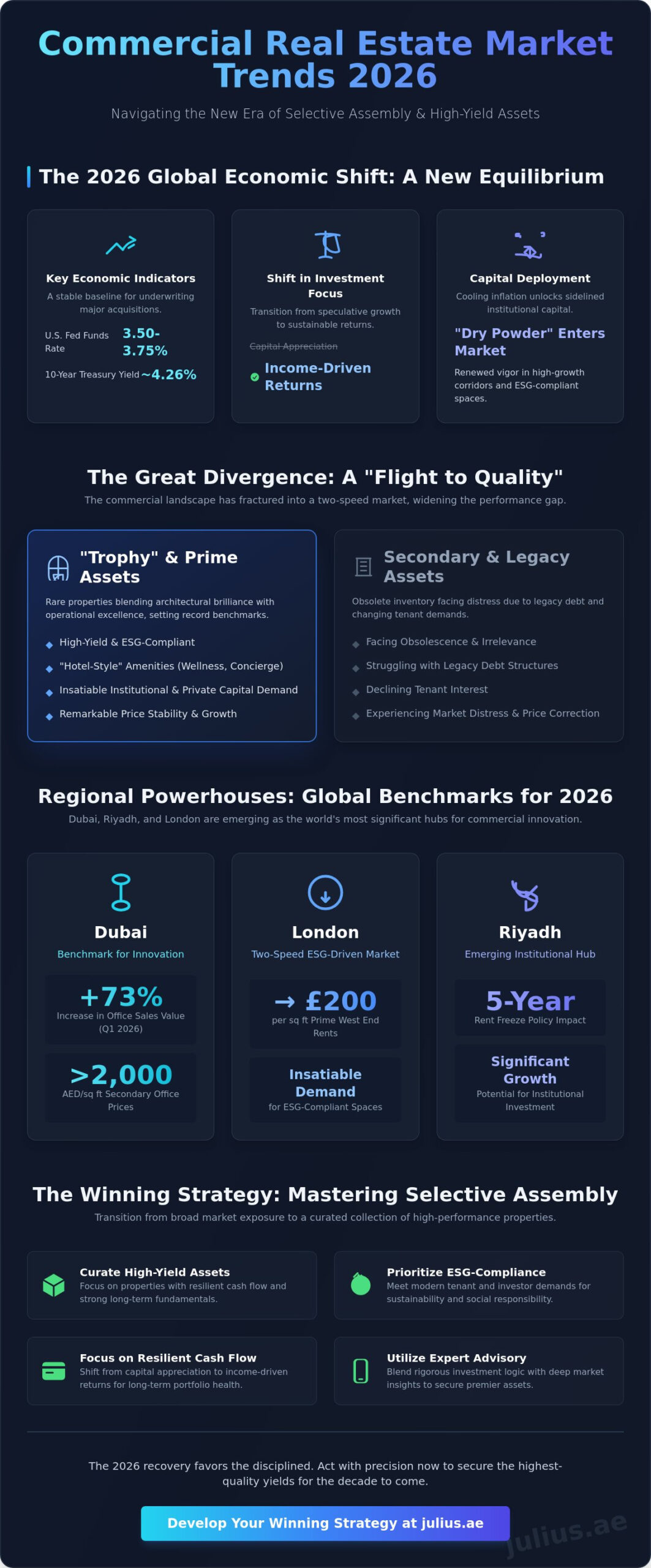
We are witnessing a definitive transition from capital appreciation to income-driven total returns. For the sophisticated investor, the focus has shifted toward the resilience of the cash flow itself. As of January 28, 2026, the U.S. Federal Reserve maintained the federal funds rate between 3.50% and 3.75%, while the 10-year Treasury yield hovered near 4.26%. These figures provide a stable baseline for underwriting major acquisitions, allowing for a level of foresight that was absent in previous years. The recovery is here, but it favors the disciplined.
To better understand this concept, watch this helpful video:
Interest Rates and the Cost of Capital
The stabilization of debt servicing costs has unlocked a massive reservoir of “dry powder” that remained sidelined during 2024 and 2025. Institutional capital is now entering the market with renewed vigor, particularly in high-growth corridors. In London, central bank policies have fostered a “two-speed market” where demand for ESG-compliant spaces remains insatiable. Conversely, the UAE market continues to thrive on a value-driven environment, supported by a significant influx of foreign direct investment and a maturing regulatory framework. This global divergence requires a specialized perspective to identify where capital is most efficiently deployed.
Inflationary Cooling and Asset Re-pricing
Cooling global inflation has initiated a sophisticated re-pricing of real assets. While secondary markets continue to experience distress due to legacy debt structures, prime assets have shown remarkable stability. Yield compression in 2026 refers to the narrowing gap between property yields and risk-free rates as investor confidence returns to high-quality assets, driving prices upward even as rental growth remains steady. Real assets remain the preferred hedge against long-term currency fluctuations, offering a tangible anchor in a digital world. This trough-to-recovery transition marks 2026 as the year where selective assembly becomes the hallmark of a successful portfolio. The commercial real estate market trends 2026 suggest that those who act with precision now will secure the highest-quality yields for the decade to come.
Sector Divergence: The Flight to Quality in 2026
The commercial landscape has fractured into a two-speed market. Success in this environment requires a sharp eye for what we call “Trophy” assets; those rare properties that blend architectural brilliance with operational excellence. The commercial real estate market trends 2026 reveal a widening performance gap where prime assets continue to set record benchmarks while legacy stock faces a steep climb toward relevance. This divergence is most evident in the office sector, where the “Flight to Quality” has become the defining movement for institutional and private capital alike.
The Office Re-imagined: Prime vs. Secondary
In global hubs like Dubai and London, “Prime A” space isn’t just holding steady; it’s thriving. Dubai’s office sector recorded a 73% increase in total sales value in Q1 2026, with secondary prices exceeding AED 2,000 per square foot for the first time. Meanwhile, London’s West End core is expected to reach rents of £200 per square foot. This isn’t merely a recovery; it’s a complete re-imagining of the corporate environment. Modern tenants demand “hotel-style” amenities, including wellness centers and concierge services, that bridge the gap between professional life and high-end lifestyle. For owners of obsolete secondary buildings, the path forward involves aggressive repurposing strategies to avoid the growing risk of stranded assets.
Sustainability and ESG compliance have also emerged as non-negotiable pillars of value. Investors increasingly consult the 2026 commercial real estate outlook to benchmark their portfolios against global standards. If you’re considering a strategic entry into these markets, reviewing the latest commercial property options in the UAE can offer a clear perspective on where high-yield opportunities meet visionary architecture.
Logistics and the Data Center Boom
The industrial sector has evolved into a high-tech ecosystem. AI-driven demand has accelerated the need for specialized data infrastructure, turning data centers into a core asset class for 2026. We’re also seeing a significant shift in logistics; “Infill” locations near major urban centers are now outperforming traditional regional mega-warehouses. This trend is driven by the reshoring of manufacturing and a global emphasis on supply chain resilience. Beyond the industrial core, the “Living” sectors are attracting sophisticated capital through specialized assets:
- Multifamily Residential: Providing stable, inflation-linked returns in supply-constrained metropolitan areas.
- High-end Student Housing: A resilient asset class benefiting from the global demand for prestigious education.
- Branded Residences: Where luxury hospitality meets commercial investment logic, a sector seeing massive growth in Dubai.
The commercial real estate market trends 2026 emphasize that asset selection is now more critical than broad market exposure. By focusing on these specialized hubs, investors can tap into a sector that remains insulated from the broader volatility seen in traditional retail or secondary office markets.
Regional Powerhouses: Dubai, Riyadh, and London
While domestic markets in the West focus on incremental recovery, the global investor looks toward the synthesis of Middle Eastern growth and European stability. The commercial real estate market trends 2026 highlight a significant redirection of capital toward regions that prioritize infrastructure and regulatory transparency. Dubai isn’t just a regional leader; it’s the global benchmark for commercial resilience. In Q1 2026 alone, the city recorded Dh38.0 billion in commercial transaction value across 3,622 deals. This surge is underpinned by a maturing regulatory environment and the strategic success of the Golden Visa program, which has incentivized long-term business expansion and permanent corporate footprints.
Dubai: A Beacon of Commercial Growth
The impact of the Golden Visa on commercial expansion cannot be overstated. It has transformed Dubai from a transient trade hub into a primary residence for global corporations. Demand for Grade A office space in the DIFC and Business Bay remains exceptionally high, reflecting a flight to quality that we’ve observed across all major sectors. Investors are moving away from speculative volume and toward institutional-grade assets that offer long-term security. Explore our curated UAE property portfolio to see how these dynamics are shaping the next generation of high-value investments.
Riyadh and London: Strategic Contrasts
Riyadh stands as the world’s largest commercial construction site, a direct result of the ambitious Vision 2030. As of January 2026, foreign investors are permitted to invest directly in the real estate sector, a move that coincided with a 3.4% annual growth in commercial property prices. Investors must navigate a unique regulatory landscape, including a five-year rent freeze initiated in late 2025 designed to stabilize the rapid urban regeneration. Navigating these rapid changes requires local expertise and a visionary perspective. For a deeper dive into this market, consult The Definitive Guide to Buying Property in Riyadh.
In contrast, London maintains its enduring status as a safe-haven “Global City” for institutional capital. Transactions are forecast to rise by 6% in 2026, reaching over 132,000 deals. The city offers a prime “yield play” in a post-correction environment, with West End core rents hitting £200 per square foot. This cross-border capital flow between Middle Eastern wealth and European institutional hubs defines the commercial real estate market trends 2026. It’s no longer about choosing one region; it’s about the selective assembly of assets across these powerhouses to ensure global portfolio resilience. London’s stability provides the perfect counterpoint to the high-growth trajectory of the Gulf, creating a balanced landscape for the sophisticated investor.
Strategic Portfolio Construction for 2026
The most frequent question we encounter is whether the 2026 entry point is “too late.” On the contrary, the current climate marks the definitive shift from defensive positioning to opportunistic acquisition. The market is no longer a monolith where a rising tide lifts all boats. Success now depends on the selective assembly of prime assets that align with long-term urban regeneration. Understanding the commercial real estate market trends 2026 means recognizing that the “wait and see” approach of previous years has been replaced by a need for decisive, data-driven action. It’s the era of the specialist, not the generalist.
Yield Analysis and Risk Mitigation
Calculating “Real Yield” in a cooling 2.5% inflation environment requires a more granular approach than in the past. Investors must look beyond surface-level percentages to find genuine growth that outpaces the cost of capital. Sourcing these high-yield opportunities often means looking behind the curtain. Utilizing a professional commercial property brokerage provides the necessary access to off-market transactions that define the portfolios of high-net-worth individuals. This level of exclusivity is essential when balancing the high-octane growth of emerging regional hubs with the established security of global financial centers. Risk is not avoided; it’s meticulously managed through asset selection.
The Role of Technology and ESG
Technology has moved from the periphery to the core of asset value. Properties that integrate AI tools for predictive maintenance and tenant retention analytics are outperforming traditional stock by significant margins. Some industry professionals report that these “Smart Buildings” command rent premiums as high as 20% in 2026. This isn’t just about efficiency. It’s about creating a prestigious environment that attracts the world’s most elite tenants. Incorporating Net Zero targets is equally vital. Assets that fail to meet these sustainability standards risk becoming stranded as global regulations tighten. The commercial real estate market trends 2026 indicate that green credentials are now a primary driver of institutional liquidity.
Diversifying through Branded Residences and mixed-use developments further mitigates this risk. These assets blend commercial investment logic with the timeless appeal of luxury living, offering a unique hedge against sector-specific volatility. They represent the pinnacle of modern urban assembly. To explore how these strategic shifts can enhance your own capital allocation, view our latest commercial opportunities and discover the Julius standard of excellence.
Navigating the 2026 Market with Julius Property
Positioning a portfolio to capitalize on current shifts requires a partner who acts as a specialized advisor rather than a mere transactional agent. We’ve explored the structural changes defining the commercial real estate market trends 2026, from the data center boom to the high-yield corridors of the Middle East. Julius Property brings a signature approach to these opportunities, blending rigorous investment logic with a deep appreciation for the architectural aesthetics that define a trophy asset. It’s about moving beyond spreadsheets to understand the lifestyle philosophy that drives long-term value in elite metropolitan markets.
Expertise Across Global Hubs
The complexity of managing cross-border acquisitions demands an international perspective and deep local knowledge. Whether you’re securing a prime office footprint in the DIFC or a safe-haven asset in London’s West End, our team ensures every detail is handled with absolute precision. We prioritize transparency and data-led advisory, providing the clarity needed to make high-stakes decisions with quiet confidence. Our role is to serve as strategic stewards of your international property portfolio, ensuring seamless execution across every jurisdiction. To understand our methodology in detail, see our Investment Consultancy Perspective.
Your Partner in Selective Assembly
Large, generic brokerages often lack the agility and discretion required by high-net-worth individuals. We intentionally maintain a boutique profile to provide a tailored experience that generic firms simply can’t replicate. This unhurried, thorough approach allows us to focus entirely on your specific aspirations, identifying off-market commercial opportunities that remain hidden from the broader market. We don’t just sell property; we assist in the selective assembly of a legacy. Our commercial real estate market trends 2026 analysis indicates that the most significant opportunities are found through exclusive sourcing and expert brokerage.
We invite you to a private consultation for your 2026 portfolio planning, where we can detail how our international property sourcing and commercial property brokerage services can secure your place in the evolving urban landscape. Begin your 2026 investment journey with Julius Property.
Securing Your Legacy in the 2026 Landscape
The global property landscape has entered an era defined by precision and the selective assembly of high-performance assets. We’ve analyzed how the stabilization of capital costs and the definitive “Flight to Quality” have recalibrated what it means to hold a prime portfolio. Success in this environment requires a departure from broad market exposure in favor of targeted acquisitions in hubs that prioritize innovation and transparency. Mastering the commercial real estate market trends 2026 is no longer just about identifying growth; it’s about securing assets that offer both aesthetic excellence and institutional-grade resilience.
Julius Property stands as your strategic steward in this evolving market. With a strategic presence in Dubai, Riyadh, and London, we provide exclusive off-market commercial access and deep expertise in high-yield urban regeneration projects. Our advisory blends rigorous investment logic with a refined understanding of the luxury landscape. It’s time to transition from observation to action. Consult with our Global Investment Advisors to begin curating a portfolio that reflects your standard of excellence. The future of global commerce is yours to shape with the right partner by your side.
Frequently Asked Questions
What are the top-performing commercial sectors in 2026?
Data centers and specialized industrial logistics are the clear frontrunners this year. The exponential surge in AI processing requirements has turned data infrastructure into a core asset class for institutional capital. Additionally, “Living” sectors like multifamily residences and high-end student housing provide the stable, inflation-linked returns that sophisticated investors demand to hedge against market volatility.
How is AI impacting commercial real estate market trends in 2026?
Artificial intelligence is revolutionizing the commercial real estate market trends 2026 by optimizing operational efficiency and tenant retention through predictive analytics. Smart buildings now use AI to reduce long-term overhead and tailor amenities to specific tenant behaviors. These technological integrations often result in significant rent premiums for properties that prioritize a seamless, high-tech user experience.
Is Dubai still a viable commercial investment hub in 2026?
Dubai remains a premier global hub due to its maturing regulatory environment and record-breaking transaction values. In the first quarter of 2026, the city recorded Dh38.0 billion in commercial deals, reflecting a definitive shift from speculative volume to institutional-grade value. The Golden Visa program continues to incentivize corporate expansion, ensuring that demand for Grade A office space remains robust.
What is the “flight to quality” and why does it matter for investors?
The “flight to quality” is the concentrated movement of capital toward modern, amenity-rich, and ESG-compliant properties. It matters because it creates a sharp divergence in the global market; prime assets see record occupancy and rent growth while older, secondary buildings face increasing obsolescence. For investors, this trend emphasizes the necessity of selective assembly to avoid the risk of stranded assets.
How do interest rates affect commercial property yields in 2026?
Stabilized interest rates have established a predictable baseline for underwriting, with the 10-year Treasury yield hovering near 4.26% in early 2026. This stability allows for more accurate yield calculations and has led to yield compression in prime metropolitan markets. As investor confidence returns, the narrowing gap between property yields and risk-free rates signals a healthy transition toward opportunistic positioning.
What are the benefits of investing in Riyadh’s commercial market now?
Investing in Riyadh provides an early entry into the world’s largest commercial construction site under the Saudi Vision 2030 initiative. Recent policy changes now permit direct foreign investment in the real estate sector, while a five-year rent freeze initiated in late 2025 offers a stable environment for urban regeneration. These factors create a high-growth corridor for those seeking long-term capital appreciation.
Should I prioritize capital growth or rental yield in the current market?
The current climate favors a shift toward income-driven total returns rather than speculative capital growth. With global inflation cooling toward 2.5%, the focus has moved to “Real Yield” and the resilience of the cash flow itself. A balanced approach that prioritizes high-yield, inflation-hedged rental income provides the most secure path through the commercial real estate market trends 2026.
How does ESG compliance affect commercial property values?
ESG compliance is now a primary driver of asset liquidity and long-term valuation across all global markets. Properties that meet Net Zero targets and high sustainability standards attract elite institutional tenants who are willing to pay a premium for green-certified space. Conversely, non-compliant buildings face higher insurance costs and potential regulatory penalties, making ESG a non-negotiable factor in modern portfolio construction.
Leave a Reply