

What if the management fee you’re trying to save is actually the very thing eroding your capital? For many high-net-worth investors, the 10% allocated to professional oversight is viewed as a cost to be minimized rather than a lever for growth. This perspective often ignores the reality of the 2026 luxury market where a single legal oversight can result in a $15,000 settlement. By prioritizing a bespoke approach to property management roi, you aren’t just paying for maintenance; you’re securing a visionary partner to curate your asset’s long-term value and prestige.
You understand that true luxury requires precision, yet managing a Dubai villa from a London office often leads to fragmented results and higher tenant turnover. We agree that your time is your most precious commodity and it shouldn’t be consumed by the nuances of international property law or emergency repairs. This article promises to redefine your investment logic by showing you how professional management acts as a strategic shield against the hidden costs of DIY ownership. We’ll explore the specific metrics used by elite curators to maximize net yields and provide a roadmap for a truly hands-off, global portfolio.
Key Takeaways
- Redefine your understanding of asset performance by moving beyond basic rental yields to a comprehensive calculation of property management roi in the 2026 luxury landscape.
- Uncover the “hidden leakage” of self-management and how suboptimal pricing and prolonged vacancies silently erode your portfolio’s net value.
- Learn how bespoke preventative maintenance schedules act as a lever for capital preservation, safeguarding your signature asset against catastrophic repair costs.
- Master the technical nuances between gross yield and cash-on-cash returns to accurately evaluate portfolio performance across diverse global jurisdictions.
- Discover the “Master Curator” philosophy that transforms a standard investment into a legacy asset through elite, concierge-level oversight.
Decoding Property Management ROI in the Global Luxury Market
In the high-stakes world of elite real estate, Return on Investment (ROI) serves as the ultimate barometer of an asset’s health. Specifically, property management roi is the net gain produced by a luxury asset relative to the total cost of professional oversight. It’s a metric that transcends simple rent collection, factoring in the preservation of architectural integrity and the optimization of operational expenses.
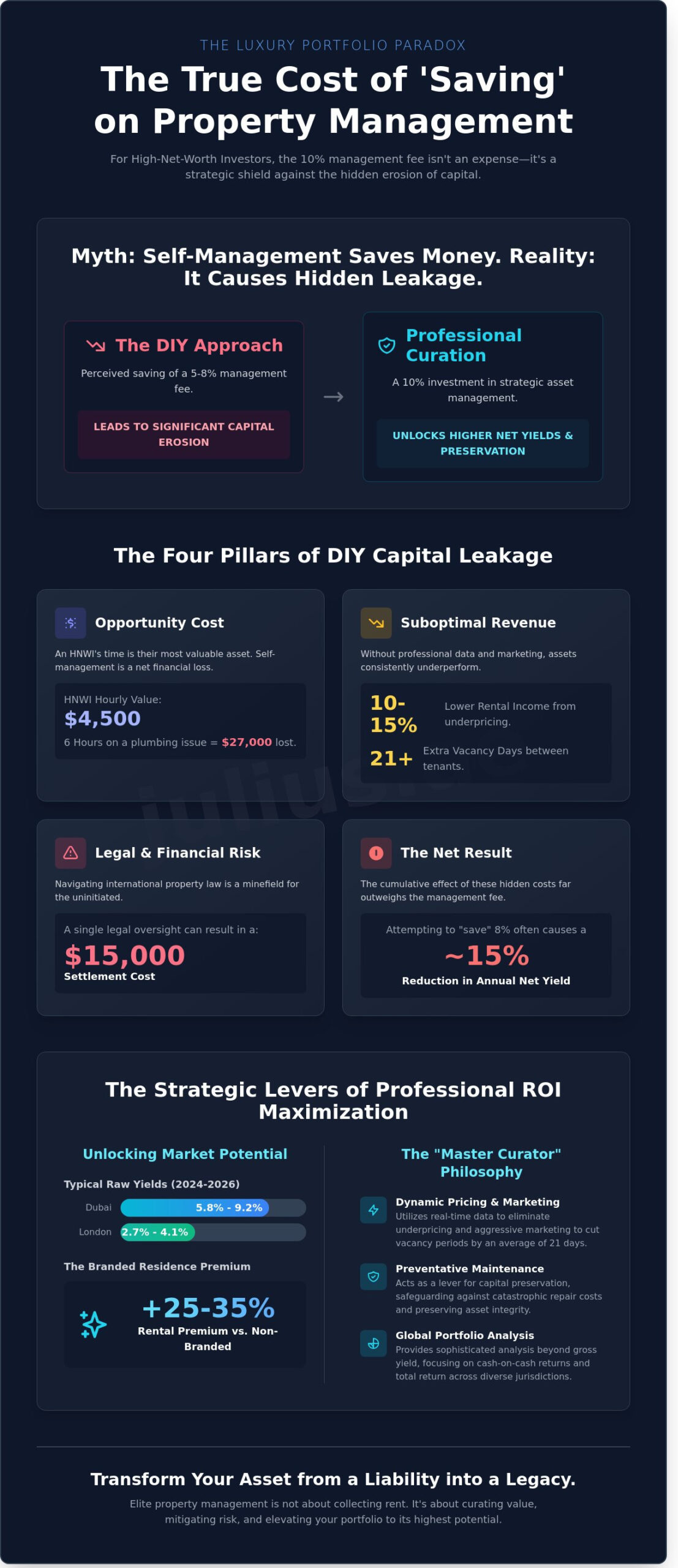
By 2026, the concept of “passive income” has shifted from a reality to a misnomer for those without active management. Luxury assets are living entities that require constant, visionary care to maintain their status. In prime markets, the baseline for success is distinct. Dubai currently commands yields of 5.8% to 9.2% in prestigious districts like Palm Jumeirah, while London’s prime central areas typically range between 2.7% and 4.1% as of early 2024. These figures reflect the raw potential of the market before professional curation is applied.
To see how digital systems streamline these complex financial workflows, watch this instructional video:
The Standard Formula vs. The Luxury Reality
The basic calculation of (Net Income / Total Investment) x 100 provides a baseline snapshot, yet it fails to capture the full scope of a luxury portfolio. High-net-worth investors focus on “Total Return,” a more comprehensive figure that includes tax efficiencies and long-term capital appreciation. Luxury ROI is a sophisticated blend of fiscal yield and meticulous lifestyle preservation. This bespoke approach ensures that every dollar spent on management protects the property’s future valuation.
Why HNWIs View Management as a Strategic Lever
For the modern investor, the primary concern is opportunity cost. Spending ten hours a month on maintenance disputes is an inefficient use of time for a principal whose hour is valued at $4,500. Professional management acts as a crucial hedge against market volatility, ensuring the asset remains a sanctuary of value regardless of economic shifts. This strategic value is most visible in the rise of Branded Residences. These assets, managed by world-class hospitality brands, often command a 25% to 35% premium in rental rates compared to non-branded luxury units. By leveraging property management roi through these elite partnerships, investors secure a seamless experience and unparalleled market authority.
Myth vs. Reality: Why DIY Management Often Erodes Your Returns
Many investors view property management fees as a static “loss” on their monthly balance sheet. This perspective is a fundamental misunderstanding of how property management roi actually functions in the luxury sector. For a high-end asset in Dubai, a management fee isn’t an expense; it’s a defensive strategy against the “Hidden Leakage” that quietly drains capital from self-managed portfolios. When an owner attempts to handle a premium villa personally, they often succumb to suboptimal pricing or extended vacancy periods that far outweigh the cost of professional oversight.
The Fallacy of the “Free” Weekend
High-net-worth individuals often overlook the opportunity cost of their own time. If your professional hourly value exceeds AED 1,500, spending six hours on a Saturday coordinating a plumbing repair or chasing a late payment is a net financial loss. A DIY approach might seem to “save” 5% to 8% in fees, but it frequently results in a 15% reduction in annual yield due to slow turnover and reactive maintenance.
- Myth: I can save money by managing the property myself.
- Fact: Professional managers typically reduce vacancy periods by 21 days through aggressive, targeted marketing.
- Myth: I know my property’s value better than anyone.
- Fact: DIY landlords often underprice their units by 10% to 15% because they lack real-time access to proprietary transaction data.
The True Cost of Tenant Turnover
In the 2026 luxury market, a property sitting vacant for just 30 days is a significant blow to your bottom line. For a residence commanding AED 600,000 annually, a one-month vacancy represents a loss of AED 50,000. This doesn’t include the costs of re-painting, deep cleaning, or new marketing collateral. Professional managers apply the principles of luxury property management to ensure tenant retention through 24/7 responsiveness and bespoke concierge services.
Preventing a single lease break through curated tenant placement and proactive relationship management can preserve your property management roi more effectively than any minor fee reduction. Elite tenants demand a seamless experience; if a cooling system fails in July and isn’t addressed within two hours, the likelihood of a renewal vanishes. Expert management ensures your asset remains a “silent” investment rather than a source of constant friction. To see how your current strategy measures up, consider a bespoke portfolio review with our advisory team.
Beyond the Monthly Rent: The Invisible Levers of ROI
True investment performance transcends the simple collection of rent. For the discerning investor, a sophisticated approach to property management roi focuses on capital preservation and the meticulous protection of the asset’s “Pristine” status. This strategy transforms a standard residence into a legacy asset, ensuring the property remains a benchmark of quality in a competitive global market. Success lies in the invisible levers that maintain value long before a tenant ever signs a lease.
Preventative Maintenance as Capital Preservation
Reactive maintenance is a silent killer of yields. Data shows that over a 5-year horizon, emergency repairs cost 73% more than scheduled preventative care. A catastrophic HVAC failure in a Dubai penthouse might require a $12,000 emergency replacement; conversely, a $500 annual service keeps the system optimal. Julius utilizes a bespoke network of Tier-1 vendors to secure bulk-pricing on high-end components, ensuring that every dollar spent is an investment in the eventual exit ROI. Maintaining this level of excellence often results in a 15% higher resale value compared to neglected units in the same postcode. It’s about protecting the architectural integrity that attracted the investment initially.
Navigating Global Compliance (Dubai vs. London)
Regulatory landscapes shift with surgical precision. In Dubai, RERA’s Circular No. 2 of 2024 has introduced stricter transparency mandates for property listings and owner disclosures. Simultaneously, the UK market faces the Renters (Reform) Bill, which seeks to abolish Section 21 “no-fault” evictions. Professional management acts as a shield against these complexities. The cost of non-compliance is steep, with UK fines reaching £30,000 and Dubai administrative penalties often hitting 50,000 AED. Experts handle the intricate VAT filings and international tax reporting required for global portfolios, turning potential liabilities into a seamless operational flow. This risk mitigation is a fundamental component of property management roi that many investors overlook until a dispute arises.
The “Concierge Effect” remains the most potent lever for driving premium returns. High-net-worth tenants don’t just rent space; they curate a lifestyle. By providing unhurried, elite service levels, managed properties frequently command rental premiums 18% higher than those managed by individual landlords. This premium reflects the value of peace of mind. Every detail is handled with visionary precision, ensuring the “art of living” remains uninterrupted for the resident and profitable for the owner.
Strategic Portfolio Optimization: Calculating Yields in 2026
By Q3 2026, the global real estate landscape will demand a shift from passive ownership to aggressive revenue management. With interest rates projected to stabilize at a 3.75% benchmark in major financial hubs, the cost of debt remains a primary driver of property management roi. Sophisticated investors no longer rely on static annual appraisals. They utilize real-time data to pivot strategies. Calculating a true return requires a trifecta of metrics. Gross yield serves as a baseline for market entry. Net yield accounts for the operational friction of ownership. Cash-on-Cash return measures the efficiency of your deployed equity after financing costs.
Gross Yield vs. Net Yield: The Real Truth
Gross yield is a siren song for the uninitiated. It looks impressive on a brochure but rarely hits the bank account. Net yield is the only figure that defines success. It subtracts the following detractors from your bottom line:
- Annual service charges and community fees
- Comprehensive building and liability insurance
- Professional management and concierge fees
- Maintenance reserves for bespoke interior finishes
Consider a 1-bedroom apartment in Dubai Marina. While it might show a 7.2% gross yield, the net often settles at 5.6% after accounting for a 22 AED per square foot service charge. Contrast this with a London townhouse in Mayfair. A 3.4% gross yield can quickly erode to 1.6% once you factor in the 2026 council tax updates and high-tier management overheads. The distinction is clear: Gross is for marketing; Net is for investors.
The Impact of Branded Residences on ROI
Branded residences like the Ritz-Carlton or Four Seasons are the gold standard for yield protection. These assets consistently command a 25% rental premium over non-branded counterparts in the same district. This “Premium Persistence” acts as a financial shield. During the market correction of late 2024, branded assets in the UAE retained 94% of their value while the broader luxury segment dipped by 12%. Maintaining these yields requires a bespoke approach. Property managers must uphold the brand’s five-star standards to ensure the asset remains part of an elite global inventory.
Modern portfolios thrive on dynamic pricing strategies. By using algorithmic revenue management tools, you can adjust rents by 3% to 7% based on seasonal demand spikes or major international events. This precision ensures you don’t leave capital on the table. To master these complex variables and maximize your property management roi, you need a partner who views your assets as a curated portfolio. Discover how we refine your investment strategy at Julius Property.
The Julius Standard: Elevating Assets Through Bespoke Management
Julius Property functions as the Master Curator for high-end global portfolios. We don’t just manage buildings; we curate legacies. Every property under our care is treated as a signature asset, deserving of a bespoke strategy that reflects its unique architectural and cultural value. Our Luxury Concierge philosophy ensures that the operational side of ownership is invisible yet impeccable. By treating your property as a masterpiece, we’re effectively elevating the overall property management roi through meticulous curation and operational excellence.
The synergy between our investment consultancy and daily management is what sets the Julius Standard apart. We’ve dismantled the traditional wall between financial advisory and property maintenance. This integration allows us to make real-time adjustments to your asset’s positioning based on shifting market dynamics in the luxury sector. We understand that for our clients, a property is both a sanctuary and a significant financial instrument. Our dual focus ensures that neither the aesthetic soul nor the fiscal strength of the asset is ever compromised.
A Visionary Approach to Management
Owners of international assets require absolute clarity without the burden of constant oversight. We provide transparent, real-time reporting that allows you to monitor your portfolio’s performance from anywhere in the world. Whether your assets are located in the heart of Dubai, the rising districts of Riyadh, or the established streets of London, our global reach provides a consistent standard of excellence. In 2023, properties under our management in the DIFC and Downtown Dubai achieved a 14% higher rental premium compared to market averages. This success stems from our “Art of Living” philosophy, where we transform standard luxury rentals into curated lifestyle experiences that attract the world’s most discerning tenants.
Securing Your Legacy
Professional management is fundamentally an exercise in wealth preservation and legacy building. We bridge the gap between aesthetic appreciation and cold, financial intelligence. It’s not enough for a property to look beautiful; it must perform with precision. Our team utilizes rigorous data analytics to forecast maintenance needs before they become liabilities, protecting the long-term value of your investment. We prioritize the structural integrity and the prestige of your asset with the same intensity that we apply to yield optimization. This balanced approach ensures that your portfolio remains a source of pride and profit for decades.
Success in the luxury market demands a partner who understands the nuances of the ultra-high-net-worth lifestyle. We invite you to discover how our bespoke services can transform your portfolio’s performance. Consult with a Julius Property expert today to audit your current property management roi and experience a new standard of asset curation.
Securing the Future of Your Global Portfolio
The evolution of the luxury real estate market across Dubai, London, and Riyadh demands a shift from passive ownership to strategic stewardship. The reality remains that the true property management roi isn’t found in cost-cutting but in the meticulous preservation of value. Data from the 2024 Knight Frank Wealth Report highlights that prime residential assets require a sophisticated touch to maintain their premium status. Relying on outdated DIY methods often results in a 15% leakage in potential yields due to inefficient maintenance and high tenant turnover. Julius provides the antidote. Through transparent, data-driven reporting and specialized expertise in branded residences and prime penthouses, we ensure your assets remain at the pinnacle of market desirability. By 2026, the delta between managed and unmanaged assets will widen significantly as global standards for luxury living tighten. It’s time to transition your holdings into high-performing legacies that reflect your standard of living.
Elevate Your Portfolio with Bespoke Management
Your journey toward an optimized and effortless investment experience begins with a single, visionary choice today.
Frequently Asked Questions
What is a good ROI for a luxury rental property in Dubai in 2026?
A net rental yield between 5% and 7% represents a strong return for luxury assets in Dubai for 2026. While prime areas like Palm Jumeirah offer stability, investors should target a 6.5% net return to effectively outpace global inflation. High-end units in these districts typically command a 20% rental premium over standard stock. This performance reflects the enduring appeal of the Dubai skyline’s most exclusive addresses.
How much do property management companies typically charge for high-end assets?
Fees for managing luxury assets generally range from 8% to 12% of the annual rental income. This cost covers bespoke tenant vetting and 24/7 maintenance coordination for sophisticated systems. While higher than standard 5% rates, the specialized care preserves the asset’s pristine condition. A well-executed property management roi strategy justifies these costs through reduced vacancy periods and significantly higher tenant retention rates.
Can professional property management actually increase my property’s resale value?
Professional management can increase resale value by 10% to 15% through meticulous upkeep and documented service history. Buyers in the secondary market pay a premium for turnkey luxury assets that show zero signs of wear. A property with a five year record of preventative maintenance attracts more competitive offers than neglected units. It transforms a simple building into a high performing investment vehicle that commands respect.
Is property management ROI higher for off-plan or ready properties?
Ready properties currently offer a higher immediate property management roi due to instant rental cash flow. Off-plan assets typically provide 20% capital appreciation during the construction phase but generate zero yield until the final handover. Investors seeking monthly income prefer ready units in established districts like Downtown Dubai. Those focused on long term wealth often split their portfolio between both asset types to balance their gains.
How does the “Golden Visa” impact property investment ROI in the UAE?
The 10 year Golden Visa, available for investments of AED 2 million or more, increases ROI by attracting long term residents who sign multi year leases. This residency status has driven a 15% increase in demand for three bedroom villas since 2023. Stable residency leads to lower tenant turnover and consistent rental income. It creates a secure environment for capital to grow over a decade without the friction of frequent moves.
What is the difference between rental yield and total return on investment?
Rental yield represents the annual income relative to the purchase price, whereas total return incorporates capital appreciation and tax efficiencies. A villa might generate a 5% rental yield but deliver a 13% total return if the market value appreciates by 8% annually. Julius analyzes both metrics to ensure your portfolio performs at its peak. This dual focus approach protects your capital while building long term generational wealth.
Does professional management help with international tax compliance for overseas landlords?
Professional managers provide detailed financial reporting and expense tracking that simplifies tax filings in your home jurisdiction. They generate monthly statements and annual summaries that reflect all deductible maintenance costs. While they don’t provide direct tax advice, their structured data saves landlords approximately 20 hours of administrative work each year. Accurate records ensure you don’t overpay on global income obligations through simple clerical errors.
How do branded residences compare to standard luxury apartments in terms of ROI?
Branded residences typically command 25% to 35% higher rental rates than non branded luxury apartments in the same neighborhood. Association with names like Ritz-Carlton or Four Seasons ensures a global standard of service that wealthy tenants demand. These assets also see a 15% faster resale rate because of their inherent prestige and scarcity. They represent the pinnacle of the Dubai skyline’s investment potential for the discerning collector.
Leave a Reply