
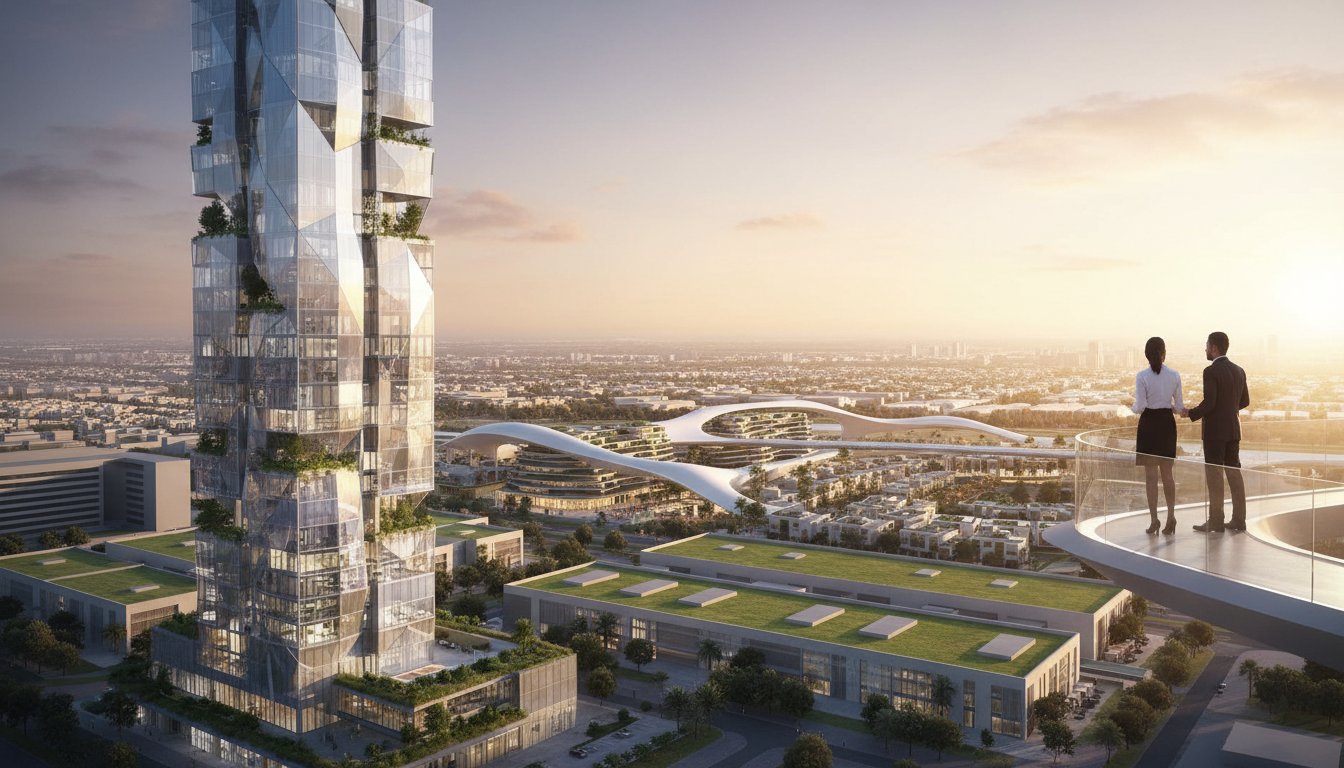
By 2026, an estimated 75% of existing office stock in major global hubs like London and Dubai could be classified as “stranded assets” if they fail to meet evolving net-zero mandates. It’s a reality that demands more than just capital; it requires a visionary understanding of how different types of commercial properties are being redefined by technology and sustainability. You likely recognize that the traditional boundary between “safe” and “speculative” assets has dissolved, leaving even the most seasoned portfolios vulnerable to shifting cross-border regulations.
Julius offers a sophisticated exploration of the commercial landscape to ensure your next acquisition is a masterpiece of both form and function. This guide promises a clear taxonomy of assets, from curated mixed-use developments to the high-yield industrial hubs fueling modern commerce. We’ll examine how urban regeneration and 2026 market trends are creating unparalleled opportunities for those who can distinguish between legacy structures and the future of the global skyline.
Key Takeaways
- Understand the fundamental transition from “space as a commodity” to “space as a service,” a critical evolution for the 2026 commercial investment landscape.
- Master the nuances of various types of commercial properties, from the evolution of Grade A+ workspaces to the industrial shift toward high-tech logistics.
- Discover why the “Build-to-Rent” model and mixed-use “Live-Work-Play” ecosystems are becoming the global gold standard for stability and recurring yield.
- Explore the high-growth potential of visionary special-purpose assets, including data centres and life sciences, that are reshaping modern investment portfolios.
- Gain exclusive insights into the performance of premier markets like Dubai, London, and Riyadh through a curated lens of elite acquisition and portfolio management.
Defining Commercial Real Estate as a Strategic Asset Class
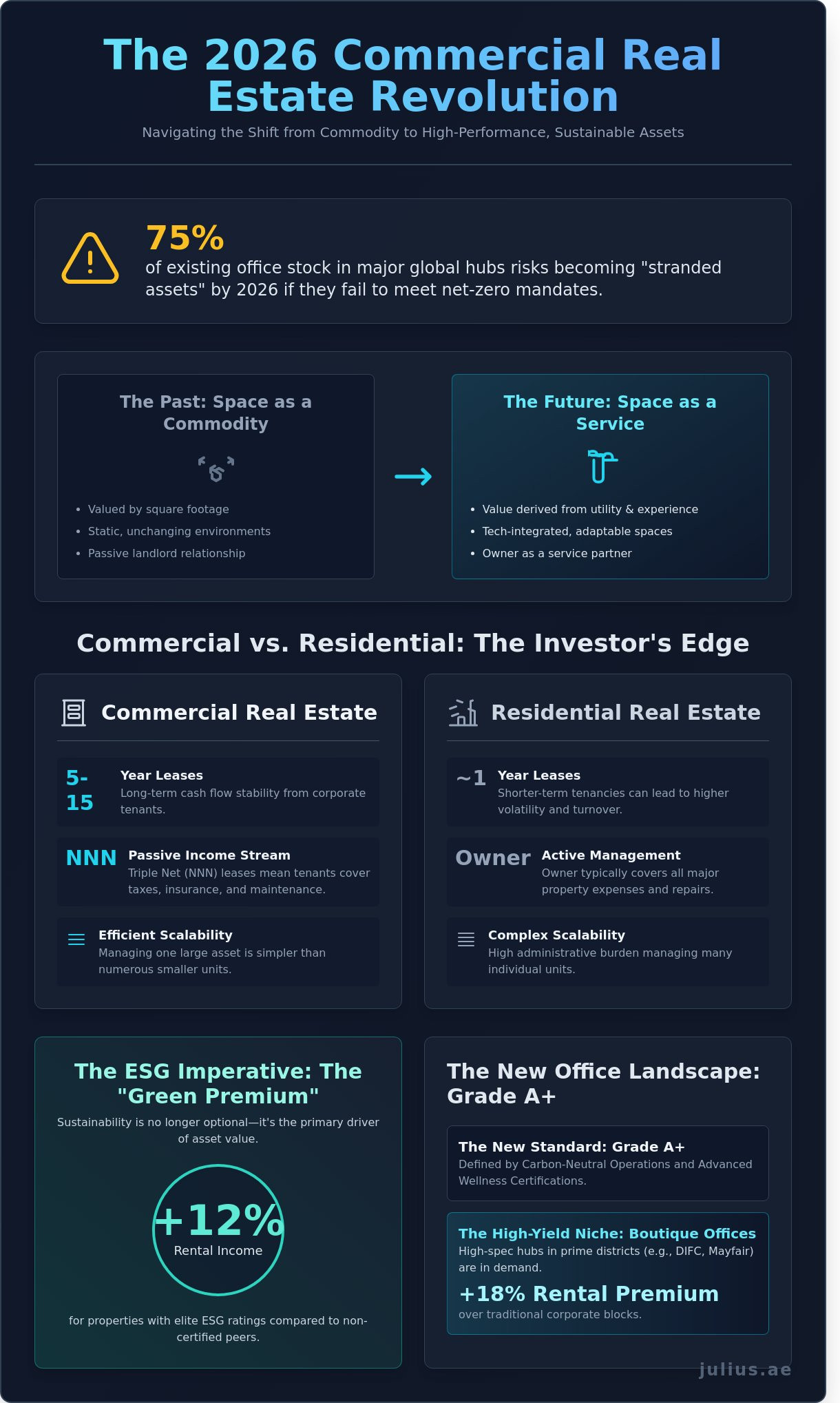
Commercial real estate (CRE) is property engineered for a singular purpose: the generation of profit. Whether through consistent rental yields or long-term capital appreciation, these assets serve as the bedrock of sophisticated wealth preservation. By 2026, the global industry has undergone a fundamental transformation. We no longer view space as a mere commodity. Instead, we embrace “space as a service.” This shift means property owners act as partners, providing tech-integrated environments that adapt to the fluid needs of global commerce. For the discerning investor, understanding the nuanced types of commercial properties is no longer optional; it’s a prerequisite for navigating a market where value is derived from utility and experience.
High-net-worth individuals are increasingly pivoting away from saturated residential markets. They seek the institutional stability that only commercial sectors provide. This transition is driven by a desire for curated portfolios that offer protection against inflation. While residential assets often fluctuate with consumer sentiment, commercial valuations remain anchored in rigorous net operating income (NOI) calculations and long-term contractual obligations. It’s a move from the emotional to the analytical. It’s an evolution toward a more resilient form of ownership.
Commercial vs. Residential: The Investor Perspective
The distinction lies in the structural integrity of the investment. Commercial contracts typically span five to fifteen years, providing a level of cash flow visibility that residential tenancies can’t match. Under a “Triple Net” (NNN) lease, the tenant assumes responsibility for property taxes, insurance, and maintenance. This creates a hands-off, passive income stream. Scalability is equally vital; managing one 50,000-square-foot office asset is significantly more efficient than maintaining twenty individual luxury villas across different jurisdictions. The administrative burden is lower, while the professional nature of the tenant-landlord relationship ensures a more seamless operational experience.
The 2026 ESG Imperative in Commercial Assets
Sustainability is no longer a secondary consideration. It’s the primary driver of asset classification. In 2026, properties with elite ESG ratings command a “Green Premium,” often resulting in a 12% increase in rental income compared to non-certified peers. Investors now face a stark reality. Assets failing to meet stringent carbon-neutral standards are being reclassified as “Special Purpose” or redevelopment opportunities. This shift has created a bifurcated market where visionary investors capitalize on retrofitting older structures to meet the unparalleled demand for sustainable, high-performance workspaces. Identifying the right types of commercial properties requires a keen eye for environmental compliance and future-proofed technology.
- Valuation: Based on income-generating potential rather than comparable sales alone.
- Lease Stability: Multi-year commitments from corporate entities provide a hedge against market volatility.
- Professionalism: Interaction with corporate tenants reduces the friction common in residential management.
The Core Pillars: Office, Retail, and Industrial Properties
The global investment landscape rests upon three foundational types of commercial properties that serve as the engine of modern commerce. While the early 2020s introduced volatility, the 2026 market reflects a flight to quality. Investors now prioritize assets that offer more than mere square footage; they seek environments that facilitate human connection and operational efficiency.
Office Buildings: From Skyscrapers to Bespoke Hubs
The traditional classification of Class A, B, and C assets has undergone a radical transformation. Class A properties in 2026 are defined by their “Grade A+” status, which mandates carbon-neutral operations and advanced wellness certifications. High-net-worth investors are increasingly pivoting toward bespoke boutique offices in districts like Dubai’s DIFC or London’s Mayfair. These smaller, high-spec hubs command rental premiums of 18% over traditional corporate blocks because they cater to the specific needs of family offices and private equity firms. Amenity-rich environments, including private rooftop gardens and concierge-led reception services, are no longer optional extras; they’re essential requirements for securing blue-chip tenants who view the physical office as a tool for talent retention.
Retail Real Estate: High-Street vs. Power Centres
Retail has shifted from a transactional space to a curated “Experience Centre.” Luxury retail remains exceptionally resilient, particularly in the Middle East where high-street destinations and flagship malls continue to see a 7% annual growth in footfall. Modern portfolios often integrate mixed-use retail, blending lifestyle elements like elite fitness clubs with traditional commerce. Savvy investors are paying close attention to “Outparcels.” These are the standalone parcels of land within a larger shopping center’s parking lot, typically occupied by banks or premium coffee brands. Outparcels offer a unique strategic value because they provide high visibility and long-term, triple-net leases that shield owners from rising operational costs.
Industrial and Logistics: The Backbone of Global Trade
Industrial assets have emerged as the undisputed “darling” of the 2026 investment landscape. The explosion of e-commerce has turned “Last-Mile” delivery hubs and cold storage facilities into the most sought-after types of commercial properties. Cold storage, specifically, is projected to see a 25% increase in demand as global supply chains prioritize food security and pharmaceutical logistics.
- Heavy Manufacturing: Large-scale facilities designed for long-term production cycles.
- Light Assembly: Versatile spaces that allow for rapid prototyping and distribution.
- Flex Space: A hybrid of office and warehouse that appeals to tech-driven startups.
Strategic positioning is the primary driver of value in this sector. Identifying commercial property for sale in Dubai allows investors to capitalize on the city’s role as a global logistics nexus between the East and West. The proximity to Jebel Ali Port and Al Maktoum International Airport ensures that industrial assets here maintain near-zero vacancy rates. If you’re looking to balance your portfolio with high-yield industrial or office assets, you can explore our curated listings to find opportunities that align with your long-term wealth objectives.
Residential with a Commercial Soul: Multifamily and Hospitality
Large scale residential buildings transition into the commercial sphere once they surpass a specific unit count, typically five or more in most global jurisdictions. This classification stems from how these assets are valued. Unlike a single villa or apartment, these properties are appraised based on their income generating potential rather than just comparable sales. Institutional investors view these types of commercial properties as essential portfolio anchors because they provide consistent cash flow even during periods of market volatility.
Multifamily Assets: Consistent Yields in Urban Hubs
Multifamily real estate offers a level of management efficiency that scattered site rentals cannot match. Single owner apartment buildings allow for centralized maintenance and streamlined tenant relations. International investors often choose between sprawling garden apartments in suburban corridors and sleek high rise complexes in city centers. In 2023, CBRE reported that multifamily investments represented 30% of total global real estate investment volume. This sector acts as a ballast, protecting capital through the stability of the Build to Rent (BTR) model.
Specialized niches like student housing and senior living have emerged as recession resistant plays. These assets rely on demographic shifts rather than economic cycles. For instance, the demand for senior housing is projected to grow by 25% by 2030 in developed markets as the “silver economy” expands. These properties offer a sophisticated blend of hospitality and long term lease security. They’re built for longevity. They’re built for steady returns.
The Hospitality Sector: A Curated Investment
The hospitality world spans from full service luxury hotels to intimate boutique stays. It’s a sector where operational excellence directly dictates asset value. We’re seeing a significant convergence between traditional hotel management and luxury property in Dubai through the rise of branded residences. These projects, often managed by global names like Ritz Carlton or Four Seasons, frequently command a 30% price premium over standard luxury developments. They offer investors a seamless blend of personal prestige and high yield commercial management.
Short term rental platforms have fundamentally altered hospitality valuations. Properties that integrate professional management with the flexibility of digital booking platforms now compete directly with traditional hotels. This evolution has made hospitality one of the most dynamic types of commercial properties for visionary investors. Success here requires a curated approach to location and service standards that transcends simple brick and mortar ownership. It’s about the art of living as much as the science of investment.
The Evolution of Mixed-Use and Special Purpose Assets
The traditional silos of real estate investment are dissolving. Visionary investors no longer view office, retail, and residential sectors as isolated categories. By 2026, the “Live-Work-Play” ecosystem will define the global standard for high-performing urban portfolios. These integrated types of commercial properties represent a shift toward self-sustaining micro-cities that offer unparalleled resilience against market volatility.
Mixed-Use: The Future of Urban Regeneration
Urban regeneration projects are currently redefining the skylines of global hubs like Dubai and London. A single title now seamlessly blends luxury residential suites with Grade A office environments and bespoke retail galleries. This synergy is intentional and highly profitable. Data from 2024 indicates that mixed-use developments often achieve a 15% to 20% valuation premium over standalone assets. Investors capture value from multiple revenue streams while benefiting from a built-in consumer base. It’s a calculated strategy to mitigate risk through diversification within a single physical structure.
Niche Commercial: Data Centres and Healthcare
The digital economy requires physical foundations. Data centers have emerged as the “digital real estate” of 2026, serving as the essential infrastructure for global AI expansion. The market for these specialized facilities is projected to grow at a compound annual rate of 9.6% through 2030. They offer long-term stability that conventional assets struggle to match. Within this niche, specific requirements create high barriers to entry:
- Life Sciences: Specialized lab-ready spaces command premium rents due to their technical complexity and precise environmental controls.
- Healthcare Facilities: Medical centers often provide 10 to 15-year leases, frequently anchored by government entities or international healthcare brands.
- Strategic Land: Land banking in high-growth corridors, such as the areas surrounding the Al Maktoum International Airport, offers visionary development potential for those with a 10-year horizon.
Special purpose assets require the most sophisticated investment consultancy in the current market. These aren’t simple square-footage transactions; they’re complex infrastructure plays. Success depends on a deep understanding of power grids, specialized zoning, and clinical compliance. Julius approaches these assets as a master curator, identifying rare opportunities where technical utility meets architectural excellence. We ensure your capital isn’t just deployed, but positioned within the most advanced sectors of the global economy.
Navigating Global Commercial Markets with Julius Property
Success in the global arena depends on more than just capital. It requires a nuanced understanding of how different types of commercial properties perform under varying economic pressures. A prime retail asset in London doesn’t behave like a luxury hotel in Dubai; the regulatory frameworks, yield expectations, and tenant profiles are fundamentally distinct. Investors must look past the surface to find value where others see saturation. At Julius Property, we bridge this gap by providing the technical expertise and local intelligence necessary to secure high-performing assets across borders.
Market Nuances: Dubai vs. Riyadh
Dubai remains a primary magnet for luxury hospitality and Grade A office headquarters. In 2023, the city’s prime office occupancy rates hit a record 92.2 percent, driven by a 15 percent increase in new company registrations. It’s a market defined by prestige and high-velocity returns. Riyadh offers a different, yet equally compelling, narrative. Under the Vision 2030 framework, the Saudi capital is seeing a massive industrial expansion. Demand for logistics space in Riyadh surged by 20 percent in the first half of 2024. Savvy investors use these regional strengths to balance their portfolios, often pairing the high-yield potential of the Middle East with the stability of European core assets to achieve a weighted average return that outpaces global inflation.
The Julius Standard: Bespoke Commercial Brokerage
We provide a signature standard of service that bridges the gap between investment logic and the art of property selection. Our methodology focuses on identifying off-market commercial opportunities that remain invisible to the general public. This exclusivity is vital for high-net-worth individuals who require discretion and precision. We move your strategy from a simple property search to comprehensive portfolio management, ensuring that every acquisition of various types of commercial properties serves a specific financial purpose.
Transparency isn’t an option; it’s our foundation. We treat every commercial deal with the technical rigor of an institutional audit while maintaining the personal touch of a luxury concierge. Our experts analyze every detail, from lease structures to ESG compliance, ensuring your investment is protected. Your next move should be calculated and visionary. Consult with our international experts to refine your commercial strategy and secure assets that define the future of your wealth.
Securing Your Legacy in the Global Commercial Market
Navigating the diverse landscape of international real estate demands a strategic approach to selecting the right types of commercial properties. Investors who diversify across the 3 core pillars of office, retail, and industrial assets often achieve more resilient returns. Our 2023 market analysis indicates that prime office spaces in London and Dubai continue to command a 15% rental premium over secondary markets. Success in this arena requires more than just capital; it requires the vision of a seasoned partner who understands the nuances of the art of living and the science of yield.
Julius brings unparalleled expertise to the high-growth corridors of Dubai, Riyadh, and London. We provide bespoke investment consultancy tailored to the precise requirements of high-net-worth individuals. Our clients gain exclusive access to off-market commercial opportunities that never reach the public eye, ensuring a competitive edge in global markets. It’s time to refine your strategy with a team that views real estate as a curated experience rather than a simple transaction.
Explore our curated portfolio of global commercial assets
Your journey toward a sophisticated and high-yielding international portfolio starts with a single, visionary decision.
Frequently Asked Questions
What are the main types of commercial properties for investment?
Investors typically focus on four primary types of commercial properties: office spaces, retail outlets, industrial warehouses, and hospitality assets. In 2024, industrial assets accounted for 25% of global commercial transactions due to the e-commerce surge. Each category offers a distinct risk-return profile. Office buildings in prime districts like Dubai’s DIFC remain a staple for those seeking long-term stability and prestigious corporate tenants who value a central business address.
Is multifamily residential considered a commercial or residential property?
Multifamily residential is classified as a commercial asset when the building contains five or more dwelling units. While it houses residents, the valuation’s based on Net Operating Income rather than comparable home sales. In 2025, institutional investment in multifamily units rose by 12% across major global hubs. This classification allows investors to access commercial financing terms and professional management structures that aren’t available for single-family homes or smaller apartment blocks.
What is a “Special Purpose” commercial building?
A Special Purpose commercial building’s a structure designed for a specific use that’s difficult to repurpose without extensive capital expenditure. Examples include private hospitals, international schools, or luxury cinemas. These assets often feature 15 year triple-net leases to ensure long-term stability. Because their utility’s limited to a niche sector, they require specialized market knowledge. Julius experts often curate these for clients seeking unique, recession-resistant yields within a diversified portfolio.
How do lease terms differ between different types of commercial properties?
Lease structures vary significantly based on the asset class and regional market standards. Industrial and special purpose assets frequently utilize 10 to 20 year terms to protect tenant-specific improvements. Retail and office leases typically range from 3 to 7 years in high-velocity markets. These shorter terms allow landlords to adjust rents more frequently. It’s a strategy that helps reflect current market appreciation and provides a natural hedge against inflation.
Which commercial property type currently offers the highest yield in 2026?
Logistics and data centers are projected to deliver the highest yields in 2026, with prime assets averaging 6.5% to 7.2% net returns. The continued expansion of AI infrastructure and global supply chains drives this intense demand. While traditional office yields hover around 4.5% in premium districts, the industrial sector benefits from lower vacancy rates. Our 2026 market analysis indicates that high-tech cold storage facilities are particularly lucrative for sophisticated investors.
What is a “Grade A” office building and why does it matter?
Grade A office buildings represent the pinnacle of commercial real estate, characterized by their location, age, and high-end amenities. These structures are typically less than 10 years old and feature sustainable certifications like LEED Gold. For an investor, Grade A assets matter because they attract blue-chip tenants and maintain a 15% rent premium over Grade B alternatives. They offer the liquidity and prestige required for a truly global investment strategy.
Can an individual investor buy commercial property or is it for corporations only?
Individual investors can absolutely acquire commercial property, either through direct ownership or fractional investment vehicles. While large-scale malls are often corporate-owned, private individuals frequently hold assets like retail strips or boutique offices valued between $2 million and $10 million. Since 2023, the rise of private syndication has allowed high-net-worth individuals to partner on larger acquisitions. Julius provides the bespoke advisory needed to navigate these complex, high-value transactions successfully.
How does the location affect the classification of a commercial asset?
Location determines whether an asset’s classified as Core, Core-Plus, or Value-Add, which directly impacts its risk profile. A warehouse in a primary logistics hub like Jebel Ali’s a Core asset, whereas the same building in a secondary market carries higher risk. Proximity to infrastructure, such as being within 2 kilometers of a major port, can increase an asset’s valuation by 20%. Geography defines the long-term viability of all types of commercial properties.
Leave a Reply