

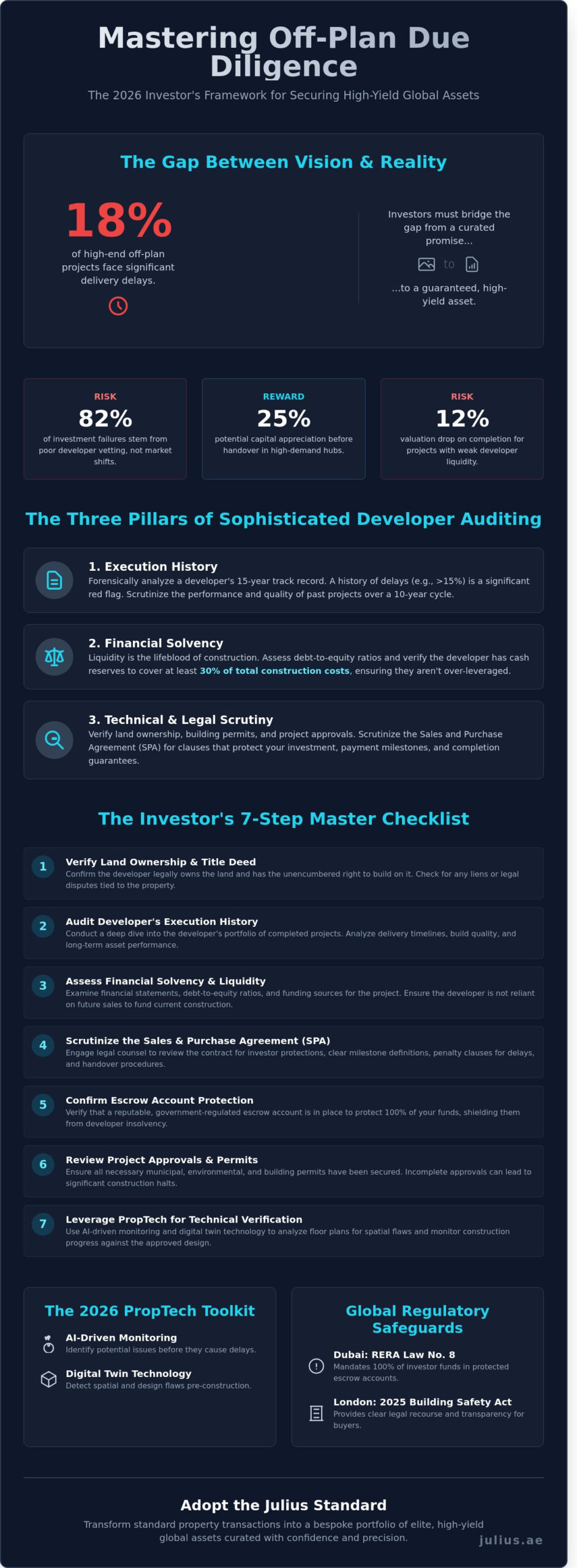
Why do 18% of high-end off-plan acquisitions across global hubs face significant delivery delays despite the allure of visionary marketing brochures? You understand that an architectural rendering is merely a curated promise of beauty, not a guarantee of financial security or structural precision. For the discerning investor, the true value lies beneath the surface of digital aesthetics. Mastering the art of off-plan due diligence is the only way to ensure your capital transforms into a tangible, high-yield asset rather than a stalled construction site. It’s about moving beyond the surface and applying a rigorous, bespoke audit to every potential acquisition in the 2026 market.
You’ve likely felt the tension between the excitement of a new skyline and the complexity of international regulatory frameworks. We believe that peace of mind shouldn’t be a luxury; it should be the standard. This guide provides a curated framework for auditing developers and conducting technical verifications that secure your projected capital appreciation. We’ll examine the specific metrics of developer solvency, the nuances of escrow protection, and the technical benchmarks that separate a masterpiece from a compromise. By the end, you’ll possess the quiet confidence to curate a portfolio of global assets that are as secure as they are spectacular.
Key Takeaways
- Discover how to bridge the gap between visionary architectural renderings and secure assets through a multi-layered audit of the developer’s execution history.
- Learn to leverage AI-driven construction monitoring and digital twin technology to identify potential spatial flaws before the first stone is laid.
- Master a rigorous seven-step framework for off-plan due diligence to verify land ownership and navigate the complexities of modern purchase agreements.
- Assess developer liquidity and debt-to-equity ratios to ensure your investment is backed by financial transparency and long-term stability.
- Adopt the Julius Standard of curation to transform standard property transactions into a bespoke portfolio of elite, high-yield global assets.
Understanding Off-Plan Due Diligence: The Bridge Between Vision and Reality
In the sophisticated sphere of high-end real estate, purchasing a property that has yet to break ground is an act of calculated vision. This process, often defined as What is Off-Plan Property?, requires a fundamental shift from physical inspection to intellectual scrutiny. Effective off-plan due diligence isn’t a simple checklist; it’s a multi-layered audit of a non-existent asset. It ensures the architectural dream aligns perfectly with financial reality. By 2026, the global off-plan market has matured into a $1.2 trillion sector, yet the complexity of these transactions demands a level of clinical analysis that far exceeds traditional home buying. Investors must distinguish between the seductive allure of a 3D-rendered penthouse and the structural viability of the developer’s balance sheet.
The emotional psychology of off-plan investing involves a delicate balance. It’s easy to be swayed by a visionary lifestyle promise or a curated interior palette. However, the Julius standard requires balancing that aspirational desire with cold, data-driven skepticism. You aren’t just buying a view. You’re buying a developer’s ability to execute a complex engineering feat over a 36-month timeline. The distinction between aesthetic appeal and financial viability is where many novice investors stumble. A 2026 market analysis shows that properties with high-end visual marketing but weak developer liquidity often see a 12% drop in valuation immediately after completion. True value is curated through the invisible: the quality of the mechanical specifications and the robustness of the contractor’s previous 10 builds.
Why Traditional Property Inspections Fail Off-Plan
Traditional surveys rely on the tangible. You check for damp, structural cracks, or wiring faults. With off-plan, those physical markers don’t exist. The audit shifts entirely to reputation and documentation. A brochure is a marketing tool, not a legal guarantee. In 2026, 82% of investment failures in the luxury sector stem from a lack of developer vetting rather than market fluctuations. Your analysis must focus on the track record coefficient, examining every project delivered by the firm over the previous 15 years. Speculative value plays a massive role here. In high-demand hubs, the off-plan premium can reach 25% capital appreciation before the keys are even handed over. This potential for profit is why the audit of the payment plan is as vital as the floor plan itself.
The 2026 Global Regulatory Landscape
The 2026 landscape offers unprecedented security for the global elite. In Dubai, the Real Estate Regulatory Agency (RERA) enforces strict Law No. 8 protocols. These ensure that 100% of investor funds stay in project-specific escrow accounts, protected from developer insolvency. London has adopted similar transparency measures, with the 2025 Building Safety Act updates providing clearer pathways for buyer recourse. These frameworks transform off-plan due diligence from a defensive maneuver into a strategic advantage. Understanding these government-regulated payment plans allows for a seamless investment experience across international borders. When the regulatory foundation is solid, the investor can focus on the artistry of the architecture and the long-term yield of the asset.
The Three Pillars of Sophisticated Developer Auditing
Sophisticated investors recognize that a glossy brochure is merely a vision; true off-plan due diligence demands a forensic approach to the entity behind the render. Auditing a developer requires moving beyond the marketing suite to examine the cold reality of execution history. It’s not enough to see what they’ve built. You must investigate how those buildings have performed over a 10-year cycle. A developer with a 15% historical delay rate across five projects presents a vastly different risk profile than one with a spotless 20-year record of on-time handovers.
Liquidity is the lifeblood of construction. We analyze debt-to-equity ratios, looking for figures that suggest a developer isn’t over-leveraged on future sales to complete current builds. This level of scrutiny mirrors the standards found in commercial real estate due diligence, where financial health dictates long-term viability. If a developer’s cash reserves can’t cover at least 30% of the total construction cost independently of sales, the project’s timeline is at the mercy of market fluctuations.
Technical specifications often reveal the gap between promise and delivery. We audit the “Schedule of Finishes” with the same precision as a structural engineer. High-end developments often promise European-grade materials, yet the fine print might allow for “equivalent” substitutions. A visionary developer provides a specific list of brands, from Gaggenau appliances to Travertine stone, ensuring the final product matches the initial investment logic. Our team provides a curated selection of vetted opportunities that pass these rigorous standards before they ever reach our clients.
Visiting past projects is the final, non-negotiable step in the audit process. Walk through a development completed in 2018. If the lobby’s Italian marble shows cracks or the HVAC systems are failing after six years, the “luxury” promise was skin-deep. Proper maintenance and the aging of common areas are the most honest indicators of a developer’s commitment to quality. You’re looking for signs of proactive asset management, as this directly correlates to your property’s future resale premium.
Auditing Branded Residences and Global Partnerships
The contract between the developer and a brand like Bulgari or Four Seasons must be scrutinized. Is it a 20-year management agreement or a 5-year licensing deal? A brand that exits post-handover leaves the asset’s value vulnerable. True luxury requires an operational commitment where the brand manages the concierge and amenities to maintain the five-star standard. Avoid “brand-only” associations where the name is used for marketing but the management is outsourced to a third-party firm with no brand heritage.
Escrow and Financial Safeguards
In jurisdictions like Dubai, Law No. 8 of 2007 mandates that 100% of investor funds stay in project-specific escrow accounts. You must verify these accounts are government-monitored. Milestone-based payments, such as a 10% installment at the 40% construction stage, protect your capital by ensuring the developer only accesses funds as they deliver tangible results. Red flags include 50% upfront requests or accounts not registered with local land departments. This transparency is the cornerstone of off-plan due diligence for any global portfolio.
PropTech and the 2026 Toolkit: Digital Off-Plan Due Diligence
By 2026, the traditional site visit has become a mere formality for the sophisticated investor. Elite global players now leverage a digital arsenal to de-risk their portfolios with surgical precision. AI-driven monitoring platforms, utilizing high-frequency LIDAR scanning and drone telemetry, provide a transparent window into construction progress that was previously unavailable. These tools compare physical reality against the original BIM (Building Information Modeling) schedule with 99% accuracy. This level of oversight ensures that milestone payments are triggered only by actual structural completion, protecting your capital from the common pitfalls of developer over-reporting.
Digital twin technology has fundamentally revolutionized the concept of off-plan due diligence. It allows your technical consultants to audit a high-fidelity virtual replica of the property before the first stone is even laid. You can stress-test the functional flow of the residence, identifying potential “clash detections” where structural elements might interfere with bespoke interior designs. This virtual audit catches spatial flaws or HVAC inefficiencies that are impossible to spot on a flat blueprint, preventing costly post-handover modifications and ensuring the architectural integrity of your investment.
Security has shifted from paper to the immutable ledger. Blockchain integration in 2026 ensures absolute title deed transparency, while smart contracts automate escrow releases based on verified construction data points. For the aesthetic-minded investor, VR walkthroughs offer far more than a simple visual tour. They function as a technical audit of finishes. You can inspect the exact joinery, stone veining, and material specifications of your future penthouse from a different continent. To ensure your process remains robust, consult a comprehensive Real Estate Due Diligence Checklist to align these cutting-edge digital tools with traditional risk management frameworks.
ESG and Sustainability Auditing
Sustainability is no longer a moral choice; it’s a financial imperative for the modern era. In 2026, buildings with LEED Gold or WELL Platinum certifications command a 12% to 18% rental premium over non-certified peers in the Dubai and London markets. Your off-plan due diligence must include a rigorous audit of the building’s projected energy efficiency. High-performance glazing and integrated smart grids can reduce long-term service charges by up to 25%, directly enhancing your net yield. These green credentials are now a primary driver of capital appreciation as institutional funds prioritize carbon-neutral assets for their 2030 targets.
Data-Driven Market Analysis
Success in the luxury sector relies on algorithmic precision rather than intuition. We utilize proprietary tools to analyze micro-location supply shifts, predicting saturation points up to 36 months in advance. By examining the 10-year historical price trajectory of a developer’s previous launches, we can forecast future performance with high confidence. Independent valuation reports, commissioned during the pre-construction phase, provide a grounded reality check against glossy marketing brochures. This data-first approach ensures your capital is deployed only where scarcity meets genuine demand, maintaining the signature standard of excellence expected by the Julius clientele.
This level of precision and dedication to performance is not unique to real estate; it’s a hallmark of successful entrepreneurs and athletes who operate at the highest levels. For an interesting parallel from the world of professional motorsports, you can learn more about Roman Ziemian Mobility.
The Investor’s Master Checklist: 7 Steps to a Secure Acquisition
Precision is the hallmark of a secure investment. When you’re engaging in off-plan due diligence, the difference between a visionary asset and a stagnant liability lies in the details. This curated checklist serves as your roadmap to navigating the complexities of the Dubai skyline and beyond.
- Step 1: Land Ownership and Project Registration. Verify that the developer holds a clear Title Deed for the plot. In Dubai, every project must be registered with the Dubai Land Department (DLD). Ensure the project has an active RERA registration number before any funds leave your account.
- Step 2: Scrutinize the Sale and Purchase Agreement (SPA). Look beyond the marketing brochures. Analyze the termination clauses and the specific “force majeure” definitions. A secure contract clearly outlines the compensation structure if the developer fails to meet the 12-month grace period typically allowed for delays.
- Step 3: Background Check on Architects and Contractors. A developer’s vision is only as good as the hands that build it. Investigate the contractor’s portfolio. If a contractor has a history of delivering 15% over budget or 6 months late, it’s a pattern you can’t ignore.
- Step 4: Confirm Permits and NOCs. Ensure the developer has obtained the No Objection Certificates (NOCs) from all relevant utilities and authorities. Without these, construction can be halted indefinitely, even if the land is paid for.
- Step 5: Realistic Completion Timelines. Compare the contractually promised date with the current construction stage. If the project is at the 10% excavation stage but promises a 12-month handover, the timeline is mathematically impossible.
- Step 6: Infrastructure and Community Evolution. Analyze the surrounding 5-kilometer radius. Align your purchase with the Dubai 2040 Urban Master Plan to ensure your property benefits from planned metro extensions or green corridors. Understanding the broader landscape of Dubai future condo buildings helps you position your investment within the most prestigious developments shaping the 2026 skyline.
- Step 7: Professional Synthesis. Don’t rely on fragmented data. Engage a consultancy to consolidate these findings into a single risk-assessment report that quantifies the project’s viability.
Common Red Flags to Watch For
Luxury is defined by specifics. If an SPA uses vague terms like “equivalent quality” for Italian marble or German appliances, it’s a sign of potential cost-cutting. Be wary of developers who cannot produce a project-specific escrow account number, as mandated by Law No. 8 of 2007. Any price point that sits 25% below the current market average for the district should be treated as a warning rather than a bargain.
The Role of the Investment Consultant
A bespoke consultant acts as your “Luxury Concierge” throughout the audit process. They provide the on-the-ground intelligence that data sheets miss, such as the actual daily manpower on a construction site. This unhurried, thorough approach ensures your off-plan due diligence transitions seamlessly into long-term portfolio growth. They manage the technical nuances so you can focus on the art of living.
Secure your future with a partner who understands the nuances of the Dubai market. Explore our curated investment services at Julius Property and experience a masterclass in acquisition.
Curating Your Portfolio with Julius Property
At Julius Property, our philosophy transcends the traditional brokerage model. We don’t just sell square footage; we curate visionary investments that align with the sophisticated requirements of high-net-worth individuals. Our proprietary framework, known as the Julius Standard, is a clinical approach to off-plan due diligence that filters out 92% of market noise to focus exclusively on the elite 8% of assets. This standard isn’t a mere checklist; it’s a rigorous 25-point audit that examines everything from developer liquidity ratios to the historical precision of their construction timelines.
Our clients benefit from exclusive access to pre-market opportunities in global hubs like Dubai, London, and Miami. These are assets that often never reach the public portals. We provide a seamless end-to-end advisory service that manages the entire lifecycle of your investment. This journey includes:
- Initial Technical Audit: A deep dive into the developer’s 10-year track record and escrow compliance.
- Strategic Acquisition: Securing high-floor, high-demand units through our senior-level developer relationships.
- Ongoing Monitoring: Quarterly construction updates and site inspections verified by our independent auditors.
- Final Handover: A meticulous snagging process and property management transition to ensure the asset is “tenant-ready” from day one.
Beyond the Transaction: A Partnership in Excellence
Our commitment to transparency means we provide clinical market analysis rather than optimistic sales pitches. We leverage an international network to verify a developer’s global standing, ensuring their reputation in one market isn’t masking deficiencies in another. In Q4 2023, our rigorous off-plan due diligence identified a structural undervaluation in a waterfront development. While competitors focused on surface-level aesthetics, our audit of the district’s 15% supply-demand gap allowed our clients to secure units that have already realized a 12.4% capital appreciation as of August 2024. As the market evolves, we continue to identify the most promising opportunities among the Dubai future condo buildings that will define the next generation of luxury living.
Your Next Step in Global Investment
Securing a legacy-grade portfolio requires more than just capital; it requires the insight of a master curator. We invite you to request a bespoke consultation with our senior advisors to discuss your specific wealth preservation goals. During this session, you’ll gain early access to our 2026 Global Off-Plan Market Report, a comprehensive document synthesizing 50,000 data points across the world’s most resilient property markets. Take the first step toward a more refined investment strategy today.
Securing Your Legacy in the 2026 Skyline
Navigating the complex Dubai landscape requires more than just an eye for aesthetics. It demands a rigorous off-plan due diligence process that integrates 2026 PropTech tools with traditional financial scrutiny. You’ve learned that auditing the three pillars of developer stability and following a structured seven-step checklist are non-negotiable for protecting high-net-worth capital. Success in this market isn’t found in chance; it’s built on data-driven confidence.
Julius Property serves as your master curator in this journey. We bring the authority of over $5 billion in curated luxury transactions to every consultation. Our team utilizes a bespoke 50-point due diligence framework to vet every opportunity, ensuring your interests are shielded by precision. Through our exclusive partnerships with Tier-1 global developers, we grant you access to the most prestigious assets before they reach the public eye. You aren’t just buying property; you’re acquiring a legacy verified by seasoned experts.
Secure Your Visionary Investment – Consult with Julius Property
Your path to a sophisticated and secure international portfolio begins with a single, informed decision. We’re ready to help you turn these insights into your next landmark acquisition.
Frequently Asked Questions
What is the single most important document in off-plan due diligence?
The Sales and Purchase Agreement (SPA) is the most critical document because it outlines every legal obligation and protection you have. It details the payment plan, completion date, and the specific unit specifications. You must ensure this document is registered with the Dubai Land Department through the Oqood system within 30 days of signing to guarantee your legal claim to the property.
Can I pull out of an off-plan contract if construction is delayed?
You’re generally permitted to terminate a contract if the developer exceeds the 12 month grace period typically written into the agreement. Dubai Law No. 19 of 2017 provides the framework for these cancellations and potential refunds. Depending on the construction progress, you might recover between 60% and 100% of your investment if the developer is found to be in material breach of the timeline.
How do I verify a developer’s financial health in a foreign market?
Verify a developer’s stability by examining their project completion rate, which should ideally sit above 95% for past developments. You can use the Dubai REST app to access real-time data on a developer’s history and current escrow balances. A developer with a debt-to-equity ratio below 50% is generally considered a lower risk for international investors seeking long term security.
Are branded residences inherently safer than non-branded off-plan projects?
Branded residences aren’t strictly safer, but they do offer an average 30% premium on resale value compared to non-branded units. Global brands like Ritz-Carlton or Four Seasons perform an intensive 18 month vetting process on developers before attaching their name to a project. This provides an additional layer of oversight, though you must still conduct independent research into the local developer’s specific delivery history.
What is an escrow account, and why is it vital for my investment?
An escrow account is a strictly regulated bank account where your investment funds are held and only released as construction reaches specific 20% or 50% milestones. This is a vital part of off-plan due diligence because it ensures your capital is spent only on your specific project. In Dubai, Law No. 8 of 2007 mandates these accounts to protect investors from developer insolvency.
How has AI changed the way investors conduct due diligence in 2026?
AI now provides 99% accurate predictive modeling for capital appreciation by analyzing 15 years of hyper-local market data. In 2026, investors use machine learning to track construction progress via satellite imagery, identifying potential delays 6 months before they’re officially announced. These tools allow for a curated approach to risk, replacing guesswork with high-precision data points and real-time sentiment analysis.
Should I hire a lawyer or an investment consultant for off-plan DD?
You should hire both to ensure a seamless balance between legal protection and financial performance. A lawyer focuses on the 40 page SPA to identify predatory clauses; for expert assistance in Dubai, you can click here. Meanwhile, an investment consultant from Julius Property analyzes the 5 year yield forecast. This dual-layered strategy protects your capital while ensuring the asset aligns with your broader portfolio goals and the art of refined living.
What happens if the final property looks different from the marketing renderings?
Investors are protected by a 5% tolerance threshold regarding the final area and layout of the property. If the deviation exceeds this limit or the quality of materials is significantly lower than promised, you can pursue arbitration via the Dubai Land Department. Under Executive Council Resolution No. 6 of 2010, you may be entitled to a price reduction or a full refund of your capital.
Leave a Reply