
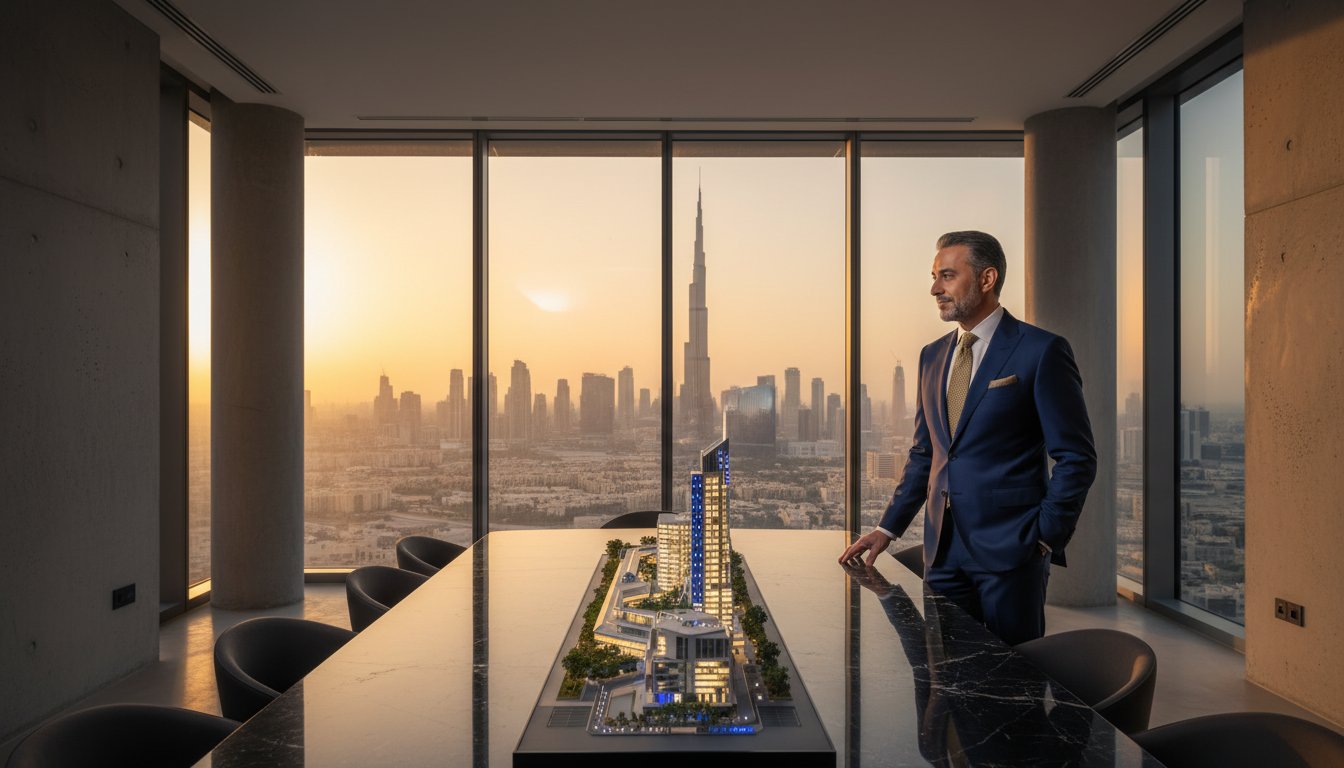
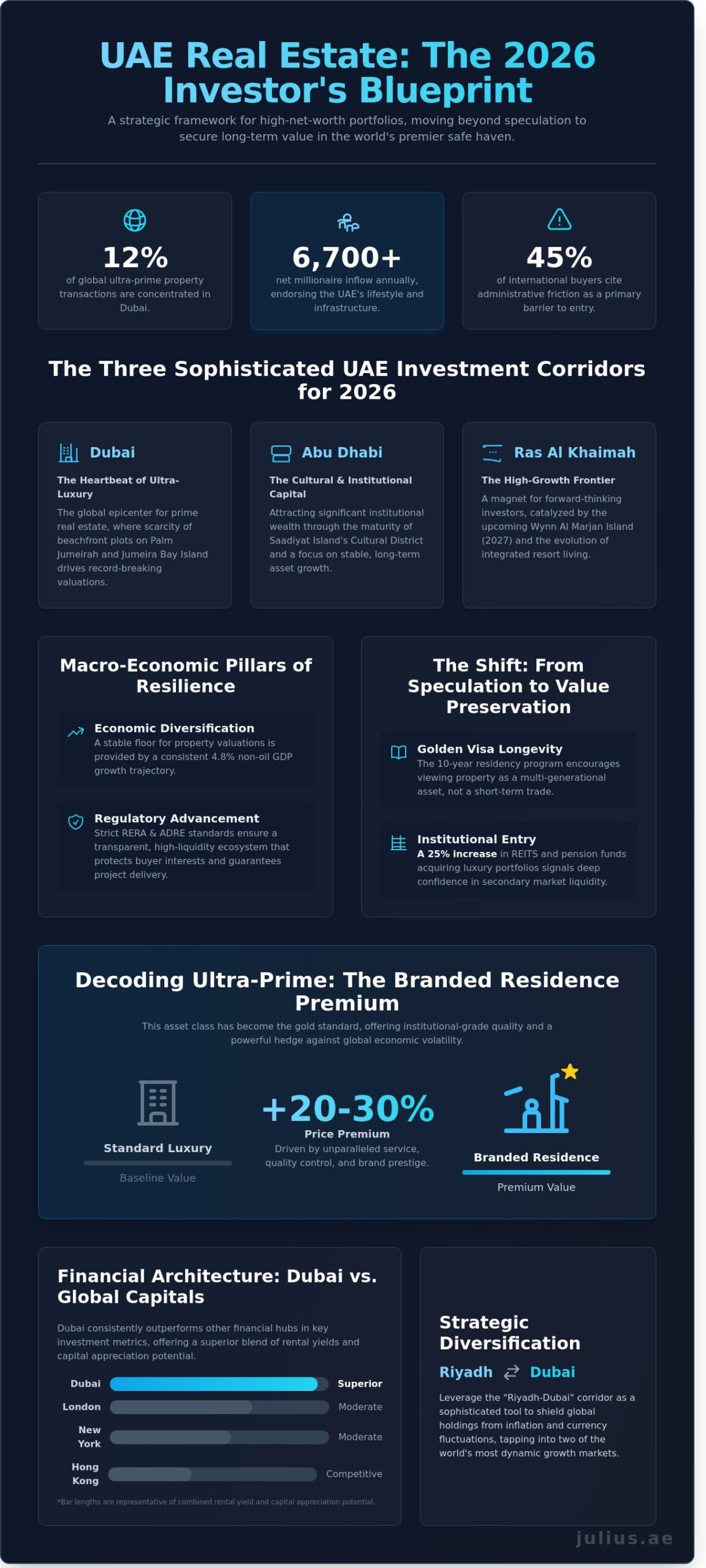
In a market where 12% of global ultra-prime property transactions now concentrate within a single desert metropolis, the era of passive capital appreciation has officially ended. You’ve likely felt the exhaustion of aggressive broker narratives and the noise surrounding high-end real estate investment UAE, which can feel perpetually “booming” yet increasingly difficult to read. It’s natural to question if saturation has finally arrived in Dubai’s luxury corridors or if managing a remote portfolio from London or Zurich has become too complex for the modern investor, especially when 45% of international buyers cite administrative friction as a primary barrier.
You deserve a strategy that respects your time and your intelligence. This strategic guide offers a sophisticated framework designed to refine global high-net-worth portfolios for the 2026 fiscal landscape. We’ll move past the surface-level sales pitches to identify high-yield asset classes like visionary branded residences. This isn’t just a market update. It’s a curated preview of the upcoming prime landscape and a roadmap for bespoke asset acquisition that prioritizes rarity over volume.
Key Takeaways
- Understand the UAE’s trajectory as a premier global safe haven for 2026, where Vision 2030 and infrastructure maturity continue to drive long-term asset value.
- Discover why high-end real estate investment UAE remains a cornerstone for HNW portfolios, particularly through branded residences that command significant premiums over traditional luxury assets.
- Analyze the financial architecture of the 2026 market, comparing Dubai’s superior rental yields and capital appreciation potential against other global financial capitals.
- Learn to leverage the “Riyadh-Dubai” corridor as a sophisticated diversification tool to shield global holdings from inflation and currency fluctuations.
- Master a bespoke acquisition methodology that prioritizes private sourcing and rigorous due diligence over generic market listings to secure the market’s most exclusive opportunities.
The Landscape of High-End Real Estate Investment in the UAE for 2026
Global capital seeks sanctuary in environments that balance visionary growth with ironclad stability. By 2026, the United Arab Emirates has solidified its position as the premier global haven for wealth. This isn’t merely a result of regional momentum; it’s a calculated outcome of the nation’s 2030 goals. While traditional Western markets grapple with fiscal volatility, the UAE offers a curated sanctuary for capital. Data from 2024 and 2025 showed a net inflow of over 6,700 millionaires annually, a trend that has only accelerated as we enter 2026. This migration isn’t just about tax efficiency. It’s an endorsement of a lifestyle and an infrastructure that remains unparalleled on the world stage.
The geography of high-end real estate investment UAE has evolved into three distinct, sophisticated corridors. Dubai remains the heartbeat of ultra-luxury, where the scarcity of beachfront plots on Palm Jumeirah and Jumeira Bay Island drives valuations to record heights. Abu Dhabi has emerged as the cultural capital, attracting institutional wealth through the maturity of Saadiyat Island’s Cultural District. Meanwhile, Ras Al Khaimah has transformed into a high-growth frontier. The anticipation surrounding the 2027 opening of the Wynn Al Marjan Island has turned the RAK coastline into a magnet for investors seeking the next evolution of branded residences and integrated resort living.
The 2026 Macro-Economic Pillars
The resilience of the property sector is anchored in the robust economic diversification in the UAE. Non-oil GDP growth, which maintained a steady 4.8% trajectory through 2025, provides a stable floor for property valuations. Regulatory advancements have also played a critical role. The professionalization of the brokerage landscape, enforced by strict RERA and ADRE standards, has eliminated the opacity of previous decades. Investors now benefit from a transparent framework that protects buyer interests and ensures project delivery timelines. The 2026 UAE investment climate is a mature, high-liquidity ecosystem.
The Shift from Speculation to Value Preservation
The era of rapid “flipping” has largely been replaced by a sophisticated focus on long-term wealth preservation. Investors in 2026 prioritize assets that offer sustained capital appreciation and yield stability. Several factors have driven this transition:
- Golden Visa Longevity: The 10-year residency program has encouraged HNWIs to view their high-end real estate investment UAE as a primary residence or a multi-generational asset rather than a short-term trade.
- Institutional Entry: We’ve seen a 25% increase in institutional REITS and global pension funds acquiring entire luxury residential portfolios, signaling deep confidence in the market’s secondary liquidity.
- Secondary Market Maturity: Established communities like Emirates Hills and District One now possess the historical price data and transaction volume required for accurate, bankable valuations.
This structural maturity means that exiting a position in 2026 is seamless. The market no longer relies on hype; it functions on the fundamental principles of supply scarcity and global demand. For the discerning investor, the UAE represents more than just a property purchase. It’s a strategic entry into a visionary future where luxury is the standard and security is the priority.
Decoding Ultra-Prime Asset Classes: Branded Residences and Penthouses
The UAE luxury market is no longer defined by simple opulence. It’s defined by rarity. Investors targeting high-end real estate investment UAE are moving beyond traditional luxury toward ultra-prime assets that offer a specific narrative of prestige. This shift is most visible in the meteoric rise of branded residences and the architectural evolution of private mansions. These aren’t just homes; they’re institutional-grade assets that provide a hedge against global economic volatility.
The Allure of Branded Residences
Branded residences have become the gold standard for international investors. These properties consistently command a 20% to 30% price premium over standard luxury developments. This valuation isn’t arbitrary. It’s built on the promise of unparalleled service and the rigorous quality control of global icons. When a buyer invests in a brand like Four Seasons or Aman, they aren’t just buying square footage; they’re purchasing a lifestyle curated by masters of hospitality. The resale value remains high because these brands act as a permanent seal of quality, ensuring the asset is maintained to a five-star standard for decades.
The pipeline for 2026 is particularly ambitious. We’re anticipating the completion of the Bugatti Residences, which brings automotive precision to residential living. Meanwhile, the Aman Dubai is set to redefine the beachfront experience with its signature minimalist aesthetic. These launches represent a new frontier in the market. For a detailed analysis of how these partnerships influence market liquidity, read An Insider Look at Dubai’s Branded Residences to see why they remain a cornerstone of high-end real estate investment UAE strategies.
Ultra-Prime Villas and Mansions
The villa market in enclaves like Palm Jumeirah and Emirates Hills has matured significantly. We’ve seen a decisive transition from the Mediterranean-inspired designs of the early 2000s to what we call Contemporary Visionary architecture. Modern buyers demand clean lines, expansive glass facades, and a seamless flow between indoor and outdoor spaces. Privacy and security are the primary currencies here. The most successful assets are those that offer total seclusion without sacrificing proximity to the city’s commercial hubs.
- Signature Villas: These bespoke properties are currently outperforming the broader luxury segment. In the first quarter of 2024, custom-built mansions on the Palm Jumeirah saw a 12% price increase, nearly double the growth rate of standard villas in the same area.
- Scarcity Factor: Beachfront and frontline golf-course plots are finite resources. As the available land in prime districts nears zero, these properties become legacy assets that pass through generations rather than hitting the open market frequently.
- Wellness Integration: Modern ultra-prime homes now include medical-grade wellness suites and oxygen-enriched bedrooms as standard features, reflecting the changing priorities of the global elite.
While residential assets capture the headlines, private family offices are increasingly looking at commercial opportunities. There’s a growing appetite for Grade A office spaces in the DIFC and boutique retail assets in Jumeirah. These commercial investments provide a robust hedge against residential market cycles. They offer stable, long-term yields that complement a diversified luxury portfolio. Success in this tier of the market requires more than just capital; it requires a deep understanding of local dynamics and global trends. If you’re ready to explore these exclusive opportunities, consider how a curated investment portfolio can secure your financial legacy in the region.
Financial Architecture: Yields, Capital Appreciation, and Tax Efficiency
The allure of a high-end real estate investment UAE offers is rooted in its mathematical precision. While legacy markets like London or New York struggle with yields hovering between 2.8% and 3.5%, Dubai prime assets consistently deliver net returns exceeding 6.5%. This performance isn’t accidental. It’s the result of a deliberate urban strategy that balances supply with an insatiable global demand for luxury living. Investors aren’t just buying square footage; they’re acquiring a stake in a tax-efficient ecosystem designed for wealth preservation.
ROI Metrics: Yield vs. Appreciation
Discerning investors must distinguish between immediate cash flow and long-term value spikes. Dubai Marina remains a titan for rental liquidity, where high-floor apartments in signature towers yield approximately 7.2% net. In contrast, the “smart money” has pivoted toward secluded luxury enclaves like Tilal Al Ghaf. These lagoon-front estates prioritize capital appreciation, with early-phase investors seeing property values climb by 25% since their 2022 launch. The short-term rental market adds another layer of profitability. By utilizing professional management for holiday homes, owners often see a 20% premium over traditional annual leases during the peak winter season. In 2026, prime UAE residential assets are projected to maintain an average net rental yield of 7.4%, outperforming the global luxury average by 320 basis points.
- Dubai Marina: Optimized for consistent, high-yield rental income through professional expatriate demand.
- Tilal Al Ghaf: Focused on capital growth and exclusivity within a gated, lifestyle-centric community.
- Short-Term Strategy: Leveraging high-occupancy periods to maximize gross revenue for waterfront properties.
The Golden Visa and Residency Perks
The 10-year Golden Visa acts as a tactical multiplier for any high-end real estate investment UAE portfolio. To qualify in 2026, the entry threshold remains a property investment of 2 million AED or more. This residency status transforms the financial landscape for the holder. It unlocks access to local financing with interest rates typically 1.5% lower than those offered to non-resident investors. Mortgage eligibility also shifts significantly; residents can often secure a Loan-to-Value (LTV) ratio of 80%, whereas non-residents are frequently capped at 50% or 60%. This leverage allows for the acquisition of multiple assets while maintaining healthy liquidity. You can explore the specific requirements and benefits in our detailed guide: The Dubai Golden Visa: Your Pathway to Residency.
Tax efficiency remains the cornerstone of the UAE’s appeal. Even with the introduction of a 9% corporate tax for business entities, individual property owners continue to enjoy 0% tax on personal rental income and zero capital gains tax. This creates a transparent environment where the gross return is remarkably close to the net return. Wealthy families are increasingly moving capital from high-tax European jurisdictions into the UAE to protect their generational wealth. They recognize that the cost of ownership, including service charges and maintenance, is offset by the absence of an annual property tax. It’s a clean, predictable model that rewards those who hold assets for five years or longer. The market isn’t just growing; it’s maturing into a global safe haven for sophisticated capital.
Strategic Portfolio Integration: Balancing UAE Assets with Global Holdings
Sophisticated investors treat their portfolios as curated collections, not mere lists of addresses. A high-end real estate investment UAE serves as a foundational pillar in this assembly. Because the UAE Dirham has remained pegged to the US Dollar at 3.67 since 1997, it offers a rare level of fiscal predictability. This stability shields your capital from the volatility seen in emerging market currencies while acting as a robust hedge against global inflation. It’s a sanctuary for wealth that demands both growth and security in an unpredictable financial climate.
The Middle East Power Play
Riyadh is currently undergoing a radical transformation. Under Vision 2030, the city aims to double its population to 15 million by the end of the decade. This creates a fascinating corridor of opportunity between Riyadh and Dubai. While Dubai offers established luxury and average rental yields between 5% and 9% in prime districts like Palm Jumeirah, Riyadh provides the aggressive growth potential of an awakening giant. Managing these two markets requires a nuanced understanding of shifting regulatory landscapes and ownership laws. You can explore the specific dynamics in our guide on Riyadh vs. Dubai: Where Should You Invest? to refine your regional strategy.
Global Diversification Strategies
London remains the quintessential “Old World” anchor. It provides a historical resilience that balances the “New World” energy of the Emirates. Prime Central London property often sees capital appreciation trends that move independently of Gulf cycles, offering a counterweight during regional shifts. Meanwhile, Istanbul offers a unique strategic proposition. By investing a minimum of $400,000 in Turkish luxury real estate, investors can secure citizenship through investment, creating a vital bridge between East and West. Our UK Real Estate: A Guide for International Investors details how to weave these stable-growth assets into your broader holdings.
Successful asset allocation isn’t about chasing the highest number on a spreadsheet. It’s about the art of the blend. While a dedicated property consultant curates real estate, a comprehensive wealth management firm ensures your high-end real estate investment UAE isn’t an isolated event. Multi-family offices like Neil Jesani Wealth synchronize your acquisitions with global exit strategies and lifestyle requirements. This bespoke approach transforms a simple purchase into a visionary move for your family’s legacy. It ensures that your portfolio remains liquid, diverse, and ready for the next global shift. In 2023, high-net-worth individuals increased their cross-border real estate allocations by 12%, proving that a global perspective is no longer optional; it’s a requirement for wealth preservation.
- Currency Stability: Leverage the AED-USD peg for predictable returns and capital protection.
- Growth vs. Yield: Balance Riyadh’s rapid expansion with Dubai’s high-performing rental income.
- Citizenship Incentives: Utilize Turkish luxury assets to enhance global mobility and residency options.
- Risk Mitigation: Use London’s mature market to offset the higher-risk, higher-reward profile of emerging hubs.
Your investment journey deserves a bespoke strategy that spans borders and secures your future. Connect with our senior advisors at Julius to begin curating your global property portfolio.
Navigating the Acquisition: The Julius Curated Investment Methodology
Securing a high-end real estate investment UAE requires more than a digital search; it demands a methodology rooted in surgical precision. Julius Property operates as a Master Curator, moving beyond the noise of public listing platforms to identify assets with genuine soul and appreciation potential. In the 2026 market, success is defined by a rigorous due diligence process. We prioritize developer reputation by analyzing historical delivery timelines and financial stability. Every transaction we oversee utilizes Dubai Land Department (DLD) regulated escrow accounts, governed by Law No. 8 of 2007. This ensures your capital remains protected until specific construction milestones are verified by independent auditors. It’s not just about buying a property; it’s about engineering a secure financial future.
Our approach blends investment logic with an aesthetic appreciation for the Dubai skyline. We understand that for high-net-worth individuals, the asset must perform as well on a balance sheet as it does as a lifestyle statement. We analyze the 20-minute city connectivity and the integration of sustainable technologies, which are now mandatory benchmarks for “Grade A” luxury assets. This level of scrutiny filters out 90% of available inventory, leaving only the elite opportunities that meet the Julius Property standard of excellence.
The Art of Bespoke Sourcing
Generic property portals often display inventory that’s already stale or lacks true exclusivity. We provide our clients with a Luxury Concierge experience, offering access to off-market inventory and exclusive pre-launch allocations that never reach the public eye. Transparency is our hallmark. We provide granular data on historical price movements and projected capital appreciation, which currently averages 5% to 8% annually in prime districts like Palm Jumeirah and Emirates Hills. You’ll receive a clear view of the total cost of ownership, including DLD fees and service charges, ensuring there are no surprises at the signing table.
- Private Allocations: Direct access to developer-held units before they hit the open market.
- Data-Driven Insights: Comparative market analysis based on actual sales registrations, not just asking prices.
- Conflict-Free Advice: We represent your interests, ensuring the property aligns with your long-term portfolio goals.
Securing Your Legacy
The journey from a Letter of Intent (LOI) to the final transfer requires meticulous coordination. Once the terms are agreed upon, we facilitate the Memorandum of Understanding (MOU) and secure the No Objection Certificate (NOC) from the developer. For those seeking leverage, our expert advisory manages the mortgage process, navigating the 20% to 25% down payment requirements typical for non-resident investors. We also ensure your investment qualifies for the UAE Golden Visa, which currently requires a minimum property value of 2 million AED. This 10-year residency permit adds a layer of security and flexibility to your high-end real estate investment UAE.
Post-acquisition, the focus shifts to preservation and growth. Julius Property provides professional property management services tailored for HNWIs who demand perfection. We oversee everything from tenant vetting to preventative maintenance, ensuring the asset maintains its premium status in a competitive market. Our goal is to create a seamless, hands-off experience that allows you to enjoy the rewards of your investment without the administrative burden. We believe that true luxury is the peace of mind that comes from knowing your legacy is in expert hands.
Mastering the Future of Your Global Portfolio
The 2026 landscape demands a shift from passive ownership to strategic curation. Market data indicates that branded residences and ultra-prime penthouses remain the most resilient asset classes, offering a distinct hedge against global volatility. Successfully navigating high-end real estate investment UAE involves balancing these high-yield assets with a diversified international footprint. By 2026, the seamless integration of Dubai holdings with core markets in London and Istanbul will be a hallmark of the most sophisticated portfolios.
Julius provides the visionary expertise needed to bridge these global markets. We offer our clients exclusive access to off-market branded residences that never reach the public domain. Our team brings deep-seated authority across Dubai, Riyadh, London, and Istanbul, ensuring your bespoke investment strategy is executed with surgical precision. We don’t just facilitate transactions; we curate legacies through meticulous financial architecture and a deep understanding of the art of living.
Your journey toward an unparalleled property portfolio begins with a single, expert conversation. Consult with a Julius Property Investment Advisor today to secure your place in the future of the UAE skyline. It’s time to transform your investment vision into a tangible, high-performing reality.
Frequently Asked Questions
What is the minimum investment for high-end real estate in the UAE in 2026?
You’ll typically need a minimum capital of AED 5 million to secure a high-end real estate investment UAE within the most prestigious postcodes. While the government’s residency threshold remains AED 2 million, the luxury tier starts higher to include premium finishes and exclusive community access. This entry point secures a sophisticated two-bedroom residence in visionary developments like the Dubai Harbour or Palm Jumeirah crescents.
How does the UAE Golden Visa impact property investment decisions?
The Golden Visa acts as a powerful catalyst by offering 10-year renewable residency to those investing at least AED 2 million in the local market. Statistics from 2024 show that 45% of international buyers prioritize this visa to ensure long-term stability for their families and businesses. It eliminates the need for a local sponsor, granting you total autonomy over your lifestyle and your growing property portfolio.
Are branded residences a better investment than traditional luxury villas?
Branded residences currently command a 25% price premium over traditional villas because they offer a seamless blend of five-star service and residential privacy. These assets often achieve 15% higher rental yields due to the global prestige of partners like Dorchester Collection or Bulgari. While a standalone villa offers more square footage, a branded residence provides a curated lifestyle that appeals to the world’s most discerning tenants.
What are the closing costs for a luxury property transaction in Dubai?
You should prepare to pay approximately 7% of the total purchase price in transaction fees to finalize your acquisition. This figure includes the mandatory 4% Dubai Land Department transfer fee and a 2% commission for your dedicated real estate consultant. Additional costs include a registration trustee fee of AED 4,000 and standard mortgage processing fees if you aren’t completing a cash purchase.
Can international investors secure mortgages for UAE prime real estate?
Non-resident investors can access mortgage products that typically cover up to 50% of the property’s total valuation. Major institutions like Emirates NBD provide these bespoke financial solutions to individuals who demonstrate a stable monthly income of at least AED 25,000. Interest rates for international clients generally fluctuate between 4.5% and 5.5%, allowing you to leverage your capital while maintaining a sophisticated global investment strategy.
What is the projected capital appreciation for Dubai properties in 2026?
Market analysts forecast a steady capital appreciation of 6% to 8% for the high-end real estate investment UAE sector throughout 2026. This growth is underpinned by the city’s limited supply of waterfront land and a consistent influx of high-net-worth individuals moving to the region. Investing now allows you to capture value in a market that saw luxury prices rise by 15% in the previous cycle.
How does the UAE property tax system compare to the UK or Europe?
The UAE maintains a 0% tax policy on personal income, capital gains, and inheritance, offering a stark contrast to the UK’s 28% capital gains tax. While European investors often face annual wealth taxes and high stamp duties, Dubai requires only a one-time 4% transfer fee at the point of purchase. This fiscal efficiency ensures your wealth remains protected and your net returns stay significantly higher than in traditional Western markets.
Is it better to invest in off-plan or ready luxury properties?
Off-plan properties are the superior choice for capital growth as they’re often launched at prices 15% below the current market value of finished homes. Ready properties are better suited for investors who require immediate rental income, which currently averages 7% net in prime districts like Downtown Dubai. Your decision should align with whether you value the 20% appreciation potential of a new masterpiece or the instant cash flow of a completed residence.
Leave a Reply