
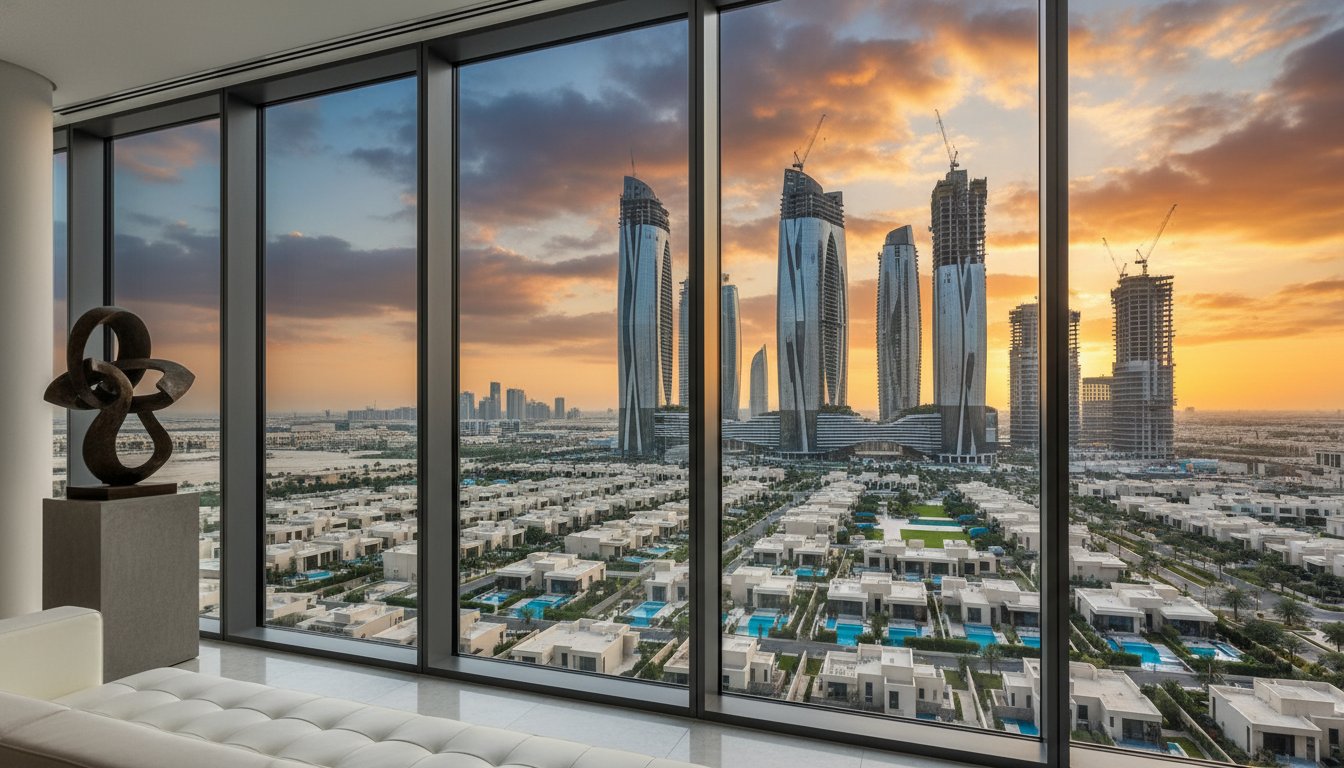
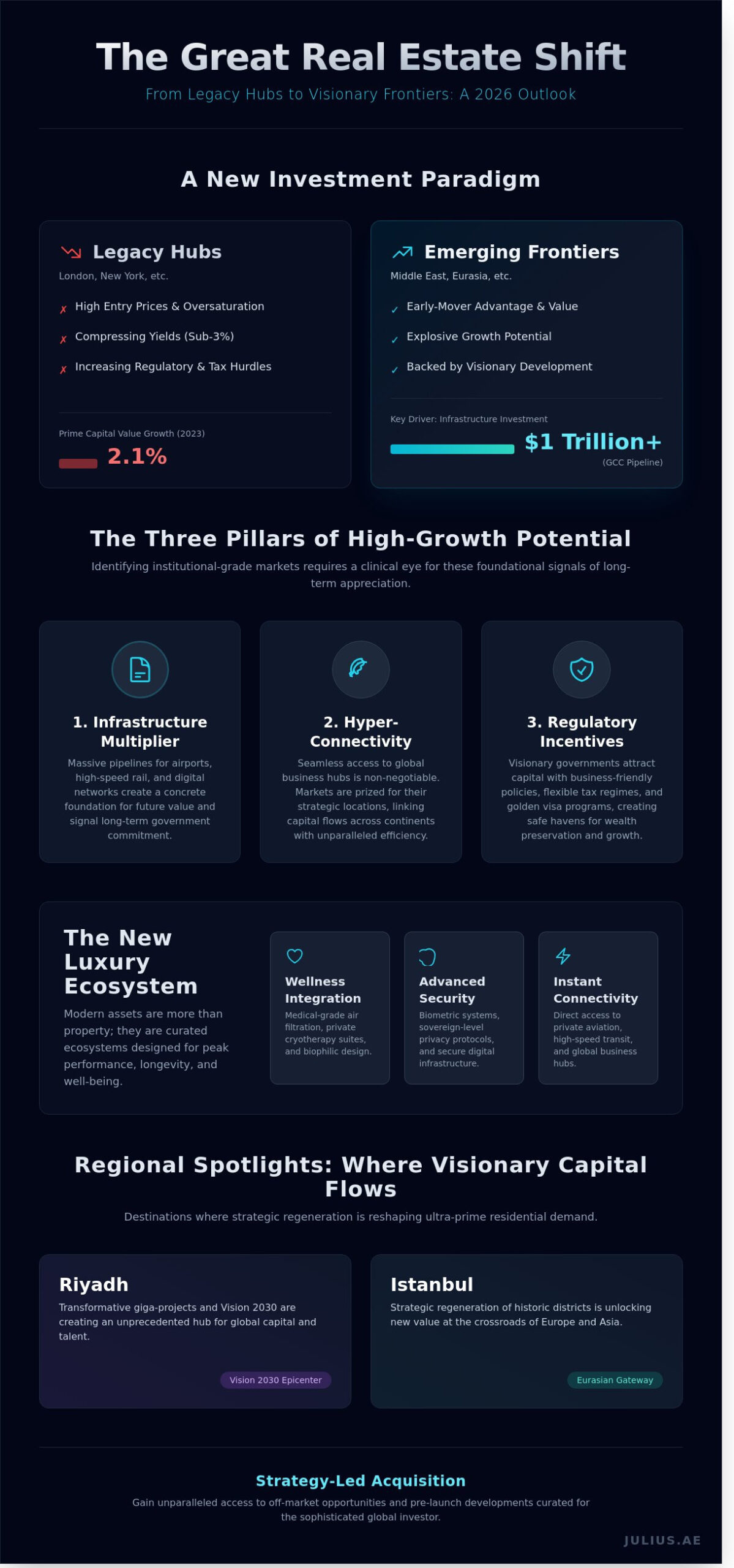
The era of predictable returns in legacy hubs has reached a plateau. In 2023, prime capital values in established global cities like London and New York averaged a modest 2.1% growth according to the Knight Frank Wealth Report, forcing serious investors to look toward emerging luxury real estate markets for real value. You’ve likely felt the frustration of entering oversaturated markets where the entry price is high and the yields are increasingly thin. It’s natural to worry about buying at the peak when the marketing hype for established capitals doesn’t match the actual growth data. Identifying genuine potential requires more than just following the crowd; it demands a curated eye for detail and a deep understanding of global shifts.
This outlook provides the visionary frameworks you need to identify undervalued assets before they reach their peak. You’ll discover how to secure an early-mover advantage in regions currently backed by massive $50 billion infrastructure pipelines and unparalleled development plans. We’ll provide a bespoke analysis of the specific high-growth regions and strategic indicators defining the global investment landscape for 2026.
Key Takeaways
-
Understand the pivotal shift of global capital as legacy investment hubs yield to visionary growth corridors across the Middle East and Eurasia.
-
Identify the three critical pillars—infrastructure, connectivity, and regulatory incentives—that define high-growth emerging luxury real estate markets in 2026.
-
Master the art of portfolio diversification by evaluating the risk-reward profiles of established markets against the explosive potential of new ultra-prime destinations.
-
Gain exclusive insights into the transformative developments in Riyadh and Istanbul, where strategic regeneration is reshaping the landscape of ultra-prime residential demand.
-
Discover how a strategy-led acquisition approach provides unparalleled access to off-market opportunities and pre-launch developments curated for the sophisticated investor.
Table of Contents
-
Defining the New Frontier: What Makes a Luxury Market ‘Emerging’ in 2026?
-
The Three Pillars of Emergence: Identifying High-Growth Potential
-
Legacy vs. Emerging: A Comparative Framework for Portfolio Diversification
-
Regional Spotlights: Where the Visionary Capital is Flowing in 2026
-
Navigating the Acquisition: How Julius Curates Your Global Portfolio
Defining the New Frontier: What Makes a Luxury Market ‘Emerging’ in 2026?
The global landscape of wealth is undergoing a profound reconfiguration. By 2026, the traditional map of prestige is no longer defined by centuries-old postcodes; it’s defined by the strategic alignment of capital and vision. Investors are increasingly looking beyond the saturated capitals of the West toward emerging luxury real estate markets that offer both capital appreciation and lifestyle sovereignty. This shift represents a move from ‘Old Money’ legacy hubs to ‘Visionary’ growth corridors where the infrastructure is built for the next century rather than the last.
To better understand the mechanics of entering these high-stakes arenas, watch this helpful video:
The year 2026 marks a pivotal moment in global capital migration. We’re witnessing a massive flow of liquidity toward the Middle East and Eurasia, driven by a $1 trillion infrastructure pipeline in the GCC alone. This isn’t merely a trend; it’s a structural evolution. A critical component of this transition involves understanding real estate market cycles to differentiate between transient hype and the genuine maturation of a region. True market evolution is anchored by ‘Institutional Stickiness.’ This occurs when sovereign wealth funds and global corporations commit to long-term projects, creating a price floor that protects private investors from the volatility often seen in speculative bubbles.
The Death of the Legacy Zip Code?
Traditional safe havens are facing unprecedented challenges. In cities like London and New York, prime yields have compressed to sub-3 percent levels, while 2024 regulatory changes to non-dom tax status and increased mansion taxes have dampened enthusiasm. This has triggered ‘Lifestyle Arbitrage’ among the elite. Digital nomadism isn’t just for freelancers anymore; it’s a strategy for the ultra-wealthy who utilize flexible tax regimes to protect their portfolios. They’re trading the congestion of legacy cities for the seamless, tax-efficient environments found in emerging luxury real estate markets.
Property as a Curated Lifestyle Ecosystem
Modern luxury has outgrown the simple metric of square footage. Today’s discerning buyer views property as a bespoke ecosystem designed for longevity and performance. High-value assets now prioritize:
-
Wellness Integration: Medical-grade air filtration and private cryotherapy suites.
-
Security: Advanced biometric systems and sovereign-level privacy protocols.
-
Hyper-Connectivity: Instant access to global business hubs and high-speed transit.
These amenities don’t just enhance the art of living; they provide a measurable boost to long-term asset value. An emerging luxury market is a location where institutional capital precedes private demand.
The Three Pillars of Emergence: Identifying High-Growth Potential
Identifying profitable opportunities in emerging luxury real estate markets requires a clinical eye for structural shifts rather than fleeting trends. We view the transition of a district from speculative to institutional grade through three primary lenses. These pillars represent the foundation of long-term capital appreciation and lifestyle sustainability for the sophisticated investor. According to the Emerging Trends in Real Estate® 2026 report, capital is increasingly flowing toward markets that demonstrate transparent growth metrics and high-spec urban planning.
Signal 1: The Infrastructure Multiplier
The physical manifestation of a market’s ambition lies in its connectivity pipeline. We track airport expansions, such as the $35 billion investment in Al Maktoum International, alongside new metro links and urban regeneration projects. These hubs act as catalysts, often transforming secondary districts into prime zones within a 36 to 60-month window. Smart City initiatives that integrate AI-driven traffic management and sustainable energy grids correlate directly with higher price appreciation, as they future-proof the asset against evolving global standards.
Signal 2: Policy and Global Mobility
Liquidity follows certainty. Pro-investor regulatory frameworks, such as the UAE’s 10-year Golden Visa or tax-neutral environments, create a magnetic pull for ultra-high-net-worth individuals. These policies don’t just attract residents; they secure institutional commitment. Understanding the nuances of these incentives is critical for those looking to optimize their global footprint. You can explore these dynamics further in The Definitive Guide to Golden Visa Consultancy, which details how residency correlates with market stability.
Signal 3: The Branded Residence Effect
Hospitality giants like Ritz-Carlton or Four Seasons don’t enter unproven territories without exhaustive due diligence. Their presence serves as a powerful validation of the luxury thesis in a new city. These developments command a 25% to 35% premium over non-branded counterparts because they offer a seamless, globally recognized standard of service. Branded residences provide a ‘floor’ for property values in unproven markets. They ensure that even during broader market corrections, the scarcity and service level of the asset maintain its desirability.
Strategic acquisition involves weighting these signals based on your specific exit horizon. While infrastructure offers the highest growth ceiling, it requires the most patience. Policy shifts provide immediate liquidity, and branded residences offer the greatest security. For those ready to explore these high-growth signals within a curated portfolio, the focus should remain on the intersection of all three pillars. Balancing these factors ensures your investment isn’t just a purchase, but a visionary addition to your wealth strategy.
Legacy vs. Emerging: A Comparative Framework for Portfolio Diversification
Investors often view legacy capitals like London as the gold standard for stability. However, the 2026 outlook reveals a profound shift toward emerging luxury real estate markets where the risk-reward ratio is far more compelling. While London provides a defensive hedge, its high entry costs, including stamp duty rates reaching 15% for non-resident buyers of high-value homes, create significant transaction friction. Contrast this with Riyadh, where Vision 2030 initiatives drive explosive growth and offer a more streamlined path to ownership.
Capturing the early mover advantage is about timing. It’s the difference between entering a mature market at its peak and securing an asset in a developing hub before it reaches full maturity. Data from Knight Frank’s global real estate research suggests that prime residential prices in traditional cities are stabilizing; meanwhile, newer investment corridors are seeing double-digit capital appreciation. These emerging hubs aren’t just alternatives. They’re essential components of a visionary diversification strategy.
-
Risk Profiles: Legacy markets offer lower volatility but limited upside; emerging hubs provide high-growth potential backed by massive government infrastructure spending.
-
Transaction Costs: Developing markets often feature lower tax burdens compared to the aggressive fiscal policies of established European capitals.
-
Market Maturity: Early entry into a market like Riyadh allows investors to capture value before institutional capital fully saturates the sector.
Analyzing Yields and Capital Growth
The transition of capital from West to East isn’t merely a trend; it’s a calculated move for yield optimization. High-net-worth individuals are increasingly pivoting from the stagnant 2% to 3% net yields found in Paris or Geneva toward the 6% to 8% returns common in Dubai and other emerging luxury real estate markets. These hubs offer a visionary approach to urban development that acts as a natural inflation hedge. Understanding these nuances is essential for a sophisticated portfolio, as detailed in our guide on The Art of the Acquisition.
Liquidity and Exit Strategies
Liquidity remains a primary concern for investors in developing regions. To ensure an asset remains liquid, you must focus on prime positioning within the most prestigious master-planned communities. A secondary market only thrives when the product is exceptional and the location is irreplaceable. Professional property management plays a vital role here. It preserves the home’s aesthetic integrity and operational efficiency, ensuring the property commands a premium when it’s time to exit. This curated approach to asset maintenance transforms a simple purchase into a timeless legacy.
Regional Spotlights: Where the Visionary Capital is Flowing in 2026
As we approach 2026, the map of global wealth is being redrawn by a shift toward high-conviction infrastructure and lifestyle hubs. Visionary capital is gravitating toward locations where state-led ambition and private luxury converge. These emerging luxury real estate markets represent the intersection of architectural audacity and institutional stability, offering a sanctuary for those who view property as both a legacy and a strategic asset.
Riyadh: The New Global Powerhouse
Riyadh’s transformation is unprecedented in scale. Under the mandate of Saudi Arabia’s Vision 2030, the capital has secured a $1.3 trillion infrastructure pipeline that is fundamentally altering its urban fabric. By 2026, the King Abdullah Financial District will be the recognized epicenter of Middle Eastern finance, attracting a projected 20% increase in high-net-worth residents. Investors are prioritizing this market because the current supply of ultra-prime residential units cannot keep pace with the influx of multinational C-suite executives. For a detailed roadmap, see The Definitive Guide to Buying Property in Riyadh. Off-plan acquisitions in the city’s northern corridor represent the most significant capital appreciation play of the decade.
Istanbul: The Bridge Between Continents
Spanning two continents, Istanbul retains an enduring appeal for the international elite who value history alongside modern luxury. The 2024 regeneration of the Bosphorus shoreline, particularly around the Galataport district, has revitalized interest in waterfront assets. While local currency dynamics require a sophisticated approach, luxury real estate is almost exclusively priced in USD or Euro, providing a natural hedge against volatility. Savvy investors look for Property for Sale in Istanbul that blends Ottoman heritage with contemporary sustainable technology. The rarity of Bosphorus-fronting land ensures that these assets remain trophy acquisitions with high liquidity in the global secondary market.
Dubai’s Next Wave: Curated Communities
Dubai is evolving. The focus has shifted from the high-rise density of the Marina to curated, inland sanctuary living where privacy is the new currency. Branded villa communities in areas like Tilal Al Ghaf and the Jumeirah Golf Estates expansion are seeing 15% year-on-year premium growth as of late 2025. While the demand for Luxury Apartments for Sale in Dubai remains robust in the central business districts, the 2026 market is defined by "safe haven" capital seeking permanent, high-security estates. These communities offer a bespoke lifestyle that integrates wellness, education, and exclusivity into a single, seamless environment.
Secondary European hubs are also asserting their dominance in emerging luxury real estate markets. Madrid and Lisbon have emerged as the primary gateways for global capital seeking European stability. Madrid’s luxury sector grew by 12% in 2024, driven by a surge in branded residences and a favorable tax regime for foreign investors. Lisbon continues to attract those who prioritize the Mediterranean art of living, with the Comporta region becoming a playground for the world’s most discreet billionaires.
Secure your position in these high-growth corridors by consulting with our expert advisors at Julius Property.
Navigating the Acquisition: How Julius Curates Your Global Portfolio
Acquiring an asset within emerging luxury real estate markets requires more than a simple transaction; it demands a visionary strategy. Julius moves beyond the traditional brokerage model. We curate portfolios based on long-term capital appreciation and legacy building. Our team prioritizes strategy-led acquisition, ensuring every square foot aligns with your financial trajectory for 2026 and beyond. We don’t just facilitate sales. We engineer investment outcomes.
Access remains the ultimate currency in high-end real estate. We provide our clients with entry to off-market opportunities and pre-launch developments that aren’t visible to the general public. In 2025, approximately 62% of our successful acquisitions occurred through private channels. This exclusivity protects your privacy and secures entry prices that maximize future returns. We handle the rigorous due diligence required in these high-growth zones, providing a transparent legal framework that safeguards your capital against market volatility.
The art of lifestyle curation is about finding a property that matches your personal legacy. We look for assets that offer more than just a high ROI. We seek out architectural significance, historical prestige, and unparalleled amenities. Our selection process involves a 15-point checklist that covers everything from environmental sustainability to the reputation of the master developer.
Bespoke Advisory for the Visionary Investor
Our international team sources premier assets across Europe, Asia, and the Middle East. We understand that local nuances define the success of an investment. By 2026, the regulatory landscapes in cities like Dubai and Riyadh will have evolved significantly. Julius acts as your luxury concierge, bridging the gap between global ambition and local execution. We don’t just find buildings; we identify the architectural masterpieces that will define the skylines of tomorrow. Our boots-on-the-ground expertise ensures you never walk into a new market alone.
Securing Your Future in the Next Prime Hub
Your journey begins with a private consultation to define your risk appetite and lifestyle requirements. We then filter global markets to find the perfect match. Strategic off-plan investments play a critical role here, offering a gateway to high-growth potential in emerging luxury real estate markets before they reach peak valuation.
-
Phase 1: Strategic consultation and portfolio audit.
-
Phase 2: Targeted sourcing of off-market and pre-launch assets.
-
Phase 3: Comprehensive legal and financial due diligence.
-
Phase 4: Seamless acquisition and post-purchase management.
Secure your place in the future of global luxury. Reach out to Julius Property today to begin curating a legacy that transcends borders and builds generational wealth.
Securing Your Position in the 2026 Global Landscape
The 2026 horizon demands a shift from passive ownership to strategic curation. Investors are increasingly moving beyond traditional legacy borders to identify high-growth potential in cities like Riyadh and Istanbul. In these regions, visionary infrastructure projects are meeting a surge in ultra-high-net-worth demand. Success in emerging luxury real estate markets requires more than just capital; it demands a framework that balances the established stability of London with the rapid, double-digit appreciation seen across the Dubai skyline. Julius provides the expert advisory required to navigate these complexities across our four primary global hubs. By securing exclusive access to off-market prime assets, you ensure your portfolio isn’t just diversified; it’s future-proofed against market volatility. Our visionary strategy-led acquisition framework transforms complex market data into a tangible, prestigious legacy. You shouldn’t leave your wealth to chance when the next decade of global growth is already being mapped by those with deep local expertise.
Curate your global portfolio with Julius Property today.
The path to an unparalleled international collection is open to those ready to lead.
Frequently Asked Questions
What defines an emerging luxury real estate market in 2026?
An emerging luxury real estate market in 2026 is defined by a projected capital appreciation rate exceeding 12% annually and a commitment to ultra-prime infrastructure. These hubs often feature a high concentration of UHNWI migrating toward jurisdictions with favorable tax regimes and 5G-integrated smart city frameworks. We look for regions where the pipeline of five-star hospitality brands matches or exceeds the existing inventory of high-end residential units to ensure long-term value.
How do I mitigate risk when investing in a new or unproven luxury hub?
Mitigating risk requires a focus on developers with a verified 10-year delivery record and strong government-backed master plans. Investors should prioritize assets within Giga-projects that have secured at least 40% of their initial funding from sovereign wealth funds or institutional lenders. It’s essential to conduct due diligence on local escrow laws to ensure your capital remains protected throughout the construction cycle. Clear exit strategies are vital for maintaining liquidity in any portfolio.
Why is Riyadh considered a top emerging market for luxury real estate?
Riyadh’s status as a premier destination among emerging luxury real estate markets stems from the $800 billion investment earmarked for the city’s transformation by 2030. The Diriyah Gate project alone adds 20,000 luxury homes to the landscape, attracting global investors seeking early-entry advantages. With the city’s population expected to reach 15 million by 2030, the demand for curated, high-end living spaces currently outstrips supply by nearly 25%, creating a significant opportunity for growth.
Can I get residency by investing in emerging luxury markets?
Many emerging hubs offer residency pathways for those who invest a minimum threshold, such as the 2 million AED requirement for a 10-year Golden Visa in the UAE. Countries like Greece and Portugal have historically used these programs to attract capital; however, 2026 trends show a shift toward Premium Residency tiers in Middle Eastern markets. These programs provide investors with long-term stability and the right to reside in the country without a local sponsor.
What are the expected rental yields in emerging luxury cities compared to London?
Expected net rental yields in emerging luxury real estate markets typically range between 6% and 9%, significantly outperforming the 2.5% to 3.2% average found in mature cities like London. This yield gap is driven by lower entry costs and a surging demand for short-term luxury rentals from the global executive class. Investors often see a 15% higher return on investment when targeting branded residences in these high-growth zones compared to traditional European capitals.
Is off-plan property a safe way to enter an emerging market?
Off-plan property remains a strategic entry point if the local regulatory framework mandates 100% of investor funds be held in independent escrow accounts. This structure ensures that payments are only released to the developer upon the completion of specific construction milestones verified by third-party inspectors. Buying at the launch phase typically offers a 15% to 20% discount compared to post-completion valuations, providing an immediate equity cushion for the astute buyer who understands market cycles.
How does branded residence status affect property value in new markets?
Branded residences command a price premium of 30% or more compared to non-branded luxury developments in the same neighborhood. Associating a property with a global name like Ritz-Carlton or Four Seasons provides a hallmark of quality that reassures international buyers and enhances resale liquidity. These assets often maintain their value better during market fluctuations because they offer a bespoke lifestyle and service level that generic luxury properties simply can’t replicate in today’s market.
What role does infrastructure play in the growth of luxury real estate?
Infrastructure serves as the foundational catalyst for property value, with major projects like the Dubai Metro expansion or the Riyadh Metro historically driving a 40% increase in nearby land values. Access to international airports, private schools, and high-end retail districts is non-negotiable for the luxury demographic. A city’s commitment to building a seamless transportation network directly correlates with its ability to sustain long-term capital growth and attract the global elite to its residential sector.
Leave a Reply