

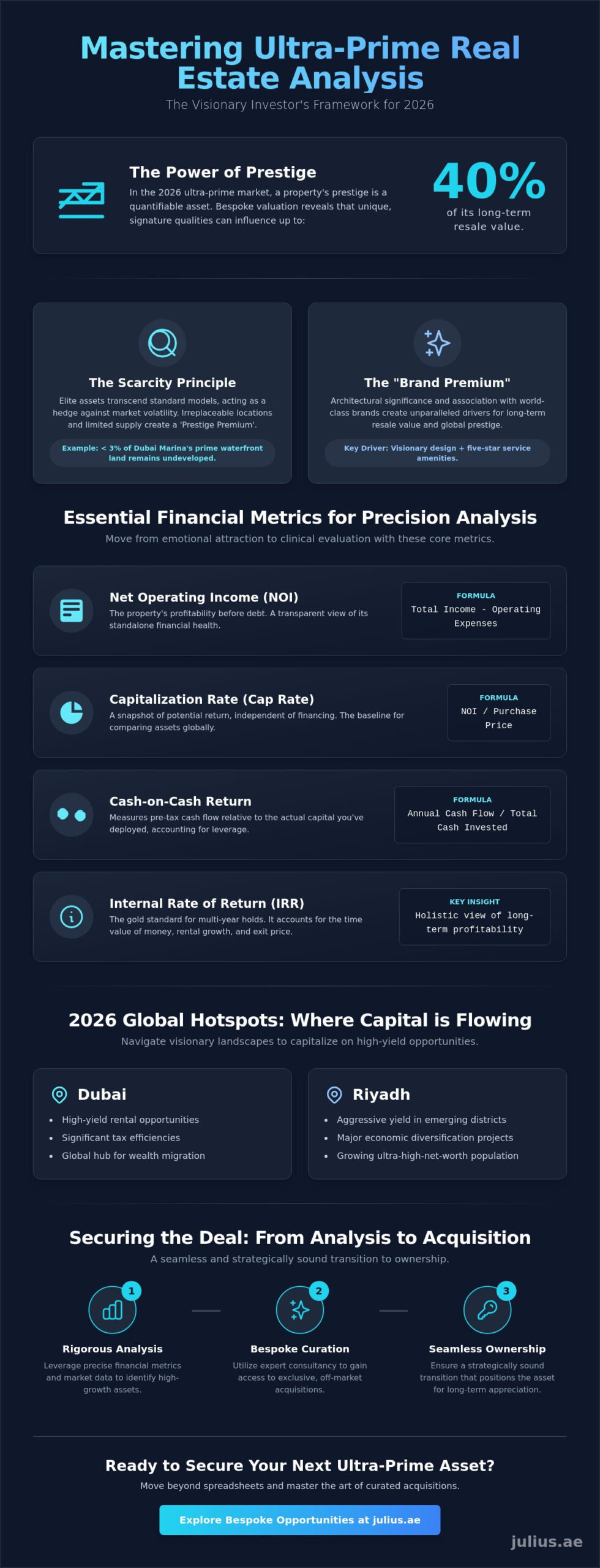
In the ultra-prime market of 2026, a property’s prestige is no longer just a subjective luxury; it’s a quantifiable asset class that can influence up to 40% of its long-term resale value based on findings from the 2025 global wealth reports. Mastering how to analyze real estate investment deals requires you to look past the noise of generic listing sites and focus on the precision of bespoke valuation. You’ve likely felt the frustration of trying to quantify the unparalleled nature of a signature residence using tools designed for the mass market.
We promise to move you beyond simple spreadsheets into a visionary approach that balances rigorous financial metrics with global market intuition. You’ll gain the confidence to identify high-growth assets that offer both immediate yield and enduring capital appreciation. This guide details a clear framework for decision-making that treats every acquisition as a curated masterpiece rather than a mere transaction.
Key Takeaways
- Master the Scarcity Principle to understand why elite assets transcend standard valuation models, acting as a sophisticated hedge against global market volatility.
- Gain a command of essential financial metrics, learning exactly how to analyze real estate investment deals by balancing Net Operating Income with nuanced Cash-on-Cash returns.
- Navigate the visionary landscapes of Dubai and Riyadh to capitalize on the high-yield opportunities and tax efficiencies defining the 2026 international market.
- Discover the “Brand Premium” and why architectural significance in branded residences creates an unparalleled driver for long-term resale value and prestige.
- Learn to secure exclusive off-market acquisitions by leveraging bespoke consultancy, ensuring your transition from analysis to ownership is both seamless and strategically sound.
The Fundamentals of Luxury Real Estate Investment Analysis
Understanding how to analyze real estate investment deals in the high-end sector requires a shift from volume-based metrics to value-based curation. Standard residential models often overlook the emotional and architectural intangibles that sustain demand in the prestige tier. To master this, sophisticated investors must look beyond simple yield and integrate the Fundamentals of Real Estate Appraisal into a broader lifestyle and macro-economic context.
To better understand the core principles of identifying high-value opportunities, watch this helpful video:
Defining the Investment Thesis for 2026
Successful acquisitions in 2026 will hinge on aligning with global wealth migration patterns. Data from recent wealth reports suggests a 28% increase in private capital flowing toward tax-efficient hubs by the mid-decade mark. Investors should decide if they seek capital preservation through a stable UAE property portfolio or aggressive yield via emerging districts. Family offices often prioritize assets that serve as generational legacies, making property selection a deeply personal endeavor that balances financial logic with aesthetic vision.
The Scarcity Factor in Prime Markets
Scarcity acts as the ultimate buffer against market fluctuations. In established hubs like Dubai Marina, where less than 3% of prime waterfront land remains undeveloped as of early 2024, the supply-demand imbalance remains skewed in favor of the owner. Irreplaceable assets, such as historic city center penthouses or branded residences with private beach access, command a significant ‘Prestige Premium.’ The Prestige Premium is a quantifiable metric that measures the price variance between a standard luxury unit and a signature asset within the same micro-market.
An exit strategy isn’t a post-script; it’s the foundation of the deal. Before signing a contract, you must identify who the secondary buyer will be in five or ten years. High-net-worth investors often look for liquidity through rarity. If an asset lacks a unique architectural pedigree or a visionary location, it risks becoming a commodity. Precision in how to analyze real estate investment deals means ensuring the asset remains desirable to the next generation of global wealth. This forward-thinking approach ensures that your capital isn’t just parked, but is actively appreciating within a seamless investment lifecycle.
Essential Financial Metrics for the Sophisticated Investor
Determining how to analyze real estate investment deals requires a shift from emotional attraction to clinical precision. Net Operating Income (NOI) serves as the primary heartbeat of any high-end asset. You calculate it by subtracting all operating expenses from the total income generated. This figure excludes debt service, providing a transparent view of the property’s standalone profitability. For a 2026 portfolio, mastering this metric ensures you aren’t blinded by gross revenue figures that mask underlying inefficiencies.
The Capitalization Rate offers a snapshot of potential return without the influence of financing. It’s your baseline for comparing a penthouse in Downtown Dubai to a townhouse in Mayfair. Conversely, Cash-on-Cash return measures the annual pre-tax cash flow relative to the actual capital you’ve deployed. If you’re utilizing a 60% loan-to-value mortgage, your Cash-on-Cash return will often diverge significantly from the Cap Rate. Both are vital for a balanced perspective.
The Internal Rate of Return (IRR) remains the gold standard for multi-year hold strategies. It accounts for the time value of money, factoring in rental growth and the eventual exit price. For those vetting luxury deals at speed, the Gross Income Multiplier (GIM) acts as a swift sanity check. It’s a simple ratio of the purchase price to the gross annual income, allowing for immediate filtering of overpriced listings.
Deep Dive into Yield and Appreciation
True yield is never the headline figure. You must calculate net yield by deducting service charges, property management fees, and maintenance reserves. In Dubai, service charges typically range from 15 to 30 AED per square foot, which can impact your bottom line. While mature markets like London might see capital appreciation hover around 3% annually, emerging luxury hubs offer higher volatility with greater upside. Mortgage leverage amplifies these results; a 4% appreciation on a property bought with 25% equity translates to a 16% return on your initial capital.
The Total Cost of Acquisition
Precision in your initial outlay prevents downstream liquidity issues. You’ll encounter a 4% DLD fee in Dubai, whereas Stamp Duty in London can reach 12% for secondary homes over £1.5 million. Beyond taxes, factor in legal fees and bespoke interior upgrades. High-net-worth investors often allocate an additional 7% for curation and staging to maximize rental premiums. Mastering how to analyze real estate investment deals ensures you account for every variable before committing capital, especially when exploring off-plan property investments.
Refining your strategy starts with the right data. You can explore our curated UAE collection to see these metrics in action.
Regional Dynamics: Analyzing Dubai, Riyadh, and London in 2026
Investment success depends on the synergy between local policy and global capital flow. When you’re mastering how to analyze real estate investment deals, you’ve got to weigh the explosive growth of emerging hubs against the steady pulse of established capitals. Each city requires a bespoke lens to evaluate its true worth.
Dubai’s High-Growth Ecosystem
Dubai remains a masterclass in visionary urban planning. By 2026, the market’s matured beyond simple speculation. The Golden Visa program, specifically the ten-year residency for property owners, has fundamentally shifted demand from transient to long-term. This creates a stable floor for luxury property in the UAE. Analysts look at the 2026 supply-demand curve for high-end apartments and see a market where supply is struggling to keep pace with the influx of high-net-worth individuals relocating from Europe and Asia. Yields remain attractive; they often hover between 6% and 9% in prime districts like Palm Jumeirah and Downtown Dubai. Tax efficiency continues to be the signature draw, ensuring that gross yields translate almost directly into net gains for the sophisticated investor.
The Riyadh Opportunity
Saudi Arabia’s capital is a different beast entirely. Vision 2030 is the primary engine here. Giga-projects like the King Salman Park and the Mukaab are reshaping property values in surrounding neighborhoods. Analyzing these deals requires a deep dive into the evolving legal framework. Updates to the Foreign Real Estate Ownership Law in late 2025 have opened new corridors for international capital. It’s a high-reward environment where infrastructure development moves faster than almost anywhere else on earth. When you’re learning how to analyze real estate investment deals in Riyadh, you’re essentially betting on the successful execution of the state’s urban transformation. The potential for capital appreciation here is unparalleled, though it requires a longer horizon than the quick-flip markets of the past.
London’s Prime Market and Risk Weighting
London serves a different purpose: capital preservation. While the Middle East offers aggressive yield, London offers a curated hedge against global volatility. The prime market in 2026 focuses on timeless quality. Investors here prioritize assets that maintain value regardless of the economic climate. Weighting regional risks involves a careful balance between regulatory changes and infrastructure development. In London, the risk is often legislative, such as shifts in stamp duty or tax status for non-residents. In contrast, the risks in Riyadh and Dubai are more closely tied to the pace of construction and global oil price fluctuations. A visionary portfolio doesn’t choose one over the other; it blends the high-yield potential of the Gulf with the enduring stability of the Thames. This balanced approach is the hallmark of a seasoned investment strategy.
Qualitative Curation: The Art of Evaluating Branded Residences
Financial metrics provide the skeleton of a deal, but qualitative factors provide the soul. When you learn how to analyze real estate investment deals in the luxury sector, you must account for the “Brand Premium.” This isn’t a nebulous concept. Data from Savills 2023 reports indicates that branded residences command an average price premium of 30% globally compared to non-branded luxury assets. Names like Armani, Bulgari, or Ritz-Carlton offer more than prestige; they provide a standardized assurance of quality that reduces risk for international buyers.
The Rise of Branded Residences
The global market for branded residences has grown by over 160% in the last decade. Ultra-high-net-worth individuals prioritize these assets because they offer a “lock-up-and-leave” lifestyle backed by five-star hotel services. This psychological comfort translates directly into higher tenant retention and superior rental yields. In emerging luxury hubs, brand association acts as a quality seal that validates the asset’s long-term viability for foreign investors who cannot be physically present for every inspection.
Architectural significance also plays a pivotal role in value preservation. A building designed by a Pritzker Prize-winning architect often experiences slower depreciation. These structures aren’t just housing; they’re collectible art. When you evaluate a deal, consider whether the design is visionary enough to remain relevant in 2035. Elite amenities like private spas, cigar lounges, and 24-hour concierge services aren’t just perks. They’re critical drivers of the 15% to 20% higher rental premiums observed in prime Dubai districts during 2024.
Strategic Asset Stewardship
Owning a masterpiece requires a curator. Professional management is a non-negotiable requirement for the modern investor who demands asset protection. High-end property management ensures that the “Art of Living” standard remains consistent, protecting the building’s physical integrity and the brand’s reputation. Without elite stewardship, even the most prestigious residence can lose its luster and its resale value. Effective management maintains the seamless experience that affluent tenants demand, ensuring your yield remains stable through market cycles.
Strategic investors look for partnerships where the operator has a proven track record of maintaining global standards. You can explore these high-performing assets within our curated selection of luxury properties in the UAE. Understanding how to analyze real estate investment deals through the lens of brand equity allows you to identify assets that will outperform the general market by leveraging the reputation of world-class hospitality leaders.
Securing the Deal: From Analysis to Acquisition
Analysis ends where execution begins. Many investors encounter friction because they treat high-stakes international markets as a DIY project. In 2026, raw data is abundant, but the wisdom to interpret it remains rare. Understanding how to analyze real estate investment deals requires an appreciation for local nuances that spreadsheets simply cannot capture. A misstep in title verification or a misunderstanding of local escrow laws can dissolve the projected returns of even the most promising asset.
The Consultant Advantage
A sophisticated commercial property brokerage serves as a visionary partner rather than a mere intermediary. These professionals provide access to “pocket listings” that never reach public portals. These off-market opportunities often feature entry points 12% to 18% lower than retail listings. Expert consultants bridge the gap between cross-border complexities and seamless acquisition, ensuring your capital is deployed with surgical precision.
The Julius Standard of Due Diligence
Precision is the hallmark of the Julius Standard. We believe that true luxury is found in the peace of mind that comes from exhaustive verification. Before any contract is signed, your acquisition roadmap must include several non-negotiable checks:
- Title Verification: Confirm the property is free of undisclosed liens via the land department’s latest digital ledger.
- Technical Assessment: For acquisitions in the UK, engage professional valuation experts like South Surveyors to conduct comprehensive building surveys, ensuring the physical asset matches the financial projections.
- Developer Track Record: Audit the developer’s delivery history and financial stability over the last 10 years.
- Escrow Compliance: Ensure all transaction funds reside in government-regulated accounts to protect your principal.
- Future Planning: Review municipal Master Plans for 2030 to ensure no upcoming infrastructure projects will negatively impact the view or accessibility.
Your 2026 Acquisition Roadmap
Finalizing a deal in today’s market demands more than just a high bid. Negotiation strategies for prime assets now focus on flexible payment structures and post-handover guarantees. Once the acquisition is complete, the focus shifts to portfolio management. This transition ensures your investment remains a performing asset rather than a dormant entry on a balance sheet. You aren’t just buying square footage; you’re securing a legacy within a curated global portfolio.
Our bespoke approach transforms the complexity of how to analyze real estate investment deals into a refined, high-touch experience for the discerning investor. We move with a steady, confident pace, focusing entirely on your long-term aspirations and the art of living well.
Mastering the Art of Visionary Acquisition
Navigating the global markets of 2026 demands more than just basic intuition. Success hinges on a mastery of sophisticated metrics like the Internal Rate of Return and a deep appreciation for the unique value of branded residences. Whether you’re targeting the high-yield potential of Riyadh’s Vision 2030 developments or the timeless stability of London’s prime postcodes, your strategy must be as refined as the assets themselves. Mastering how to analyze real estate investment deals is the first step toward securing a legacy of wealth that transcends market cycles.
At Julius Property, we bridge the gap between rigorous analysis and visionary acquisition. Our team provides exclusive access to off-market opportunities across Dubai, Riyadh, and London, backed by comprehensive mortgage and Golden Visa advisory. We don’t just facilitate transactions; we curate portfolios for the world’s most discerning investors. Your journey toward an unparalleled property portfolio begins with a partner who understands the nuance of excellence.
Secure your bespoke investment consultation with Julius Property today
The future of your global footprint is waiting to be shaped.
Frequently Asked Questions
What is the most important metric for real estate investment analysis?
Cash-on-Cash Return is the most vital metric when learning how to analyze real estate investment deals because it isolates the performance of your actual liquid capital. While Cap Rate provides a useful asset valuation, it doesn’t account for the nuances of financing. For instance, a 7% return in Dubai Hills Estate often proves more lucrative than higher gross yields elsewhere because maintenance costs are lower and tenant profiles are more stable.
How do I calculate the ‘Prestige Premium’ for luxury properties?
You calculate the Prestige Premium by measuring the percentage difference between a property’s price per square foot and the sub-market’s average for standard luxury units. In 2024, reports from Knight Frank indicated that branded residences in Dubai commanded a 30% premium over non-branded equivalents. This figure reflects the value of architectural rarity, bespoke interior finishes, and the elite status of the resident community.
Is off-plan property a better investment than ready-to-move-in homes in 2026?
Off-plan properties offer higher capital appreciation potential in 2026 as developers launch projects with visionary amenities that older homes simply can’t match. Data from the Dubai Land Department shows that investors entering during the launch phase frequently realize 15% to 20% appreciation before the building is even finished. Ready homes remain the preferred choice for those who want immediate rental income in iconic districts like Palm Jumeirah.
What are the common mistakes to avoid when analyzing real estate deals?
The most common mistake is failing to account for the total cost of ownership, specifically service charges and sinking funds. Investors often get blinded by high gross yields, but a 5% increase in annual fees can significantly damage your long-term ROI. Another error is ignoring exit liquidity. A unique villa might be a masterpiece, but it takes an average of 180 days to find a qualified buyer.
How does the Dubai Golden Visa impact real estate investment analysis?
The Dubai Golden Visa impacts analysis by creating a floor for property values and encouraging long-term hold strategies. Since the 2 million AED investment threshold was introduced, the market has seen a 40% rise in resident owners. This shift reduces the volatility typically found in speculative markets. It makes the city a more predictable environment for high-net-worth individuals who value stability alongside growth.
What is a good Cap Rate for luxury apartments in Dubai vs. London?
A strong Cap Rate for luxury apartments in Dubai typically sits between 5% and 7%, while prime London assets generally offer between 2.5% and 4%. This difference is largely due to Dubai’s tax-free rental income and the high demand for premium short-term stays. You must weigh these yields against the historical capital growth of each city to ensure the asset fits your specific risk profile.
How do I analyze the potential of a commercial property deal?
Analyzing a commercial deal requires focusing on the Weighted Average Lease Expiry (WALE) and the financial strength of the tenants. A WALE of 7 years or more is the industry standard for a secure, institutional-grade investment. You should also examine the building’s ESG ratings. Modern corporate tenants in 2026 prioritize sustainable, Grade A office spaces that align with their own global corporate responsibility goals.
Why should I use an investment consultant instead of a standard real estate agent?
An investment consultant provides a curated portfolio strategy that goes far beyond the transactional focus of a standard real estate agent. While an agent wants to sell a specific property, a consultant at Julius manages your wealth by identifying market cycles and off-market gems. This partnership ensures every acquisition is a deliberate step toward your financial legacy, backed by deep data and an international perspective.
Leave a Reply