
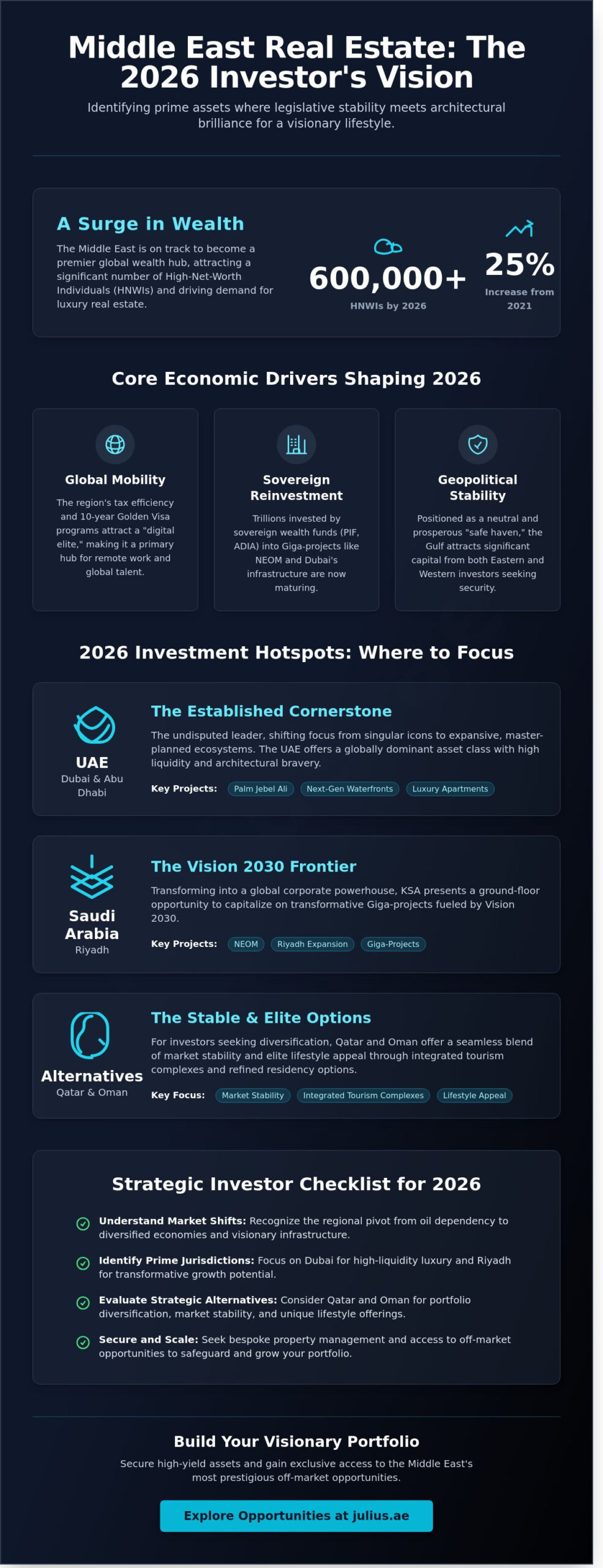
By 2026, the Middle East is projected to host over 600,000 high-net-worth individuals, marking a 25% increase from 2021 levels according to Knight Frank’s Wealth Report. You recognize that true wealth isn’t just about accumulation; it’s about the art of preservation and the pursuit of a visionary lifestyle. Identifying the best places to buy property in the Middle East requires moving past the marketing hype to find genuine prime assets that stand the test of time. You’ve likely felt the weight of oversupply concerns or the complexity of shifting foreign ownership laws in emerging hubs that promise much but deliver little.
This guide curates the most lucrative and prestigious real estate markets for the strategic investor, focusing on jurisdictions where legislative stability meets architectural brilliance. You’ll discover how to secure high-yield assets that offer more than just financial returns, providing a seamless path to residency and a prestigious home in a global city. We’ll examine the specific districts where your investment logic aligns with your aesthetic aspirations, ensuring your 2026 portfolio remains as refined as it is profitable.
Key Takeaways
-
Understand how the regional shift toward non-oil sectors and visionary infrastructure projects are redefining the landscape of high-end real estate for 2026.
-
Identify the best places to buy property in the Middle East by exploring Dubai’s next-generation developments and the unparalleled prestige of luxury apartments.
-
Discover how to capitalize on the Saudi Arabian frontier as Riyadh transforms into a global corporate powerhouse through transformative Giga-projects.
-
Evaluate strategic alternatives in Qatar and Oman, where integrated tourism complexes offer a seamless blend of market stability and elite lifestyle appeal.
-
Learn how to safeguard and scale your international portfolio through bespoke property management and exclusive access to off-market opportunities.
Table of Contents
The Middle East Real Estate Landscape in 2026
By 2026, the Gulf’s architectural silhouette has transitioned from a collection of ambitious blueprints into a tangible, high-functioning reality. This era represents the peak of a maturity phase where the Economic landscape of the Middle East has decoupled from crude oil volatility to embrace a diversified, service-led future. Investors now look beyond mere speculation, seeking the stability of a market that has refined its regulatory frameworks and luxury offerings. Identifying the best places to buy property in the Middle East requires an appreciation for this newfound maturity, where tax-free environments and global mobility aren’t just perks, but standard pillars of the investment thesis.
The acceleration of the UAE 2031 vision and Saudi Arabia’s Vision 2030 has catalyzed a shift in capital. We’re seeing the results of trillions of dollars in infrastructure spending, creating urban centers that rival London or New York in sophistication. This isn’t a temporary boom; it’s a structural realignment of global wealth. As 2026 approaches, the focus is on long-term residency and the "art of living," supported by a seamless integration of technology and bespoke lifestyle services.
For those looking to equip their high-end residences with the latest tech, you can check out Budget Gamer UAE for high-performance PC systems that complement a luxury lifestyle.
To better understand how property ownership facilitates your global lifestyle, watch this helpful video:
What Defines a Middle Eastern Property ‘Hotspot’?
A strategic location in 2026 is defined by its proximity to financial epicenters and curated luxury amenities. It’s no longer enough to offer a view; a true hotspot provides a frictionless lifestyle. Regulatory transparency, particularly regarding freehold ownership rights in zones like Dubai’s DIFC or Riyadh’s new districts, ensures that capital remains secure. A hotspot is a zone where state-backed vision meets private capital. This synergy creates unparalleled value for those seeking the best places to buy property in the Middle East, as it guarantees that the surrounding infrastructure will continue to evolve long after the initial purchase.
Key Economic Drivers for 2026
The fiscal strength of the region remains formidable. High oil prices throughout the early 2020s allowed sovereign wealth funds, such as the Public Investment Fund (PIF) and the Abu Dhabi Investment Authority (ADIA), to reinvest billions into domestic non-oil sectors. This reinvestment has fostered a thriving ecosystem for digital nomads and high-net-worth individuals who utilize the 10-year Golden Visa programs to secure their future. Several factors drive this demand:
-
Global Mobility: The rise of remote work has made the Gulf a primary hub for the "digital elite" seeking tax efficiency.
-
Sovereign Reinvestment: Massive projects like NEOM and the expansion of Dubai’s metro systems have reached critical milestones.
-
Geopolitical Stability: The region’s role as a neutral, prosperous "safe haven" attracts capital from both East and West.
By 2026, global events and the completion of visionary landmarks have shifted investor attention permanently toward the Gulf. It’s a market defined by precision, where the visionary leadership of the past decade has created a landscape of rare opportunity and enduring prestige.
The United Arab Emirates: Curating Luxury in Dubai and Abu Dhabi
The United Arab Emirates remains the undisputed cornerstone for those identifying the best places to buy property in the Middle East. By 2026, the landscape has shifted from the iconic skyline of the Burj Khalifa toward the expansive, visionary horizons of Palm Jebel Ali. This project, which spans an area twice the size of Palm Jumeirah, defines the next era of waterfront living. It’s not just about scale; it’s about the precision of a master-planned ecosystem designed for the global elite. Investors are increasingly gravitating toward luxury apartments for sale Dubai, where the fusion of architectural bravery and high liquidity creates a globally dominant asset class.
The 2026 outlook suggests a refined maturation across the Emirates. While capital appreciation remains robust, the focus has pivoted toward long-term value preservation and sophisticated lifestyle integration. Rental yields in prime districts are expected to stabilize between 6% and 9%, consistently outperforming major European and North American capitals. This regional momentum is often compared to the strategic shifts outlined in Saudi Arabia’s Vision 2030, showcasing a broader Middle Eastern commitment to institutional-grade real estate standards and transparent regulatory frameworks.
Dubai’s Prime Districts: Where the Smart Money is Moving
The 2026 market favors the "Green Heart" of Dubai Hills Estate and the vertical sophistication of Business Bay. We’re seeing a massive surge in off-plan property investments, particularly those tied to global fashion and automotive brands. These branded residences are no longer just homes; they’re collectible assets. Projects like the Bugatti Residences or Armani Beach Residences offer a level of rarity that insulates them from market fluctuations. The demand for these bespoke spaces has driven a 15% increase in transactions for ultra-prime properties since the start of 2025.
Abu Dhabi: The Sophisticated Investor’s Choice
Abu Dhabi offers a rhythmic contrast to Dubai’s high-velocity growth. Saadiyat Island has emerged as a global cultural titan, with the Zayed National Museum and the Guggenheim Abu Dhabi nearing their 2026 completion targets. This district appeals to the unhurried investor seeking stability and intellectual prestige. Meanwhile, Yas Island continues to capture the entertainment-driven market, fueled by a 25% increase in annual visitor numbers recorded in the 2024-2025 cycle. This dual-city approach allows for a balanced portfolio that captures both high-growth energy and steady, long-term appreciation.
For those seeking to refine their portfolio with precision, exploring the curated selections at Julius provides a gateway to these exclusive opportunities.
Saudi Arabia: Capitalizing on the Vision 2030 Frontier
Saudi Arabia represents the most ambitious urban transformation of the century. By 2026, the Kingdom has transitioned from a speculative prospect to a concrete reality for global portfolios. It stands as one of the best places to buy property in the Middle East due to the unprecedented scale of its Giga-projects and the maturity of its regulatory environment. The 2024 mandate requiring multinational firms to establish regional headquarters in the capital has fueled a sustained surge in demand that shows no signs of slowing. This shift has turned Riyadh into a high-stakes arena where premium supply struggles to keep pace with the influx of C-suite executives and specialized talent.
Riyadh’s Residential Revolution
The capital is currently facing a critical shortage of high-end residential stock that meets international luxury standards. Investors are gravitating toward the North expansion, specifically districts like Al-Malqa and Al-Yasmin, where infrastructure is designed to support a new global workforce. The HQ effect in 2026 functions as a structural catalyst where the influx of thousands of high-earning expatriates, driven by the regional headquarters mandate, creates a permanent upward pressure on luxury rental rates and capital values. This fundamental supply-demand imbalance makes buying property in Riyadh a cornerstone of any strategic Middle Eastern portfolio. Navigating the 2026 legal framework requires precision, as the Kingdom continues to refine its Premium Residency options to attract long-term capital and simplify the path to ownership for non-residents.
The Red Sea and NEOM: Future-Proofing Portfolios
Beyond the capital, the Red Sea Global project and NEOM offer a different breed of luxury asset. These are visionary, tourism-centric developments designed for an elite global audience seeking rarity and architectural innovation. While the primary market remains state-driven, secondary market opportunities are emerging as the first phases of Sindalah and The Line reach operational milestones. This frontier carries unique variables that require a sophisticated approach to risk management. According to expert analysis from S&P Global, regional credit channels and broader economic shifts can impact liquidity in emerging markets, making entry timing crucial. Success in these ultra-futuristic zones isn’t about rapid flips; it’s about securing a curated stake in the world’s next great luxury destination. Investors who prioritize assets with high ESG ratings and seamless tech integration will be best positioned as the 2030 deadline approaches.
-
Strategic Advantage: Early entry into districts like Al-Malqa provides exposure to the highest rental yields in the Kingdom.
-
Regulatory Ease: The 2026 landscape features streamlined digital title deed transfers and expanded residency-linked property rights.
-
Market Maturation: Saudi Arabia is no longer just an oil economy; it’s a diversified hub for the best places to buy property in the Middle East.
Strategic Alternatives: Qatar, Oman, and Turkey
While the headlines often focus on the rapid ascent of Dubai and Riyadh, the 2026 landscape reveals sophisticated corridors of value in Qatar, Oman, and Turkey. These markets represent some of the best places to buy property in the Middle East for investors who prioritize a curated balance between capital preservation and lifestyle excellence. Each destination offers a distinct narrative, moving away from high-volume speculation toward a more measured, architectural prestige.
The strategic choice between these markets depends on whether an investor seeks pure yield or a sophisticated hedge. Qatar and Oman provide a sanctuary of stability and wellness, while Turkey functions as a visionary bridge between continents. This diversification is no longer a luxury; it’s a requirement for the modern high-net-worth portfolio.
Doha: The Safe Haven of the Gulf
Post-2022 World Cup Doha has matured into a masterpiece of high-end infrastructure. The focus has shifted from rapid expansion to the refinement of its most prestigious districts. Lusail City, a $45 billion visionary project, and The Pearl-Qatar remain the primary magnets for international capital. These areas aren’t just residential hubs; they’re seamless ecosystems of luxury retail and maritime elegance.
The impact of Law No. 16 of 2018 continues to resonate in 2026. By granting residency to those investing $200,000 and permanent residency benefits to those crossing the $1 million threshold, Qatar has secured a loyal base of conservative wealth. Investors here value the unhurried pace and the government’s commitment to a high-spec, secure environment. It’s a market built on the art of living well rather than the pursuit of volatile gains.
Oman and Turkey: The Lifestyle and Value Plays
Oman offers a departure from the glass-and-steel aesthetic of its neighbors. Through Integrated Tourism Complexes (ITCs), the Sultanate allows 100% foreign ownership in developments that emphasize wellness and heritage. Muscat’s elite segment attracts HNWIs who view property as a sanctuary for retirement. These "under-the-radar" coastal developments provide a rarity in the region: low-density luxury paired with genuine natural beauty.
Turkey presents a more dynamic calculus. Istanbul’s luxury districts, specifically along the Bosphorus, serve as a strategic hedge against currency fluctuations. By 2026, the demand for dollar-pegged high-end real estate in areas like Beşiktaş has solidified. For the strategic investor, these assets are one of the best places to buy property in the Middle East to capture the intersection of European lifestyle and Eastern capital flow. Coastal enclaves in Bodrum are also evolving into year-round luxury hubs, mirroring the sophistication of the French Riviera.
Understanding the nuances of these emerging corridors is essential for securing long-term growth. Discover how these strategic alternatives can enhance your bespoke property portfolio through our expert curation.
Building Your Portfolio with Julius Property
Identifying the best places to buy property in the Middle East is only the first step in a sophisticated investment journey. True wealth preservation requires a transition from simple acquisition to strategic asset stewardship. For the international owner, professional property management is the cornerstone of this transition. It ensures that luxury assets remain high-performing vehicles rather than passive holdings. In a market as dynamic as 2026, local expertise acts as your eyes and ears on the ground, protecting yields and maintaining the architectural integrity of your residence.
Julius Property specializes in the "Art of the Acquisition." This philosophy balances risk across multiple jurisdictions, from the high-liquidity corridors of Dubai to the emerging institutional hubs in Riyadh. We curate exclusive off-market opportunities that never reach public listings. These private placements offer our clients a distinct advantage, providing access to rare penthouses and prime commercial floors before they are exposed to the broader market. Our approach is unhurried and deliberate, focusing on the long-term appreciation of your global footprint.
Risk Mitigation and Asset Stewardship
Diversifying into mixed-use assets requires a nuanced understanding of local regulations and tenant dynamics. The strategic role of commercial property brokerage is vital for investors looking to anchor their portfolio with stable, income-producing units. We prioritize transparency in every cross-border transaction, utilizing the latest 2026 escrow protocols and digital verification systems to secure your capital. In the current climate, curation is more important than volume because a single, meticulously selected asset provides far greater resilience than a large portfolio of generic properties.
-
Rigorous due diligence on master developers and delivery timelines.
-
Strategic allocation between residential lifestyle assets and commercial yields.
-
Ongoing advisory on tax efficiencies and regional regulatory shifts.
The Julius Signature Experience
Our bespoke approach to sourcing high-value assets is designed for the individual who demands excellence without compromise. We don’t just find buildings; we find legacies. By integrating residency consultancy with property acquisition, we provide a seamless path for investors to secure their future in the region. Whether you are seeking a Golden Visa in the UAE or navigating the new investment residencies in Saudi Arabia, our team handles the complexity so you don’t have to. We act as your master curator, ensuring every addition to your portfolio aligns with your aesthetic and financial aspirations.
The 2026 market offers unparalleled potential for those who move with precision. Consulting with a Middle East real estate expert is the most effective way to navigate the best places to buy property in the Middle East while avoiding the pitfalls of over-saturated sectors. Your journey toward a refined regional portfolio begins with a single, expert conversation.
Discover the Julius Property collection today and experience the standard of service your investments deserve.
Securing Your Legacy in the 2026 Landscape
The transition toward 2026 marks a pivotal era where the best places to buy property in the Middle East are defined by visionary infrastructure and unparalleled luxury. Saudi Arabia’s Vision 2030 has reached a critical maturity phase, driving a significant surge in Riyadh’s institutional investment. Simultaneously, the UAE remains a global magnet for wealth, with industry data from Knight Frank projecting a 15 percent increase in ultra-high-net-worth interest for the coming year. These markets aren’t just growing; they’re evolving into the world’s most sophisticated residential hubs.
Success in this elite environment requires a partner who treats real estate as a curated experience. Julius Property brings deep expertise to the Dubai, Riyadh, and Istanbul markets, offering our clients exclusive access to off-plan branded residences that define the skyline. Our comprehensive consultancy ensures that every aspect of your investment and residency journey is handled with precision. We don’t just find properties; we curate portfolios that reflect your highest aspirations.
Curate your Middle Eastern property portfolio with Julius Property. The opportunity to shape your future in this vibrant region is yours to command.
Frequently Asked Questions
Can foreigners buy freehold property in the Middle East in 2026?
Yes, international investors hold full ownership rights in designated freehold zones across the region. In Dubai, Law No. 7 of 2006 established this right, while Saudi Arabia’s 2024 premium residency updates now allow property ownership in specific economic hubs. These regulations ensure your investment is a permanent asset. It’s why these locations remain the best places to buy property in the Middle East for those seeking long-term security.
Which Middle Eastern city offers the highest rental yields for investors?
Dubai continues to lead the region with gross rental yields averaging between 6% and 9% in 2025. Areas like Jumeirah Village Circle and Dubai Marina consistently outperform global averages of 2% to 3% found in London or New York. Ras Al Khaimah’s emerging hospitality sector also shows projected yields of 7% following the 2027 Wynn Resort announcement. Investors prioritize these high-performing districts for immediate, reliable cash flow.
How does the Golden Visa program work for property buyers in the UAE?
The UAE Golden Visa grants a 10 year residency to investors who purchase property valued at 2 million AED or more. This long-term visa remains independent of employment, allowing you to sponsor family members and domestic staff seamlessly. According to the Dubai Land Department, this initiative contributed to a 20% increase in long-term investor retention since its 2019 inception. It transforms a simple transaction into a permanent lifestyle anchor.
Is it better to invest in Dubai or Riyadh in 2026?
Choosing between these markets depends on whether you value established luxury or rapid capital appreciation. Dubai offers a mature ecosystem with sophisticated infrastructure and 0% tax on rental income. Riyadh presents a high-growth frontier where residential prices rose by 10% in 2024 due to the 2030 World Expo preparation. Both cities represent the best places to buy property in the Middle East, offering distinct paths to wealth preservation.
What are the hidden costs of buying property in the Middle East?
Beyond the purchase price, you must account for the 4% Dubai Land Department transfer fee and a 2% agency commission. Annual service charges, which cover the maintenance of bespoke amenities, typically range from 15 to 60 AED per square foot depending on the building’s prestige. Administrative fees for No Objection Certificates usually cost between 500 and 5,000 AED. Understanding these figures ensures your financial planning remains as precise as your investment.
How do I manage a luxury property in the Middle East while living abroad?
Professional property management firms handle everything from tenant vetting to maintenance while you reside overseas. These curators of your investment typically charge between 5% and 10% of the annual rent to ensure the property meets elite standards. They use digital portals to provide real-time updates on occupancy and financial performance. This seamless approach allows you to enjoy the rewards of ownership without the daily operational burdens.
What is the impact of Saudi Vision 2030 on real estate prices?
Saudi Vision 2030 has driven a $1.25 trillion investment in infrastructure, directly pushing residential prices in Riyadh up by 10% annually. The government’s goal to increase homeownership to 70% by 2030 creates a massive, sustained domestic demand floor. Major projects like the 2025 completion of the Riyadh Metro further enhance land values. This visionary roadmap turns the kingdom into a primary destination for strategic capital looking for high growth.
Leave a Reply