

The most sophisticated global investors recognize that a London postcode remains the ultimate hedge against international volatility. You likely understand that the British capital offers a unique blend of cultural heritage and financial stability that few cities can match. While the process of buying a second home in London has become increasingly nuanced due to the 2% non-resident Stamp Duty Land Tax surcharge introduced in April 2021, it’s clear the city’s status as a premier safe haven for capital remains undisputed.
We promise to equip you with the expert insights required to master these complexities, ensuring your acquisition is both a lifestyle triumph and a masterclass in asset preservation. You’ll gain clarity on the legal structures and tax efficiencies that define the 2026 market. Our guide explores the critical distinctions between leasehold and freehold ownership, provides a curated selection of high-growth prime neighborhoods, and details the bespoke pathways to a seamless property acquisition.
Key Takeaways
- Understand why London remains an unparalleled global safe haven for capital preservation and how to leverage its cultural capital for a sophisticated lifestyle.
- Navigate the complexities of buying a second home in London by mastering the critical distinctions between leasehold, freehold, and the impact of lease terms on resale value.
- Evaluate the strategic investment potential of the historic “Golden Postcodes” against the modern amenities and yields offered by London’s emerging luxury hubs.
- Gain a comprehensive overview of the 2026 Stamp Duty Land Tax (SDLT) landscape and the bespoke financing structures available to international high-net-worth investors.
- Discover how a curated property concierge provides exclusive access to off-market opportunities and visionary developments that define the art of London living.
The Strategic Allure of London Real Estate in 2026
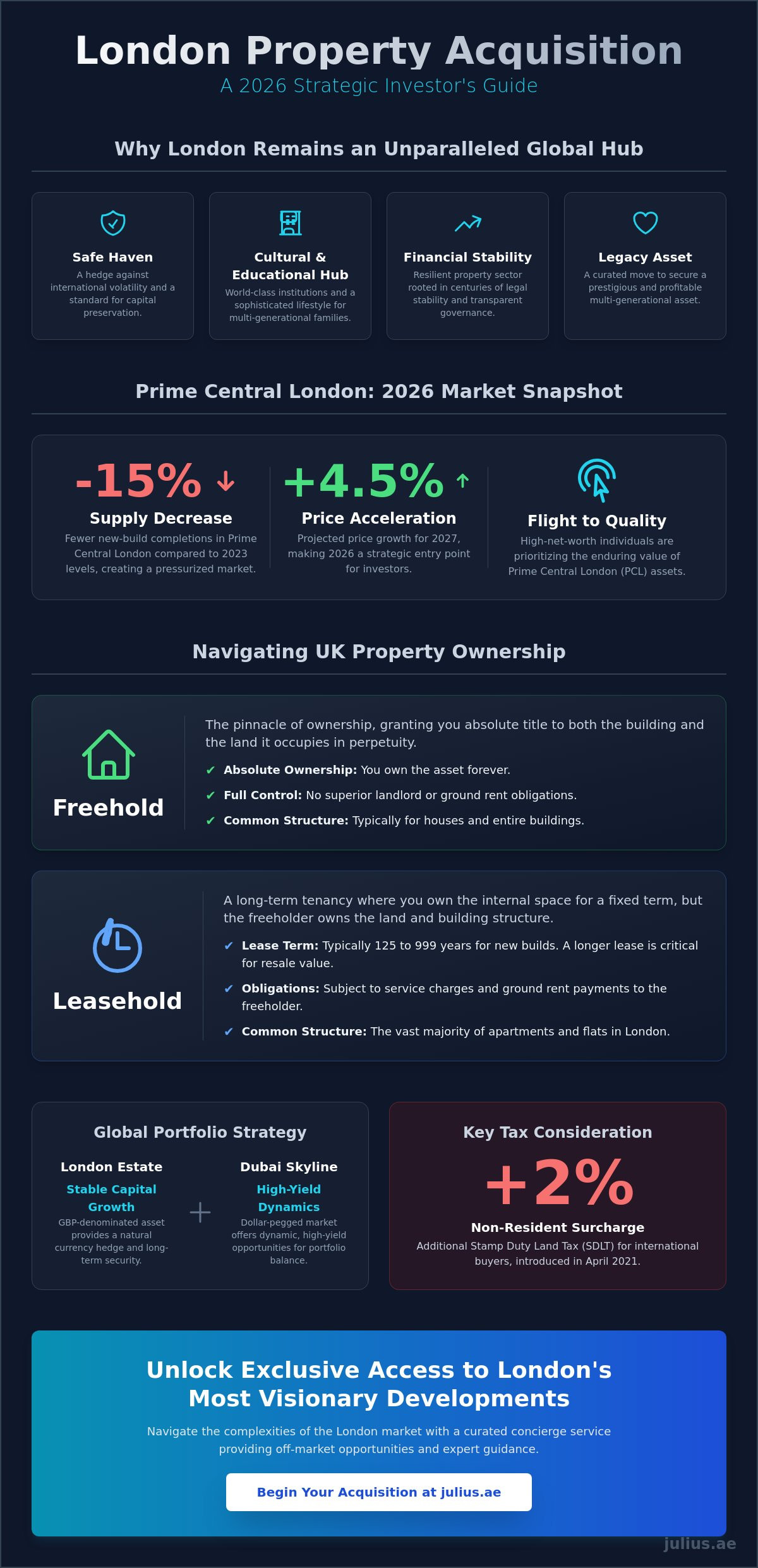
London’s status as a premier global safe haven has matured into a definitive standard for capital preservation in 2026. While other markets experience cyclical volatility, the London property sector maintains an unparalleled resilience rooted in centuries of legal stability and transparent governance. For the discerning investor, buying a second home in London isn’t merely a transaction; it’s a curated move to secure a legacy asset within a city that remains the financial and cultural heartbeat of Europe. The 2026 landscape shows a distinct “flight to quality,” where high-net-worth individuals prioritize the enduring value of Prime Central London (PCL) over the speculative yields of emerging territories.
To gain a deeper perspective on the financial nuances of this market, watch this helpful video:
The distinction between a lifestyle residence and an investment asset has blurred as we enter 2026. Modern investors demand a bespoke residence that functions as a high-performing vehicle for wealth while serving as a sophisticated base for global connectivity. London’s educational ecosystem, featuring institutions like Imperial College and LSE, continues to draw Middle Eastern families who view a second home as a multi-generational necessity. This demand is reinforced by the city’s seamless integration of historic charm and visionary infrastructure, ensuring that a property in Mayfair or Marylebone remains as prestigious as it is profitable.
London in the Global Portfolio
Strategic investors often balance the high-yield, dynamic assets found in the Dubai skyline with the stable capital growth of a London estate. This duality creates a robust financial equilibrium. Holding GBP-denominated property provides a natural currency hedge, protecting wealth against fluctuations in the dollar-pegged markets of the Gulf. The 2026 London prime market stands as a cornerstone of international diversification, providing a sophisticated hedge against the volatility of global equity markets. By integrating a London acquisition into a broader portfolio, investors achieve a seamless blend of liquidity and long-term security.
The 2026 Market Outlook
Current supply dynamics in Prime Central London reflect a 15% decrease in new-build completions compared to 2023 levels, creating a pressurized environment that favors existing owners. Urban regeneration projects, such as the final phases of the Battersea Power Station masterplan and the 2025 upgrades to the South Bank, have fundamentally shifted property values in adjacent postcodes. For those considering buying a second home in London, 2026 represents a strategic entry point before the projected 4.5% price acceleration forecasted for 2027. Investors must understand the structural framework of their acquisition; a thorough reading of English Land Law Explained reveals the vital distinctions between leasehold and freehold titles that dictate long-term value. This legal clarity, combined with restricted supply, ensures that PCL assets remain a rare and coveted commodity for the global elite.
Navigating Ownership: Leasehold, Freehold, and Share of Freehold
London’s property market operates on a legal framework that often surprises international investors accustomed to simpler systems. When buying a second home in London, you’ll encounter a hierarchy of ownership that dictates your long-term control and financial obligations. The UK system distinguishes between the land itself and the right to occupy the space above it; a nuance that requires a sophisticated approach to acquisition.
The Leasehold vs. Freehold Distinction
Freehold represents the pinnacle of ownership. It grants you absolute title to the building and the land it occupies. This structure is the hallmark of grand townhouses in Belgravia or historic estates in Hampstead. You own the asset in perpetuity. Leasehold, by contrast, is a long-term tenancy granted by the freeholder. Most luxury apartments in London’s iconic new developments are sold as leaseholds, typically with terms ranging from 125 to 999 years. While you own the internal space, the freeholder retains ownership of the structure and land.
Sophisticated buyers often seek a Share of Freehold. This hybrid model is common in period conversions where the apartment owners collectively own the freehold via a management company. It offers the security of a long lease alongside the autonomy to manage the building’s maintenance and costs without a third-party landlord. This curated approach to ownership often yields better long-term value and lower management friction.
Due Diligence for International Buyers
Your solicitor plays a pivotal role in de-risking the transaction. They must verify the unexpired lease term; any lease dropping below 80 years is a significant red flag. At this threshold, the cost to extend the lease increases dramatically due to “marriage value” calculations, which can complicate financing and depress resale liquidity. In the current 2026 market, lenders demand at least 85 to 90 years of unexpired term to offer the most competitive rates.
Financial transparency is essential when buying a second home in London. In elite developments, service charges cover the cost of bespoke amenities such as 24-hour concierge teams, private cinemas, and subterranean wellness centers. These charges are usually calculated per square foot and can range from £7 to £18 annually in prime locations. Additionally, you must factor in the Non-UK Resident Stamp Duty Rates, which include a 2% surcharge for buyers who haven’t been present in the UK for at least 183 days in the 12 months prior to purchase.
Compliance with the Building Safety Act 2022 is now a non-negotiable part of the due diligence process for high-rise residences. Your legal team must ensure the building has the necessary safety certifications to protect your capital and ensure the property remains a visionary investment. For those seeking a seamless transition into the London market, our team provides a curated selection of international opportunities that meet these rigorous standards of excellence.
Curating the Location: London’s Most Prestigious Neighborhoods
Selecting a residence in the UK capital is a deliberate act of curation. When buying a second home in London, the distinction between a simple purchase and a visionary investment lies in the specific postcode’s DNA. The 2026 market rewards investors who look beyond the surface, identifying neighborhoods where heritage value and modern lifestyle requirements converge.
The Classic Prime Central London (PCL) Choice
Mayfair and Knightsbridge remain the undisputed anchors of global wealth. These districts offer more than just high-value real estate; they provide a seat at the table of the world’s most exclusive social and financial circles. In Mayfair, the air of exclusivity is palpable, characterized by the presence of world-class galleries and the historic private clubs of Berkeley Square. Knightsbridge offers a similar level of prestige, anchored by iconic institutions and a proximity to Hyde Park that few global cities can match.
Belgravia and Chelsea represent a different facet of the PCL experience. Here, historic white-stucco facades and secluded garden squares meet a contemporary, village-like lifestyle. Choosing these areas requires a deep understanding of the art of luxury acquisition, where the architectural heritage is as critical as the property’s liquidity. Proximity to elite education, such as Imperial College London, and private members’ venues like 5 Hertford Street, continues to insulate these values. Industry data from late 2024 suggests that PCL is positioned for a cumulative price growth of 18.7 percent by 2028, making 2026 a strategic entry point for capital preservation.
Visionary New Developments and Branded Residences
Branded residences are the pinnacle of this shift. Projects associated with names like the Mandarin Oriental or the Four Seasons offer a turnkey solution that resonates with the global elite. These properties provide a “lock-up-and-leave” security that traditional homes lack. The benefits of this model are clear:
- Seamless Service: 24/7 hotel-style concierge and in-residence dining.
- Modern Wellness: Private spas, treatment rooms, and fitness suites that rival five-star resorts.
- Investment Logic: Higher rental demand for tech-enabled, managed spaces compared to unmanaged period properties.
International buyers are increasingly prioritizing these “turnkey” new builds. They offer a lifestyle that is both frictionless and prestigious, ensuring that buying a second home in London remains a cornerstone of any sophisticated global portfolio.
Financial Structuring and Tax Efficiency
Precision in capital allocation defines the successful acquisition of a London residence. While the city’s prestige remains constant, the fiscal framework surrounding entry costs and long-term holding structures requires a meticulous approach. Investors shouldn’t view the purchase price in isolation; instead, they must account for a layered tax environment that rewards early planning and expert curation.
Buying a second home in London involves a commitment to understanding the UK’s evolving regulatory landscape. The goal is to balance immediate liquidity needs with long-term wealth preservation, ensuring the asset remains a sanctuary rather than a fiscal burden. This requires a sophisticated blend of tax efficiency and robust property management.
The SDLT Framework for Second Homes
Stamp Duty Land Tax (SDLT) serves as the primary entry cost for global investors. Since 2016, a 3% surcharge has applied to the purchase of additional residential properties, specifically targeting those who already own a home elsewhere in the world. Additionally, the 2% surcharge for non-UK residents, introduced in 2021, creates a combined 5% premium over standard residential rates for international buyers.
For a £5,000,000 acquisition, a non-resident buyer faces a total SDLT liability of approximately £763,750, representing a significant effective tax rate of 15.3% that must be factored into the initial capital outlay.
Mortgages and Liquidity Management
Financing for high-net-worth individuals (HNWIs) in 2026 relies on private banking solutions that offer bespoke terms unavailable through retail channels. These institutions prioritize the client’s global balance sheet over simple income multiples, often providing interest-only options to preserve cash flow. Loan-to-Value (LTV) ratios for international investors typically range from 60% to 70%, depending on the property’s location and the borrower’s existing relationship with the bank.
Sophisticated investors often find that commercial property brokerage expertise provides a superior blueprint for residential financing. By applying commercial debt structures to residential portfolios, buyers can optimize their leverage and secure more competitive margins. This cross-disciplinary approach ensures that buying a second home in London integrates seamlessly with a broader global investment strategy.
Holding Structures and Ongoing Costs
Special Purpose Vehicles (SPVs) remain a preferred method for holding London property, particularly for those looking to manage inheritance tax exposure or facilitate future transfers. However, buyers must account for the Annual Tax on Enveloped Dwellings (ATED), which applies to properties valued over £500,000 held within a corporate structure. Beyond taxes, ongoing maintenance is essential to preserve the asset’s value.
- Council Tax: Top-tier properties in the City of Westminster or Kensington and Chelsea often fall into Band H, with annual costs exceeding £1,900, though rates vary by borough.
- Insurance: Comprehensive buildings and contents insurance for prime residences requires specialist providers who understand high-value assets and fine art collections.
- Management: Professional management fees typically range from 10% to 15% of the rental value, covering everything from tenant relations to emergency repairs.
Secure your legacy in the London market by consulting with our expert advisors at Julius.
The Julius Signature: A Curated Path to London Ownership
Securing a premium residence in the UK capital requires more than a simple transaction. It demands a partnership built on discretion and an intimate understanding of the global elite’s standards. At Julius, we transcend the traditional role of a broker. We act as your international property concierge, ensuring that buying a second home in London is a seamless extension of your lifestyle. Our approach is rooted in quiet confidence, providing a bridge between your Middle Eastern interests and the British capital’s most prestigious postcodes.
Our presence in the market grants our clients exclusive access to off-market opportunities and pre-launch developments that never reach the public eye. These “pocket listings” often represent the most desirable assets in postcodes like W1 and SW1, where demand consistently outstrips supply. For investors already managing a sophisticated UAE property portfolio, we provide a unified strategy. We align your London acquisitions with your existing holdings to balance capital growth and personal utility across borders, ensuring a cohesive global asset map.
Bespoke Sourcing and Acquisition
We identify assets by meticulously analyzing how they serve your financial objectives and your family’s needs. Whether you seek a heritage townhouse near Hyde Park or a glass-fronted penthouse in Nine Elms, our sourcing process is data-driven and highly selective. We’ve cultivated a robust network of London-based legal and tax specialists to facilitate every step. This network ensures your acquisition meets every regulatory standard without compromising your privacy or your time. Our commitment to discretion remains unparalleled, protecting your interests at every stage of the negotiation.
Managing Your Global Legacy
The journey doesn’t end when the keys are handed over. A London residence is a significant component of your global legacy, requiring constant, expert supervision. We provide comprehensive post-acquisition support, managing maintenance and security for vacant homes so they remain in pristine condition for your arrival. Our team oversees everything from routine inspections to complex interior styling projects. To see the standard of excellence we uphold, you can watch our luxury property showcases for inspiration. We treat your investment as if it were our own, ensuring buying a second home in London remains a source of pride rather than a management burden. This meticulous care preserves the long-term value of your asset, allowing you to focus on the art of living.
Mastering the London Market in 2026
The 2026 London real estate landscape demands more than just capital; it requires a surgical approach to acquisition. Success hinges on navigating the nuances of ownership structures and identifying prime opportunities in neighborhoods like Mayfair where JLL forecasts a 4.5% price growth for prime central London by 2026. Buying a second home in London remains a definitive statement of financial sophistication for the global elite. It’s a move that secures both a lifestyle asset and a resilient hedge against global volatility. We understand that your time is the ultimate luxury, which is why our approach focuses on precision and exclusivity.
Julius provides the bridge between your vision and the city’s most prestigious postcodes. Our signature service includes bespoke international portfolio management and direct access to exclusive off-market London listings that remain invisible to the general public. We bring deep expertise in high-value cross-border transactions, ensuring every detail of your investment aligns with your broader financial goals. Consult with our London Investment Experts to begin curating your UK portfolio. Your next landmark acquisition is waiting to be discovered.
Frequently Asked Questions
Can a non-UK resident buy a second home in London in 2026?
Non-UK residents can freely purchase property in London without any legal restrictions on foreign ownership. The UK remains one of the world’s most transparent and accessible markets for international capital. You’ll simply need to account for the 2% non-resident Stamp Duty surcharge that became effective in April 2021. This ensures your journey of buying a second home in London is built on a foundation of clear, predictable fiscal policy.
How much is the Stamp Duty (SDLT) for a second home in London?
Stamp Duty for a second home includes a 3% surcharge on top of the standard residential rates. If you’re a non-UK resident, an additional 2% levy applies, bringing the total surcharge to 5% above the baseline. These figures are based on HMRC’s 2024 framework and represent a significant consideration for your initial capital outlay. It’s a transparent cost that secures your place in one of the world’s most resilient economies.
What is the difference between Leasehold and Freehold in the UK?
Freehold means you own the building and the land it sits on indefinitely. Leasehold, which is common in luxury developments across Mayfair or Chelsea, grants ownership for a specific term, often 999 years for new builds. Most high-end apartments are leasehold assets managed by a superior landlord. This structure ensures the architectural integrity and bespoke communal services of the estate are maintained to an unparalleled standard over decades.
Is it better to buy a London property through a company or personally?
Buying through a limited company often benefits professional investors looking to offset mortgage interest against rental income. However, personal ownership is frequently preferred for lifestyle assets to avoid the Annual Tax on Enveloped Dwellings, known as ATED, which applies to corporate-held properties valued over £500,000. Your choice depends on whether the property is a private sanctuary or a yield-focused asset within a larger, curated investment portfolio.
What are the best areas in London for investment growth in 2026?
Investors are focusing on the Battersea Power Station district and the visionary Old Oak Common regeneration hub for 2026. Data shows that properties near major infrastructure like the Elizabeth Line continue to see price growth 5% higher than the city average. These areas offer a curated blend of capital appreciation and unparalleled modern amenities. They’re perfect for those buying a second home in London with a long-term growth perspective.
Are there restrictions on renting out a second home in London?
London enforces a 90-day annual limit on short-term rentals like Airbnb without specific planning permission from the local council. Long-term tenancies are generally unrestricted, though bespoke leasehold agreements in luxury blocks may prohibit sub-letting to protect the building’s exclusivity. It’s essential to review the head lease with a seasoned expert to ensure your rental strategy aligns with the property’s private governance and the city’s regulatory framework.
How long does the property buying process take in London for international buyers?
The property acquisition process typically spans 12 to 20 weeks for international purchasers. This timeline accounts for the bespoke due diligence required for high-value assets and the coordination of international fund transfers. Selecting an experienced solicitor familiar with global transactions can reduce this period significantly. Our role is to ensure the journey remains seamless, moving from the initial offer to the exchange of contracts with visionary precision.
What ongoing costs should I expect for a luxury London apartment?
Luxury apartments incur annual service charges ranging from £7 to £15 per square foot. These fees cover 24-hour concierge services, private wellness suites, and the meticulous upkeep of communal grounds. You’ll also need to budget for Council Tax, which varies by borough. For instance, Westminster historically offers some of the lowest rates in the city, making it a highly efficient location for maintaining a prestigious secondary residence.
Leave a Reply