

A property’s true value in 2026 isn’t found in a spreadsheet. It’s hidden in the friction between a 4.5% capitalization rate and the architectural legacy of a global financial hub. You’ve likely felt the weight of information overload as dozens of conflicting market reports flood your desk. It’s a constant challenge to balance the demand for high yields with the inherent safety of asset prestige. To analyze commercial real estate with the precision of a master curator, you must look beyond the noise of the previous decade’s volatility.
We’ll provide you with a sophisticated 7-step methodology for vetting deals that replaces uncertainty with a clear, professional framework. You’ll gain the confidence to identify high-growth assets while weighing qualitative factors like location prestige against hard financial metrics. This guide explores the essential technical pillars and the nuanced risks of international jurisdictions to ensure your next acquisition meets the Julius standard of excellence.
Key Takeaways
- Learn to distinguish between mere speculative acquisition and the art of strategic asset curation to build a resilient, high-value global portfolio.
- Discover how to precisely analyze commercial real estate by mastering critical financial DNA, including Net Operating Income and the nuanced relationship of Cap Rates.
- Understand why architectural heritage and tenant creditworthiness are the silent pillars of long-term value that transcend simple spreadsheets.
- Follow a sophisticated, step-by-step methodology to align your investment thesis with deep-dive market research and global supply-demand dynamics.
- Unlock the secrets to sourcing exclusive, off-market opportunities through a partnership that prioritizes visionary curation over standard transactions.
The Foundation of Strategic Commercial Real Estate Analysis
To analyze commercial real estate with precision in 2026, an investor must look far beyond the physical boundaries of a property. This isn’t merely a transaction. It’s a multi-dimensional vetting process that distinguishes visionary asset curation from speculative buying. While the amateur looks at current rent rolls, the strategic investor examines the property’s place within a shifting global hierarchy. Julius approaches every analysis as a master curator, ensuring that each acquisition aligns with a legacy of excellence and long-term capital preservation.
Professional analysis serves as the ultimate risk-mitigation tool for high-net-worth individuals. In a market cycle defined by a flight to quality, the ability to dissect a property’s “financial DNA” is what protects a portfolio from volatility. This rigorous standard of evaluation ensures that every investment is a deliberate step toward a curated future. It’s about quiet confidence and the security that comes from unparalleled market intelligence.
To gain a deeper understanding of the velocity behind these professional assessments, watch this expert breakdown of rapid property evaluation:
Asset Classes and Their Unique Risk Profiles
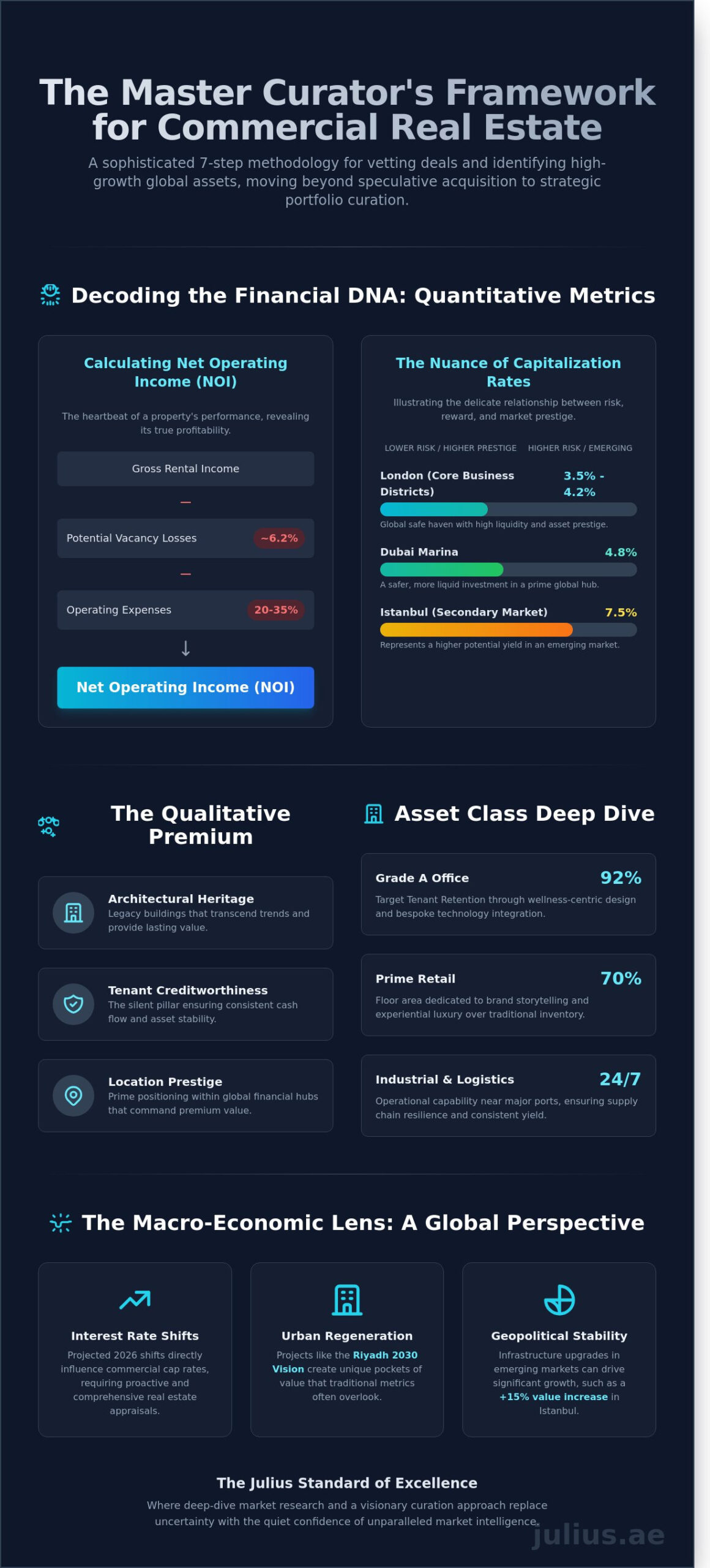
Grade A office spaces in 2026 demand a focus on 92% tenant retention through wellness-centric design and bespoke amenities. The landscape has shifted toward buildings that offer a seamless integration of technology and human-centric spaces. Prime retail has transformed into a theater of experiential luxury, where 70% of the floor area often focuses on brand storytelling rather than traditional inventory. Meanwhile, the industrial sector remains the backbone of the global supply chain. We prioritize logistics hubs with 24/7 operational capabilities and proximity to major ports to ensure consistent yield and operational resilience. Understanding the distinct characteristics of types of commercial properties is essential for building a diversified portfolio that can weather market volatility.
The Macro-Economic Lens: Beyond the Building
The broader economic climate dictates the pulse of every investment. Interest rate shifts projected for 2026 directly influence commercial cap rates, making a comprehensive real estate appraisal an indispensable part of the due diligence process. Urban regeneration projects, particularly those tied to the Riyadh 2030 Vision, create unique pockets of value that traditional metrics might overlook. We also evaluate geopolitical stability in emerging markets like Istanbul, where infrastructure upgrades are driving a 15% increase in localized property values. To analyze commercial real estate effectively, one must treat the global map as a living, breathing organism of opportunity.
Deciphering the Financial DNA: Essential Quantitative Metrics
Mastering essential quantitative metrics is the only way to truly understand the pulse of a high-stakes acquisition. You aren’t just buying brick and mortar; you’re purchasing a future cash flow stream. When you analyze commercial real estate, the numbers must tell a story of resilience and growth that transcends simple arithmetic. This financial DNA determines whether a property is a legacy asset or a liability in disguise.
Calculating Net Operating Income (NOI)
Net Operating Income is the total income generated minus all necessary operating expenses. It’s the heartbeat of property performance. Accurate forecasting requires you to look beyond the surface of gross rental income. You must factor in potential vacancy losses, which currently average 6.2% for prime logistics hubs in 2024. Identifying hidden operating expenses is where seasoned investors excel. Management fees, routine maintenance, and specialized insurance premiums often account for 20% to 35% of total revenue. Neglecting these details leads to inflated expectations and diminished returns.
The Nuance of Capitalisation Rates
Cap rates illustrate the delicate relationship between risk and reward. A 4.8% cap rate in the Dubai Marina often signals a safer, more liquid investment than a 7.5% yield in a secondary market like Istanbul. In London’s core business districts, cap rates have historically stayed between 3.5% and 4.2%; this reflects the city’s status as a global safe haven. You use these rates to estimate current market value by dividing the NOI by the market-specific cap rate. This calculation provides a baseline for a purchase that aligns with your portfolio’s risk tolerance. Our team at Julius Property excels at identifying these subtle market shifts to ensure your capital is positioned for maximum advantage.
Advanced Metrics: IRR and Equity Multiple
The Internal Rate of Return (IRR) remains the gold standard for long-term wealth projection. It factors in the time value of money, providing a clear picture of performance over a multi-year hold strategy. While Cash-on-Cash return measures the immediate efficiency of your deployed capital, the equity multiple shows the total cash return over the entire investment lifecycle. Leverage remains a critical variable. Mortgage brokerage fees and loan-to-value ratios, which typically sit at 60% for international investors in the UAE, significantly impact your final yield. By analyzing these metrics through a 2026 lens, you can anticipate how shifting interest rates will influence your total equity multiple upon exit. Understanding how debt service interacts with your IRR is essential for a truly visionary investment strategy to analyze commercial real estate effectively.
The Qualitative Premium: Why Numbers Aren’t Everything
To truly analyze commercial real estate for the 2026 market, an investor must adopt the lens of a Master Curator. While spreadsheets provide the skeleton of a deal, the qualitative elements provide its soul. Architectural significance and heritage are no longer mere aesthetic choices; they’re defensive moats. A building designed by a Pritzker Prize winner or one that preserves a city’s historical narrative often commands a 15% valuation premium over generic glass towers. Julius recognizes that these bespoke assets don’t just house businesses; they curate a brand’s identity and inspire confidence in stakeholders.
Location rarity remains the ultimate arbiter of value. There’s a profound difference between a prestigious address and a visionary one. A visionary location anticipates infrastructure shifts, such as the 2025 expansion of the Dubai Metro Blue Line, which is projected to increase nearby commercial land values by 22% before the first train even runs. Investors must also weigh the impact of ESG mandates. By 2026, green certifications aren’t optional. GRESB data indicates that buildings with LEED Platinum ratings see 10% higher occupancy rates because multinational tenants now have strict carbon-neutral targets to hit by 2030.
The Power of the Anchor Tenant
The strength of a lease isn’t found in the rent per square foot but in the creditworthiness of the name on the door. We prioritize multinational corporations over local startups because their balance sheets weather economic cycles. A critical metric is the Weighted Average Lease Term (WALT). Securing a WALT of 7.5 years or more can lower financing costs by 50 basis points. Additionally, the rise of branded residences and luxury hospitality, like the Dorchester Collection’s integration into commercial hubs, creates a synergy that boosts footfall by 30% compared to standalone assets.
Physical Due Diligence and Obsolescence
Physical integrity defines the longevity of your capital. Older assets often face “brown discounts” if they aren’t future-proofed for 2026 technology standards. Retrofitting a 20 year old tower for ultra-high-speed connectivity and AI-driven climate control can cost $150 per square foot; failing to do so leads to terminal vacancy. The wellness premium is another tangible factor. Modern office spaces that maximize 90% natural light penetration and utilize HEPA-filtered air systems attract elite tenants willing to pay 12% higher rents. Architecture must serve the human experience to remain relevant.
A Step-by-Step Methodology for Commercial Asset Evaluation
Precision in acquisition distinguishes the visionary investor from the speculator. To effectively analyze commercial real estate in the 2026 climate, you must adhere to a disciplined, five-stage framework that prioritizes data integrity and long-term viability. This methodology ensures every asset aligns with a bespoke portfolio strategy rather than mere market momentum.
- Step 1: Define your investment thesis. Establish clear parameters for risk tolerance, whether you’re seeking a 6.5% stable yield in core assets or 15% internal rates of return through value-add opportunities.
- Step 2: Conduct deep-dive market research. Move beyond surface metrics to examine 10 year absorption rates and micro-location shifts.
- Step 3: Perform a rigorous financial audit. Validate every line item in the historical ledger to ensure projected cash flows are grounded in reality.
- Step 4: Execute physical and legal due diligence. Partner with elite structural engineers and legal counsel to uncover hidden liabilities.
- Step 5: Finalize the management plan. A property is only as successful as its operational strategy; define your exit or hold timeline before the capital is deployed.
Phase One: Market and Financial Scrutiny
Success begins with an unyielding audit of the numbers. You must scrutinize rent rolls and 36 month service charge histories to identify discrepancies that could erode your margins. Using high-performing benchmarks like commercial property for sale Dubai allows investors to measure regional performance against global standards. By 2026, the local supply pipeline is expected to deliver 4.2 million square feet of new office space; understanding how this competition impacts your specific asset is vital. Analyzing these supply-demand dynamics prevents over-leveraging in saturated sub-sectors. When evaluating different types of commercial properties, it’s crucial to understand how each asset class responds to market cycles and technological disruption.
Phase Two: The Due Diligence Checklist
The final layer of protection involves a technical deep dive. In international hubs, zoning laws and land-use restrictions can shift rapidly; ensuring your asset remains compliant with 2026 environmental standards is a prerequisite for institutional-grade investing. You must assess structural integrity and ESG compliance to avoid future capital expenditure shocks. Transparent, expert guidance during this closing phase is what separates a seamless transaction from a costly error. When you analyze commercial real estate, the quality of your advisory team is your strongest hedge against market volatility.
Ready to secure your position in the global market? Explore bespoke commercial opportunities with Julius and leverage our signature standard of investment excellence.
Navigating Global Markets with Julius Property
Julius Property acts as a visionary partner. We transform the way sophisticated investors approach the market by moving beyond the role of a traditional brokerage. Our team functions as a master curator of the Dubai and European skylines, identifying assets that align with both your financial goals and your standard of living. We understand that premium investments require more than a standard search; they demand a bespoke strategy. Our approach involves a deep dive into off-market commercial opportunities that never reach the public eye. These exclusive listings provide a competitive edge for those looking to build a resilient, high-yield portfolio before the 2026 market shift.
We bridge the gap between aesthetic appreciation and financial intelligence. Every architectural masterpiece we represent is backed by rigorous data and a clear path to appreciation. When you analyze commercial real estate through our lens, you see beyond the glass and steel. You see the long-term yield potential and the intrinsic value of a rare asset. Our bespoke investment consultancy ensures that you aren’t just buying a property; you’re securing a legacy. We balance the emotional appeal of luxury with the cold logic of market dynamics, ensuring your capital is positioned for maximum growth.
Our Global Reach: From Dubai to London
Accessing high-value developments in the Middle East and Europe requires a nuanced understanding of local regulations and cultural shifts. We maintain a constant presence in key financial hubs, providing seamless access to prime assets in the Dubai International Financial Centre and London’s most prestigious commercial districts. Our local knowledge informs our international property sourcing, allowing us to identify emerging trends before they become mainstream. In 2024, prime office rents in Dubai rose by 7% annually. We used these specific metrics to guide our clients toward high-performing districts like Business Bay and Downtown Dubai. The Julius standard rests on transparency, expertise, and a level of service that mirrors the prestige of the properties we manage.
Your Next Step in Commercial Excellence
Securing your financial future requires a partner who understands the complexities of the 2026 investment environment. We invite you to a private consultation to discuss your portfolio diversification goals in a discreet, professional setting. Our service goes beyond the transaction. We offer integrated mortgage advisory to help you secure optimized commercial financing, ensuring your leverage is as efficient as your asset selection. Our advisors help you analyze commercial real estate opportunities with a focus on risk mitigation and capital preservation. This unhurried, thorough process is designed to align with your personal aspirations and professional requirements.
- Private consultations for tailored portfolio growth
- Access to exclusive, off-market commercial inventory
- Expert mortgage advisory for complex commercial structures
- Strategic insights into Dubai and London market cycles
Discover how we analyze commercial real estate to secure your financial legacy.
Mastering the 2026 Commercial Landscape
Success in the upcoming 2026 market cycle demands a departure from traditional, one-dimensional evaluation methods. To truly analyze commercial real estate with precision, you must harmonize rigorous quantitative metrics with the qualitative nuances of architectural rarity and location prestige. This dual-layered framework ensures that every acquisition isn’t just a transaction, but a strategic cornerstone for a resilient portfolio. Data from our 2024 market intelligence reports suggests that investors who integrate these visionary insights across Dubai, Riyadh, and London are better positioned to navigate the shifts expected in the next fiscal cycle.
Julius Property serves as your master curator in this complex environment. We provide expert guidance across the globe’s most competitive markets, offering our clients exclusive access to off-market commercial assets that remain invisible to the broader public. Our sophisticated mortgage and investment advisory services are designed to streamline your path to ownership while maintaining the highest standards of discretion. It’s the level of bespoke service that high-net-worth individuals require to secure their financial legacy.
Begin your curated investment journey with Julius Property
The future of global commerce is yours to command.
Frequently Asked Questions
What is the most important factor when you analyze commercial real estate?
When you analyze commercial real estate, the most critical factor is the stability and quality of the Net Operating Income (NOI). This metric represents the property’s ability to generate cash flow after operating expenses but before debt service. In the 2026 market, elite investors prioritize assets with a 95% occupancy rate and tenants holding investment-grade credit ratings. A predictable income stream ensures the property’s long-term valuation remains resilient against global market fluctuations and economic shifts.
How do I calculate the cap rate for a commercial building?
You calculate the capitalization rate by dividing the annual Net Operating Income by the current market value or purchase price. For instance, a bespoke office tower in Dubai generating $1,200,000 in NOI with a valuation of $20,000,000 results in a 6% cap rate. This figure allows you to compare the relative value of diverse assets with precision. It’s a fundamental snapshot of the property’s unleveraged yield, providing a clear benchmark for your investment’s immediate performance.
What is a good IRR for a commercial property investment in 2026?
A competitive Internal Rate of Return (IRR) for a core-plus commercial investment in 2026 typically ranges between 12% and 15%. High-net-worth investors seeking value-add opportunities in emerging districts often target 18% or higher to account for development risks. These figures reflect the total anticipated return over a 7 year holding period. Your target should align with your specific risk tolerance and the property’s unique position within the global market to ensure consistent growth.
How does commercial real estate analysis differ from residential?
Commercial analysis focuses on income generation and lease structures, whereas residential evaluation relies heavily on comparable sales and lifestyle aesthetics. Commercial leases often span 10 years with triple-net terms, shifting maintenance costs to the tenant. Residential properties typically operate on 12 month cycles and require more intensive management. This distinction requires a shift from emotional appeal to a rigorous, data-driven assessment of corporate tenant reliability and sector-specific trends that define the Dubai skyline.
What are the risks of investing in international commercial property?
Currency volatility and shifting regulatory frameworks represent the primary risks in international commercial acquisitions. A 12% shift in exchange rates can erode your annual yields if you don’t employ sophisticated hedging strategies. Geopolitical stability in markets like the UAE provides a contrast to more volatile regions where legal protections for foreign owners might change. Success requires a curated approach that balances global diversification with deep local expertise to navigate these complex, high-stakes variables.
Should I use a professional investment consultant for my analysis?
Engaging a professional consultant is essential for accessing off-market opportunities and ensuring technical precision in your underwriting. Approximately 35% of premium commercial transactions in Dubai occur through private channels before reaching the public market. A specialist provides a bespoke service, identifying hidden risks and negotiating lease terms that protect your capital. Their visionary perspective transforms a standard transaction into a curated investment that aligns with your broader financial legacy and the art of living.
How does the 2026 market cycle affect property valuations?
The 2026 market cycle emphasizes technological integration and environmental sustainability, which now command a 15% valuation premium over traditional assets. Properties lacking smart-building infrastructure or high ESG ratings face faster depreciation as corporate tenants demand modern, efficient workspaces. You must analyze commercial real estate through this lens to ensure your portfolio remains relevant. This cycle rewards investors who prioritize future-proofed assets that meet the evolving, sophisticated standards of global commerce and luxury.
Leave a Reply