
The most profound luxury in property isn’t found in a marble foyer; it’s the quiet confidence that your capital is anchored in a resilient ecosystem. You’ve likely questioned, is it safe to invest in Dubai real estate as the market enters this sophisticated 2026 cycle. It’s a prudent hesitation shared by those who view property as a legacy rather than a mere transaction. We agree that true security requires more than just a signature; it demands a deep alignment with the region’s evolving legal safeguards and the stringent oversight of the Dubai Land Department.
This guide provides the clarity you require, detailing the regulatory protections and market dynamics that define the high-end sector today. You’ll discover a strategic framework for selecting assets that offer both aesthetic brilliance and institutional-grade safety. We examine the 2025 developer accountability mandates and revised escrow protocols to ensure your next move is as secure as it is visionary.
Key Takeaways
- Understand how the Dubai Land Department and mandatory escrow accounts provide unparalleled transparency and capital protection for sophisticated investors.
- Examine the market’s transition from a speculative era to a mature global hub to understand why is it safe to invest in Dubai real estate in the current economic landscape.
- Discover why the “Luxury Gap” ensures sustained 7-10% net yields in prime districts, even as mass-market supply dynamics fluctuate.
- Master a strategic framework for risk mitigation by prioritizing developer track records and the long-term viability of master-planned communities.
- Learn how to transition from transaction-based buying to a curated portfolio approach that identifies undervalued luxury assets through the Julius lens.
The Evolution of Security: Dubai’s Real Estate Maturity in 2026
For decades, the global perception of the Emirates was defined by rapid, speculative growth. By 2026, that narrative has fundamentally changed. The history of Dubai’s real estate market reveals a journey from a high-yield frontier to a regulated, institutional-grade environment. Investors no longer ask if their title deed is valid; they ask which specific districts will outperform the 5% market average. The question of is it safe to invest in Dubai real estate has evolved from a concern about legal protections to a sophisticated analysis of asset-specific performance.
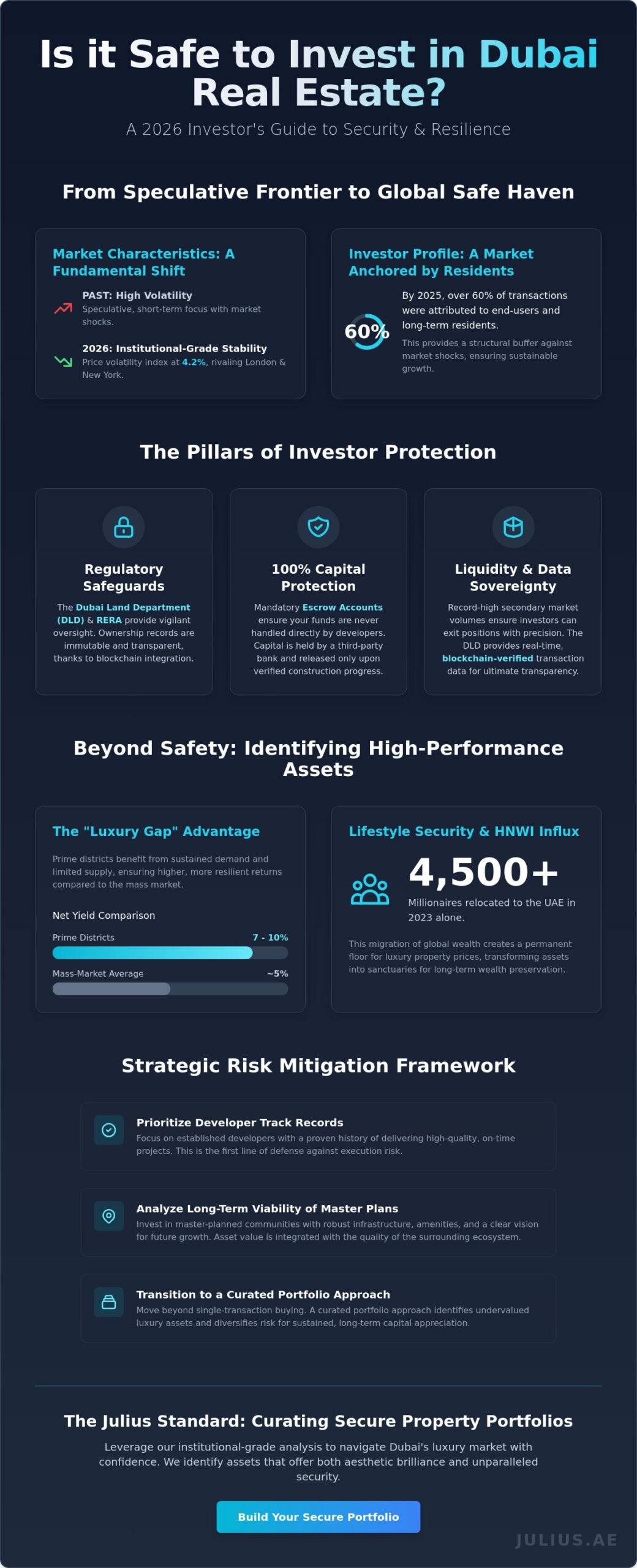
In 2026, Dubai’s price volatility index sits at 4.2%, a figure that rivals traditional safe havens like London or New York. This stability stems from the UAE’s strategic neutrality and the 10-year Golden Visa program. By 2025, over 60% of transactions were attributed to end-users and long-term residents. This shift provides a structural buffer against market shocks, as the city is no longer a playground for short-term flippers. It’s a home for global capital.
Defining “Safe” in the 2026 Global Context
Market safety is the intersection of regulatory transparency and economic liquidity. Following the UAE’s removal from the FATF grey list in February 2024, the flow of institutional capital has accelerated. Dubai’s inclusion in major global financial indices ensures that every luxury property in the UAE is backed by rigorous reporting standards. Political neutrality acts as a shield, protecting international wealth from the fiscal instability seen in other major economies. Safety is now found in the following pillars:
- Escrow Protection: 100% of investor funds are held in government-monitored accounts, a standard enforced since the late 2010s.
- Liquidity: Secondary market volumes reached record highs in 2025, ensuring investors can exit positions with precision.
- Data Sovereignty: The Dubai Land Department provides real-time, blockchain-verified transaction data.
The Aspirational Shift: Beyond ROI to Lifestyle Security
The influx of high-net-worth individuals (HNWIs) has created a permanent floor for luxury property prices. Wealthy families are moving to the city not just for tax efficiency, but for personal security and the “art of living.” When considering is it safe to invest in Dubai real estate, one must look at the 4,500 millionaires who relocated to the UAE in 2023 alone, a trend that intensified through 2025. This migration transforms property from a mere line item into a sanctuary. Asset value is now naturally integrated with the quality of the surrounding ecosystem, from bespoke concierge services to visionary architectural standards. Dubai has become a safe haven for wealth preservation amidst global currency fluctuations, offering a curated experience that few other cities can replicate.
Regulatory Safeguards: How the DLD and RERA Protect Your Capital
The transition of Dubai from an emerging market to a global financial fortress is anchored in its rigorous legislative framework. When global families ask, is it safe to invest in Dubai real estate, the answer lies in the institutional maturity of the Dubai Land Department (DLD). This entity acts as the ultimate guarantor of title deed transparency; it ensures that every square foot of your investment is registered with absolute precision. By 2026, the integration of blockchain technology within the DLD has reached a point where ownership records are immutable, providing a level of security that rivals or exceeds traditional European markets.
The Real Estate Regulatory Agency (RERA), the regulatory arm of the DLD, maintains a vigilant oversight of developer performance. This isn’t merely administrative; it’s a proactive defense of your capital. RERA mandates that every developer meets strict financial and construction criteria before they can even market a project. For international investors, the legal framework for foreign ownership in designated Freehold areas provides 100 percent ownership rights, effectively removing the barriers that once complicated cross-border acquisitions.
The Off-Plan Protection Framework
Investing in vision requires more than just trust; it requires structural certainty. Dubai’s mandatory Escrow account system ensures that your funds are never handled directly by the developer for general expenses. Instead, capital is held by a third-party bank and released only upon the completion of verified construction milestones. This system eliminates the risk of fund misappropriation, making the “off-plan” route a cornerstone of sophisticated portfolio growth.
To further secure your position, the “Oqood” system requires the registration of your initial purchase agreement with the government immediately. This digital certificate acts as a pre-title deed, protecting your rights from the moment you sign the contract. For those looking to master this specific asset class, exploring our insights on off-plan property investments will provide the granular strategy needed for 2026.
Dispute Resolution and Investor Rights
The efficiency of the Dubai legal system is a primary reason why is it safe to invest in Dubai real estate is no longer a question of “if,” but “how.” The Rental Dispute Center (RDC) and specialized real estate courts offer a streamlined process for resolving conflicts, often reaching settlements in less than 30 days. These courts protect you against arbitrary rent increases and provide clear recourse if a developer faces delays.
The 2026 regulatory landscape favors the investor more than ever. New transparency laws now require developers to provide real-time construction updates through a centralized government app, ensuring you are never in the dark about your asset’s progress. This curated approach to regulation creates a seamless experience for those who demand excellence. To see how these protections apply to the current market, you may wish to browse our curated UAE portfolio and witness the standard of luxury we represent.
Analyzing Market Resilience: Addressing Oversupply and ROI
The question of whether is it safe to invest in Dubai real estate often centers on the fear of oversupply. Sophisticated investors recognize that the market isn’t a monolith. While the mass-market segment sees frequent handovers, the ultra-luxury tier faces a profound scarcity known as the Luxury Gap. Demand for bespoke, high-end residences continues to outpace the delivery of truly exceptional properties. We see this specifically in the shortage of ready-to-move-in penthouses and beachfront villas.
Historical data confirms the resilience of this asset class. In prime districts, net yields of 7% to 10% remain achievable, providing a robust cushion against global economic shifts. This performance is anchored by the UAE’s strategic move away from oil. Non-oil GDP growth reached 5.9% in the first half of 2023, signaling a diversified economy that protects property values over the long term. Branded residences also play a pivotal role. These curated partnerships with global luxury brands ensure superior price retention and enhanced resale liquidity compared to unbranded counterparts.
- Scarcity of prime waterfront land in established hubs.
- High demand from a record influx of high-net-worth individuals.
- Tax-efficient rental income structures that maximize net returns.
Prime vs. Secondary Markets
Dubai Marina and Downtown operate under unique constraints. Land in these iconic hubs is nearly exhausted. This makes existing luxury apartments highly supply-constrained. Scarcity drives capital appreciation that secondary markets in newer, inland developments rarely match. Land is exhausted. For those seeking curated area insights, exploring luxury apartments for sale in Dubai reveals why location remains the ultimate arbiter of value. The capital appreciation potential in Dubai’s core remains significantly higher than in neighboring emirates due to this concentration of global lifestyle infrastructure.
The 2026 Liquidity Factor
Exiting an investment is as critical as the entry. The secondary market in Dubai has matured, with transaction speeds hitting record highs in 2024. Institutional investors and REITs now provide a stabilizing floor, ensuring the market remains active even during global cooling periods. It’s a seamless transition from asset to cash when the timing is right. Liquidity is the ultimate measure of investment safety. This fluidity transforms a brick-and-mortar asset into a flexible financial instrument for the visionary investor. When you choose the right district, you don’t just buy a home; you secure a liquid position in a global financial hub.
Strategic Risk Mitigation: A Due Diligence Framework
Sophisticated investors recognize that the question isn’t merely whether the market is secure, but how one navigates it with precision. While historical data suggests the environment is stable, the answer to is it safe to invest in Dubai real estate often depends on the rigor of your entry strategy. True security is found in the details of the developer’s history and the long-term vision of the surrounding infrastructure. It’s about moving beyond the glossy brochure to examine the underlying structural integrity of the deal.
Vetting the Developer
A builder’s track record is your most reliable safeguard. You should prioritize developers who’ve navigated multiple market cycles, such as the 2008 global correction or the 2020 shifts. Government-backed giants offer a different risk profile compared to private boutique firms that specialize in ultra-luxury niches. Before committing, review their delivery timelines from the last five years and verify their escrow account compliance through the Dubai Land Department (DLD) Rest app. For a broader perspective on the regional landscape, consult our UAE property country page to understand how developer reputations influence capital appreciation.
- Analyze the percentage of projects delivered on time versus delayed.
- Verify the quality of finishing in buildings completed three to five years ago.
- Check for active litigation or unresolved maintenance issues in existing portfolios.
- Confirm that all project payments are directed into RERA-approved escrow accounts.
Infrastructure and Master Plans
While many wonder is it safe to invest in Dubai real estate during phases of rapid growth, the safety lies in the government’s 2040 Urban Master Plan. This blueprint dictates where future green spaces, transport links, and commercial hubs will emerge. Buying into a master-planned community managed by a single entity reduces the risk of “ghost projects” or fragmented development. You must also investigate the “No Objection Certificates” for neighboring plots. This prevents the common pitfall of a pristine sea view being obstructed by a new skyscraper within 24 months. Beyond the purchase price, account for the 4% DLD fee and ongoing service charges, which can range from 15 to 30 AED per square foot in premium districts like Downtown Dubai.
For ready-to-move assets, professional third-party inspections are non-negotiable. These specialists identify latent structural defects or MEP (Mechanical, Electrical, Plumbing) issues that aren’t visible during a standard viewing. This technical audit ensures your investment isn’t compromised by hidden maintenance liabilities. If you’re ready to secure an asset that meets these elite standards, contact our advisory team for a curated portfolio review.
The Julius Standard: Curating Secure Property Portfolios
Investing in high-tier property requires more than just liquid capital; it demands a fundamental shift from transactional logic to a philosophy of curation. Many investors approach the market as a series of isolated purchases. We view it as the construction of a legacy. When clients ask is it safe to invest in Dubai real estate, the answer depends entirely on the rigor of the selection process. Julius doesn’t just broker deals. We act as a Master Curator, identifying undervalued luxury assets that the broader market often overlooks. This ensures your entry point is as secure as your eventual exit strategy.
The 2026 market presents a unique set of variables. Supply in the ultra-luxury segment remains constrained, while global demand from high-net-worth individuals continues to climb. To secure a portfolio in this environment, you need a partner who understands that a property’s value isn’t just in its square footage. It’s in the architectural pedigree, the protection of the view, and the exclusivity of the community. We bridge the gap between cold financial metrics and the aesthetic nuances that drive long-term desirability.
Why Professional Guidance is Non-Negotiable
Buying directly from a developer might seem convenient, but it’s often a tactical error for the sophisticated investor. Developers are incentivized to move their own inventory. They won’t tell you if a competing project next door will block your sea view in 2027. They won’t highlight the historical maintenance issues of their previous builds. Without independent representation, you lack the critical vetting of construction quality and delivery timelines. Our network provides access to exclusive, pre-market opportunities that never reach public listings, allowing you to buy in before the hype drives prices upward. We employ a rigorous methodology detailed in our guide on the art of the acquisition to ensure every asset justifies its price tag.
Your Visionary Partner in Dubai
Security in the 2026 market is found in the details of management. Professional property management serves as the final layer of your investment security. It ensures your asset remains in peak condition while maximizing net yields through high-quality tenant placement. We don’t just find a property; we manage the lifecycle of the investment. This holistic approach is why a significant portion of our clients return for second and third acquisitions. We focus on the “art of living” as much as the “art of the deal.”
True safety comes from a partner who understands that is it safe to invest in Dubai real estate is a question of who you trust to navigate the nuances. Experience a seamless investment journey by scheduling a curated consultation for your 2026 portfolio today. Let us transform your vision into a tangible, secure reality. Our team is ready to provide the professional expertise your capital deserves as you explore the most prestigious UAE property opportunities currently available.
Securing Your Legacy in the Dubai Skyline
By 2026, the landscape of the Emirates has transformed into a global benchmark for regulatory excellence. The Dubai Land Department’s integrated systems and RERA’s stringent escrow mandates ensure that the question of whether is it safe to invest in Dubai real estate is met with a resounding yes for the informed investor. Data from the 2025 fiscal year demonstrates that Tier-1 branded residences continue to outperform broader market averages, offering a rare combination of capital preservation and lifestyle prestige. These regulatory safeguards provide a foundation of trust that didn’t exist in previous cycles.
Julius serves as your visionary partner in this sophisticated market. We don’t just facilitate sales; we curate legacies. Our team delivers a bespoke experience, blending international market standards with an intimate knowledge of the city’s most exclusive postcodes. Secure your curated Dubai investment with Julius Property and leverage our exclusive access to Tier-1 branded residences, expert consultancy with an international perspective, and seamless end-to-end acquisition and management services. Your journey toward a refined global portfolio begins with a single, decisive step.
Essential Insights for the Sophisticated Investor
Is it possible for a foreigner to lose their property in Dubai?
Foreigners cannot lose their property when they purchase in designated freehold zones. Under Law No. 7 of 2006, non-residents gain absolute ownership rights for an indefinite period. These rights are registered officially with the Dubai Land Department, ensuring your title deed is as secure as any global financial hub. It’s a system designed for the international elite who demand ironclad security for their capital.
How does the Dubai Land Department protect off-plan investors in 2026?
The Dubai Land Department enforces Law No. 8 of 2007, which requires every developer to use a project-specific escrow account. All investor funds are held by an independent trustee and only released as construction milestones are verified by government inspectors. This 100% protection of capital ensures your investment is used solely for the creation of your property. It’s a transparent process that eliminates financial misappropriation.
Are there any property taxes for international investors in the UAE?
Dubai maintains a highly attractive tax environment with 0% personal income tax and 0% capital gains tax on residential property. Investors are only required to pay a one-time 4% transfer fee to the Dubai Land Department at the time of purchase. This fiscal policy allows you to retain the entirety of your rental yields and appreciation. It’s a significant advantage over high-tax jurisdictions in Europe or North America.
What happens if a developer fails to finish a project?
RERA provides a robust safety net through Decree No. 33 of 2020 if a project faces cancellation. A specialized liquidation committee is tasked with protecting your interests and ensuring the return of funds from the escrow account. In many cases, the government facilitates a transfer to a more capable developer to ensure completion. You aren’t left stranded; the regulatory framework is built to safeguard your equity.
Is there a risk of a real estate bubble in Dubai in 2026?
Market data from the 2024 UBS Global Real Estate Bubble Index classified Dubai as fair-valued, indicating a healthy distance from bubble territory. This suggests the growth seen leading into 2026 is driven by genuine demand rather than speculation. Many sophisticated buyers ask is it safe to invest in Dubai real estate today. The answer lies in the city’s 3.3% annual population growth, which continues to outpace new housing supply.
Can I manage my Dubai investment property while living abroad?
You can seamlessly manage your portfolio from anywhere in the world through RERA-licensed property management firms. These professionals handle everything from tenant vetting and contract renewals to maintenance and rent collection via the digital Ejari system. Most high-net-worth investors utilize these bespoke services to ensure their assets perform optimally without requiring their physical presence. It’s a hands-off experience tailored for the global citizen.
Is the Dubai Golden Visa still linked to property investment?
The Golden Visa remains a cornerstone of the UAE’s residency strategy for property owners. You qualify for a 10-year renewable residency when you invest a minimum of 2 million AED in real estate. This visa isn’t just a residency permit; it’s an invitation to a lifestyle of security and prestige. It allows you to sponsor family members and domestic staff, creating a permanent base in a global crossroads.
What is the “Oqood” and why is it vital for my safety?
Oqood is a mandatory digital registration system for all off-plan properties in Dubai. This certificate acts as a temporary title deed that registers your ownership interest during the construction phase. It’s a critical reason why it is safe to invest in Dubai real estate. By recording the transaction in the government’s central database, the system prevents any possibility of double-selling and ensures the developer adheres to the agreed contract.
Leave a Reply