

What if the most successful investors in 2026 aren’t chasing the lowest entry price, but rather the most sophisticated exit strategy? You likely recognize that parking substantial capital in a non-yielding asset for 36 months feels counterintuitive to true wealth preservation. It’s a valid concern, as traditional off-plan payment plans often demand 30% upfront liquidity that could be working harder elsewhere in your portfolio. We understand the hesitation of seeing your resources remain static while the skyline evolves.
This guide reveals how to leverage bespoke financial structures to maximize your ROI and secure high-yield assets without sacrificing your current liquidity. You’ll discover how the evolution of 40/60 and 50/50 payment milestones provides a strategic hedge against market volatility. We’ll explore the specific regulatory shifts and cross-border payment protocols that ensure your acquisition of premium branded residences is both seamless and secure. By the end, you’ll possess a visionary roadmap for mastering capital efficiency in the modern era of luxury real estate.
Key Takeaways
-
Understand the evolution of the 2026 financial landscape, focusing on how mature 60/40 and 70/30 structures serve as strategic roadmaps for capital efficiency.
-
Distinguish between construction-linked and time-linked off-plan payment plans to align your capital outlays with project milestones and personal cash flow.
-
Learn to synchronize your liquidity profile with your intended exit strategy, whether targeting the agility of a "flip" or the sustained yield of a long-term hold.
-
Navigate the robust regulatory environment of 2026, leveraging RERA-mandated escrow accounts to ensure your investment remains protected and transparent.
-
Discover how the Julius Standard of bespoke consultancy provides a curated approach to matching exclusive opportunities with your visionary investment goals.
Table of Contents
Decoding the 2026 Off-Plan Payment Landscape
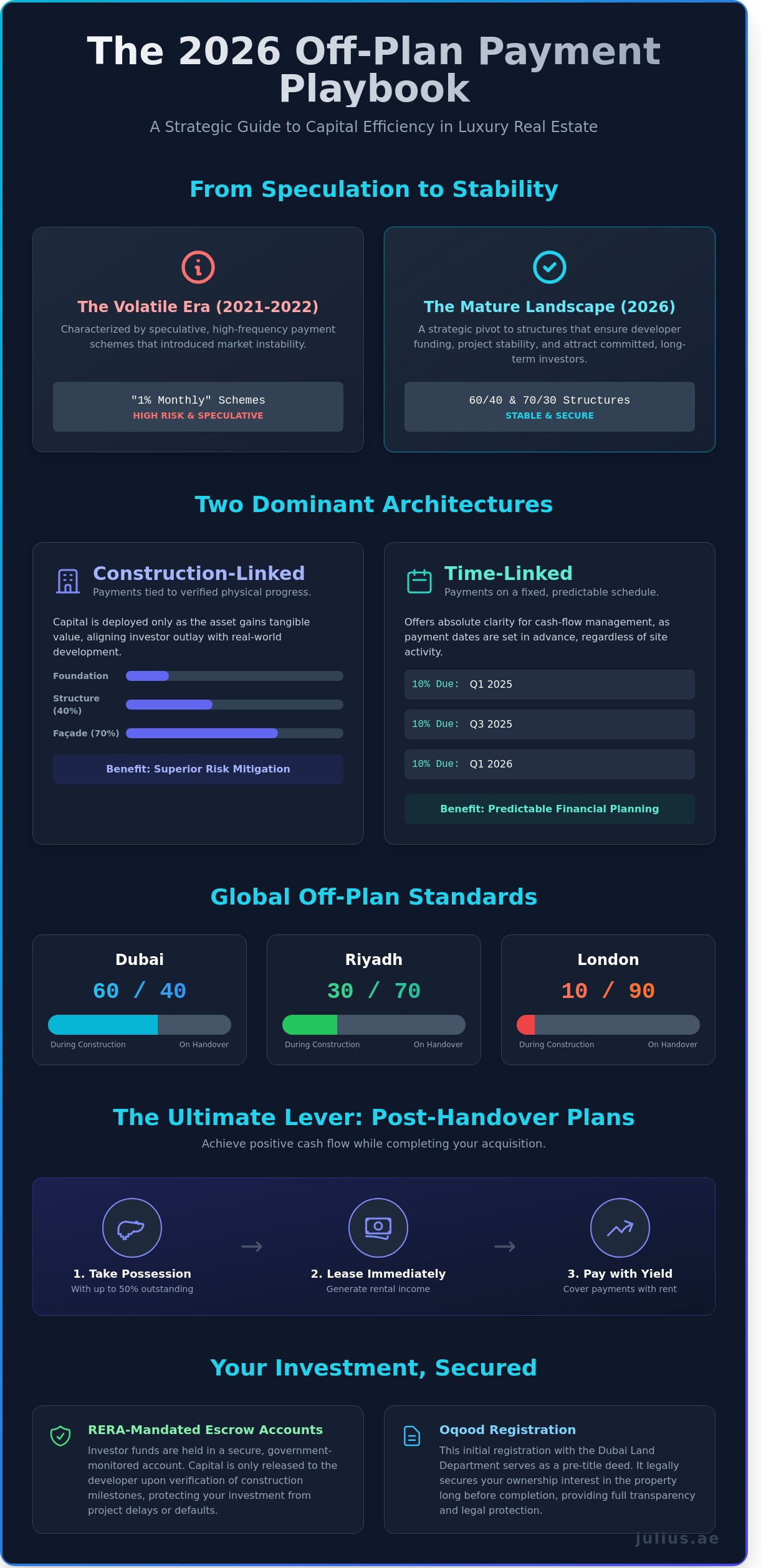
Off-plan payment plans serve as sophisticated financial blueprints for acquiring premium real estate assets before their physical completion. At its core, understanding what is off-plan property involves recognizing it as a contract for a future residence, where the payment structure acts as a bridge between vision and reality. In the 2026 landscape, we’ve witnessed a definitive transition toward 60/40 and 70/30 structures. These models ensure that capital appreciation cycles align perfectly with construction milestones, protecting your equity as the project matures.
Developers in global hubs like Dubai have largely abandoned the speculative 1% monthly schemes that characterized the volatile periods of 2021 and 2022. This pivot reflects a desire for market stability. By requiring higher percentages during the construction phase, developers filter for committed investors, which effectively reduces the risk of mass defaults and protects the long-term valuation of the development. It’s a strategic evolution that favors the serious collector over the short-term flipper.
To better understand the nuances of these financial structures, watch this detailed comparison:
The Core Concept of Phased Deployment
Acquiring property through off-plan payment plans is akin to a pre-IPO investment in the equity markets. It offers a curated entry point into high-growth districts without the immediate requirement of full capital lock-up. Typically, the journey begins with a 5% booking fee, followed by a 15% down payment within 30 days. This phased deployment allows you to diversify your liquidity across multiple bespoke assets, rather than sinking the entire purchase price into a single finished unit. It’s about maintaining agility while securing a visionary piece of the skyline.
Why 2026 Demands a Sophisticated Approach
The current market maturity has shifted leverage back toward developers who prioritize project completion quality over rapid sales volume. While London often utilizes a 10/90 structure and Riyadh is rapidly adopting a 30/70 model, the Dubai standard has settled into a rhythmic 60/40 split. This balance ensures the developer is well-funded to meet 2026 sustainability and smart-home integration standards. A 2026 payment plan is a tool for risk-adjusted capital deployment.
The Mechanics of Modern Payment Structures
Selecting the right financial framework is as critical as the property’s floor plan. Today’s off-plan payment plans are designed to balance developer liquidity with investor security. In the luxury segment, two primary architectures dominate the market: construction-linked and time-linked models. Each offers distinct advantages depending on whether your priority is risk mitigation or predictable capital scheduling.
Construction-Linked vs. Time-Linked
Construction-linked plans offer a sophisticated safeguard by tying disbursements to physical progress. An investor might pay 10% at the 20% construction milestone, verified by independent consultants. This structure aligns perfectly with the RERA investor protection framework, ensuring capital is deployed only as the asset gains tangible value. Time-linked plans operate on a fixed calendar. They provide absolute clarity for cash-flow management, as you’ll know exactly when the next 5% or 10% is due regardless of site activity. Both paths culminate in the Oqood registration, the pre-title deed that secures your legal interest in the Dubai Land Department system long before the keys are handed over.
Post-Handover Luxury: The Ultimate Lever
For high-net-worth individuals, the Post-Handover Payment Plan (PHPP) represents the pinnacle of fiscal flexibility. These off-plan payment plans allow you to take possession of a branded residence while 30% to 50% of the cost remains outstanding. In 2024, we’ve seen a resurgence of 5-year post-handover structures for premium villas in districts like Tilal Al Ghaf. The logic is compelling. You can lease the property immediately, using the rental yield to settle the remaining installments. It’s a self-funding asset strategy that transforms a purchase into a sophisticated yield-generating engine while you enjoy the lifestyle benefits of a world-class residence.
Standard luxury ratios often follow an 80/20 or 60/40 split. An 80/20 plan requires 80% during the build phase and 20% on completion. These are typical for high-demand projects in Downtown Dubai where the developer holds significant market leverage. Emerging hybrid models, such as Rent-to-Own, are gaining traction in prime districts like Dubai Marina. These allow residents to convert a portion of their annual rent into equity over a fixed 3-year period, providing a seamless transition from tenant to landlord. If you’re looking to refine your investment portfolio, explore our curated selection of developments offering these bespoke financial structures.
How to Choose the Best Payment Plan for Your Portfolio
Selecting the ideal financial structure for your acquisition is a precise art that balances immediate cash flow with long-term capital appreciation. It’s not merely a schedule of checks. It’s a strategic roadmap for your wealth. At Julius, we view off-plan payment plans as bespoke financial instruments designed to optimize your entry into the Dubai market.
-
Step 1: Define your exit. A "flip" strategy requires a plan that allows for resale after 30% to 40% of the total value is paid. A "hold" strategy prioritizes lower installments during construction to maximize post-handover rental yields.
-
Step 2: Audit the developer. Scrutinize the 10-year delivery record of the builder. Verify that every payment is directed into a RERA-regulated escrow account to protect your capital.
-
Step 3: Calculate the effective cost. Factor in a conservative 8% to 15% annual capital appreciation. This growth often offsets the premium paid for a more flexible payment schedule.
-
Step 4: Secure your handover strategy. If you intend to mortgage the final 50%, ensure your credit profile meets the 80% Loan-to-Value (LTV) requirements set by UAE banks for completed properties.
-
Step 5: Account for acquisition costs. Budget for the 4% Dubai Land Department (DLD) fee and the AED 5,250 Oqood registration fee at the outset to avoid liquidity gaps.
Liquidity Management for the Global Investor
Managing a curated portfolio requires a sophisticated approach to cash reserves. Many of our clients balance three or four simultaneous commitments by staggering their payment cycles. Using Post-Handover Payment Plans (PHPPs) is a masterful way to bypass the current 5.5% mortgage interest rates. By paying the developer directly over three to five years after completion, you retain your capital for other high-yield opportunities. It’s about timing. We recommend matching your 10% or 15% installment milestones to your annual dividend cycles or liquidity events to ensure a seamless experience.
The Developer Due Diligence Checklist
Trust is earned through transparency. Always verify the project’s unique escrow account number via the Dubai REST app. A major red flag is any request for funds to be transferred into a personal or general corporate account. The Sales and Purchase Agreement (SPA) should be a masterpiece of clarity. It must detail the exact completion date and the compensation clauses for delays. In 2023, Dubai’s regulatory framework monitored over 1.6 million transactions. This level of oversight ensures that your investment in the city’s skyline is as secure as it is prestigious.
Navigating Investor Safeguards and Regulatory Frameworks
Investing in Dubai isn’t a leap of faith; it’s a calculated move backed by one of the world’s most rigorous regulatory environments. The Real Estate Regulatory Agency (RERA) acts as the ultimate guardian of your capital. By enforcing Law No. 8 of 2007, RERA ensures that every dirham committed to off-plan payment plans is shielded from developer mismanagement. This oversight creates a sanctuary for international wealth, where transparency isn’t just a promise but a legal mandate.
Escrow Accounts: The Cornerstone of Security
For all projects slated for 2026 completion, the Escrow Account mechanism is non-negotiable. Developers can’t touch your funds for marketing or administrative costs. Instead, capital is released in tranches only when an independent consultant certifies specific construction milestones. You can track this progress in real-time via the Dubai Land Department (DLD) ‘REST’ app. It provides a 100% transparent view of the project’s financial and physical health. These 2026 regulations represent the strictest oversight in UAE history, virtually eliminating the risk of project abandonment.
Construction delays are the primary concern for most sophisticated investors. Executive Council Resolution No. 6 of 2010 provides the remedy. If a developer exceeds the standard 12-month grace period, you possess the legal right to seek a refund or contract termination through the Dubai Courts. In the rare event of project cancellation, RERA prioritizes the liquidation of the developer’s assets to reimburse investors first. It’s a system designed to protect the individual over the institution.
Mitigating Risk in International Transactions
Managing global wealth requires a keen eye on currency stability. Because the AED is pegged to the USD at a fixed rate of 3.67, dollar-based investors don’t face the volatility found in other emerging markets. For those holding GBP or EUR, we provide bespoke guidance to time your off-plan payment plans effectively against market shifts. Our integrated Golden Visa consultancy ensures that investments exceeding AED 2,000,000 translate into long-term residency, securing your place in the city’s future. Julius Property curates only ‘Tier-1’ developer opportunities to ensure every project meets our exacting standards of delivery and craftsmanship.
-
RERA Compliance: All developers must own 100% of the land before selling.
-
Construction Linkage: Payments are tied to 20%, 40%, and 60% completion stages.
-
Legal Recourse: Access to the Dubai International Arbitration Centre (DIAC) for swift resolution.
Secure your legacy with a portfolio built on transparency and expert oversight. Consult with a Julius Property advisor today to explore our curated selection of protected investments.
The Julius Standard: Curating Your Investment Journey
Most brokers sell units; we curate legacies. At Julius Property, we don’t just facilitate transactions. We architect portfolios. Strategic management of off-plan payment plans requires more than a signature. It demands a precise alignment with your long-term wealth goals and lifestyle aspirations.
Bespoke Consultancy vs. Transactional Brokerage
Standard brokerages often treat real estate as a volume game. We view it as a gallery of opportunities where only the most resilient assets earn a place. Our team deconstructs the investment logic of every project, assessing developer track records and infrastructure timelines. Our presence in Riyadh and London provides a macro view of capital flow, ensuring your portfolio remains diversified across tax-efficient and high-growth jurisdictions. Our vetting process includes:
-
Quantitative analysis of developer liquidity and historical delivery speed.
-
Projections based on the 18% capital appreciation seen in prime Dubai districts during 2023.
-
Evaluation of regional growth drivers to ensure long-term exit viability.
This international perspective allows us to identify global shifts before they become common knowledge. You can discover the depth of our approach through Our Investment Consultancy Services.
Your Invitation to the Art of Living
Acquiring a signature home is an exercise in both emotion and mathematics. We offer a gateway to the art of living through exclusive pre-launch incentives that remain hidden from the general market. These often include full 4% DLD fee waivers or bespoke 24-month post-handover schedules designed to preserve your capital. Mastering the structure of these off-plan payment plans requires a partner who understands how to leverage liquidity to your absolute advantage. We invite you to a private consultation to review a curated portfolio of the world’s most prestigious developments. It’s time to Explore Branded Residences and secure a legacy that transcends the ordinary.
Architecting Your Future in the 2026 Dubai Skyline
Mastering the 2026 real estate landscape requires a surgical approach to liquidity and timing. You’ve seen how strategically structured off-plan payment plans function as a sophisticated lever for capital efficiency, often yielding 15% to 25% higher returns for early-stage investors compared to secondary market acquisitions. Success hinges on a dual focus: identifying Tier-1 branded residences that command premium rentals and ensuring every move aligns with the latest RERA regulatory standards. It’s about moving beyond simple transactions toward a model of curated wealth preservation. The most visionary investors are already securing positions in the dubai future condo buildings that will define the Emirates’ architectural legacy. Julius Property delivers the precision your global portfolio deserves through expert advisory and bespoke management. We handle the intricate mechanics of your investment journey while you focus on the art of living well. Your vision for a prestigious Dubai legacy starts with a partner who understands the nuance of excellence.
Secure Your Visionary Investment: Consult with Julius Property
The path to an unparalleled property portfolio is clear, and we’re ready to guide you home.
Frequently Asked Questions
What is the standard down payment for off-plan property in Dubai in 2026?
The standard down payment for off-plan property in Dubai in 2026 typically ranges between 10% and 20% of the total purchase price. This initial commitment is accompanied by a mandatory 4% Dubai Land Department registration fee. Julius experts observe that ultra-luxury developments in 2026 often require the higher 20% threshold to secure the most exclusive units within a curated collection, reflecting the high demand for elite residences.
Can off-plan payment plans be negotiated with the developer?
Off-plan payment plans are often negotiable for high-net-worth investors, particularly when securing multiple units or high-value penthouses. Developers may adjust 10% of the payment milestones to align with a client’s specific liquidity requirements or extend certain deadlines. Our advisory team facilitates these bespoke arrangements to ensure the financial structure reflects the prestige of the acquisition, providing a seamless experience for those seeking a tailored investment journey.
What happens if I miss a scheduled payment in an off-plan plan?
Missing a scheduled payment triggers a formal legal process governed by Law No. 13 of 2008, starting with a 30-day notice period issued through the Dubai Land Department. If the default continues, the developer has the right to terminate the contract and retain up to 40% of the total property value depending on the construction progress. Maintaining clear communication with the developer is essential to avoid these stringent penalties and protect your capital.
Are post-handover payment plans available for all projects?
Post-handover payment plans are not a universal feature and are currently offered in roughly 25% of new luxury launches. These visionary schemes allow investors to pay the remaining 30% to 40% of the balance over a 3 to 5-year period after receiving the keys. These off-plan payment plans represent a sophisticated tool for managing cash flow while enjoying the immediate lifestyle benefits of the property in prime districts.
How do I verify if my payments are going into a RERA-approved escrow account?
You can verify your payments by checking the official Dubai REST app or the Dubai Land Department website using the project’s unique escrow account number. Every RERA-approved development must hold 100% of investor funds in these regulated accounts to ensure project completion. This transparent system provides a seamless layer of security for your capital throughout the construction journey, ensuring your investment is handled with the highest level of integrity.
Can I sell my off-plan property before the payment plan is completed?
You can sell your off-plan property once you’ve paid a specific percentage of the purchase price, which is typically set at 30% or 40% by major developers. This process allows investors to capitalize on capital appreciation before the final handover. The secondary market for off-plan payment plans remains highly liquid for premium assets in locations like Palm Jumeirah, where demand for immediate luxury continues to grow every year.
Is it possible to get a mortgage for the final handover payment?
Securing a mortgage for the final handover payment is a standard practice, with UAE residents often eligible for up to 80% loan-to-value ratios. Non-resident investors can typically access 50% financing through major local banks once the project reaches 80% completion. This financial strategy allows for an elegant transition from an installment-based plan to a long-term mortgage structure, providing flexibility for those who demand the absolute best in financial planning.
What are the additional costs besides the property price in an off-plan deal?
Beyond the property price, you should budget for the 4% Dubai Land Department fee and an Oqood registration fee of approximately AED 5,250. Investors also account for a 2% agency commission and developer administrative fees ranging from AED 2,000 to AED 5,000. These costs are essential components of a transparent investment plan; they ensure every detail of the acquisition is professionally managed and legally secured from the very beginning.
Leave a Reply