

By 2026, the global shift toward the Emirates as a primary wealth sanctuary has transformed the landscape of cross-border lending. You likely recognize that while the potential for high-yield returns is undeniable, the path to securing a mortgage for non-residents in UAE is often obscured by the intricacies of international documentation and the subtle movements of EIBOR rates. It’s natural to feel a sense of hesitation when faced with the unyielding LTV limits typically set at 50 percent for overseas investors by the Central Bank of the UAE.
This strategic guide is designed to replace uncertainty with quiet confidence. We’ll show you how to master the nuances of UAE property financing to leverage your international capital and secure premium Middle Eastern assets with surgical precision. We’ll examine the total cost of acquisition, detail the bespoke documentation required for high-leverage success, and illustrate how to align your financing structure with Golden Visa eligibility for a truly seamless transition into the Dubai skyline.
Key Takeaways
-
Discover why sophisticated global investors are increasingly prioritizing strategic leverage over cash acquisitions to maximize capital efficiency within the UAE’s secure financial landscape.
-
Gain clarity on the 2026 Central Bank regulations regarding a mortgage for non-residents in UAE, including essential loan-to-value (LTV) benchmarks for international buyers.
-
Learn to navigate the nuances of EIBOR and the strategic advantages of choosing between fixed and variable rates to protect your long-term investment yield.
-
Master the seamless transition from initial inquiry to key handover by understanding how a master curator streamlines the complexities of international property financing.
-
Explore how bespoke financing solutions can be harmonized with premium property acquisitions to ensure your portfolio reflects a visionary standard of excellence.
Table of Contents
-
The Strategic Appeal of UAE Property Financing for Global Investors
-
Understanding Mortgage Eligibility and Loan-to-Value (LTV) for Foreigners
-
Navigating the Nuances: Fixed Rates, Variable Options, and Off-Plan Financing
-
The Step-by-Step Path to Securing Your International Home Loan
-
Curating Your Legacy: How Julius Property Facilitates Seamless Acquisitions
The Strategic Appeal of UAE Property Financing for Global Investors
By 2026, the Emirates has solidified its reputation as the ultimate sanctuary for international capital. Investors no longer view the region merely as a high-growth market but as a sophisticated cornerstone of a global wealth preservation strategy. Understanding the UAE’s economic landscape reveals a system built on resilience, where the Dirham’s peg to the US Dollar provides a critical hedge against the currency volatility currently destabilizing European and emerging markets. For the discerning investor, a mortgage for non-residents in UAE isn’t a sign of restricted liquidity; it’s a calculated move to maximize capital efficiency within a tax-neutral environment.
To better understand the mechanics of this financing landscape, watch this helpful video:
The 2026 mortgage landscape has matured significantly, offering bespoke products tailored to the unique profiles of high-net-worth individuals. Lenders have streamlined the digital application process, allowing for seamless cross-border approvals that were once bogged down by bureaucracy. This evolution ensures that securing a mortgage for non-residents in UAE is now as intuitive as financing a penthouse in Manhattan, yet often yields far superior fiscal outcomes.
The Power of Leverage in High-Yield Markets
Leverage is the silent engine of the sophisticated portfolio. By utilizing bank capital, you significantly amplify your Return on Equity (ROE). If a property in a prime district like Palm Jumeirah appreciates by 7% annually, a cash buyer sees a 7% return; however, an investor with a 60% loan-to-value mortgage sees that return multiply on their initial deposit. While mortgage rates in traditional hubs like London or New York often hover near 5% with stagnant growth, the UAE offers a compelling spread between financing costs and total yields. It’s a visionary approach to wealth where debt is used as a tool for accelerated expansion rather than a liability.
UAE Real Estate as a Safe Haven in 2026
The regional synergy between Dubai’s established luxury market and the rapid ascent of Saudi Arabia’s Vision 2030 has created a corridor of unprecedented growth. Investors flock here to escape the fiscal overreach and geopolitical uncertainty of the West. The transparency of the Dubai Land Department, combined with world-class infrastructure, ensures that assets remain liquid and protected. In 2026, Dubai real estate functions as a Safe Haven by offering a unique convergence of sovereign stability, hard-currency pegging, and a transparent regulatory framework that shields private wealth from global geopolitical tremors.
-
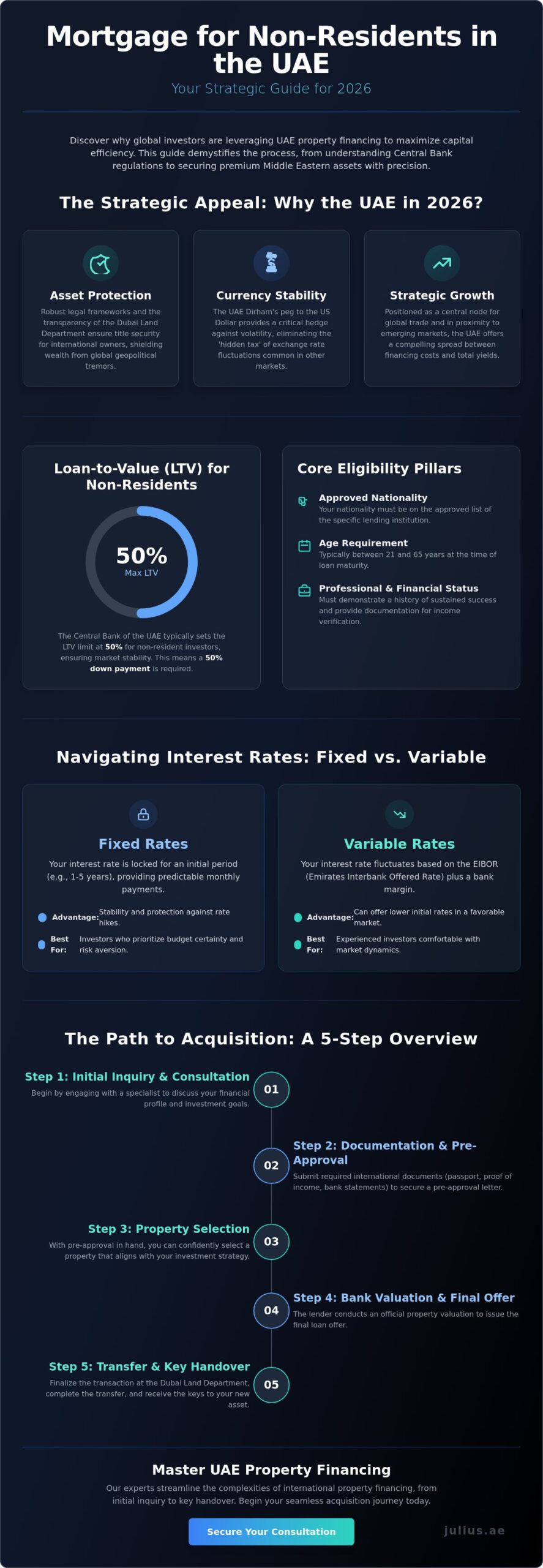
Asset Protection: Robust legal frameworks ensure title security for international owners.
-
Currency Stability: The USD peg eliminates the "hidden tax" of exchange rate fluctuations.
-
Strategic Growth: Proximity to emerging markets in Asia and Africa positions the UAE as a central node for 2026 global trade.
Understanding Mortgage Eligibility and Loan-to-Value (LTV) for Foreigners
Securing a mortgage for non-residents in UAE is a process defined by precision and strategic alignment with local banking standards. For the 2026 fiscal year, the Central Bank of the UAE (CBUAE) has refined its framework to balance market accessibility with financial stability. A non-resident is typically defined as an individual who does not hold a UAE residency visa but seeks to invest in the nation’s burgeoning skyline. Eligibility hinges on several pillars: your nationality must be on the approved list of the lending institution, your age should generally fall between 21 and 65 at the time of loan maturity, and your professional status must demonstrate sustained success.
Many international investors hesitate, fearing a labyrinth of paperwork. This perception is often exaggerated. While the requirements are rigorous, they’re entirely logical for a high-value transaction. The process isn’t about creating barriers; it’s about establishing a transparent financial narrative that satisfies both local risk appetites and international compliance standards. By approaching the documentation with a curated mindset, the path to approval becomes a structured journey rather than a source of friction.
Non-Resident LTV Limits and Down Payment Requirements
The standard Loan-to-Value (LTV) ratio for non-residents in 2026 remains anchored at 60%. This means you’ll need to prepare a 40% down payment to initiate your acquisition. This ratio applies primarily to ready properties, which provide immediate collateral for the bank. If you’re looking at the secondary market, the 60% threshold is the benchmark for stability, reflecting current data and trends that show a robust demand for established luxury villas and penthouses. Structuring your 40% down payment requires foresight; funds must be verifiable and transferred through recognized banking channels to ensure a seamless closing process.
Income Thresholds and Documentation for HNWIs
Lenders look for a specific profile of financial health. For salaried applicants, a minimum monthly income of approximately AED 25,000 is often the baseline, though this can vary depending on the institution and the property’s total value. Self-employed individuals face a more detailed review, requiring proof of business longevity and audited financial statements. The essential checklist for a mortgage for non-residents in UAE typically includes:
-
Six months of personal and corporate bank statements.
-
Certified tax returns from your home country.
-
A comprehensive Know Your Customer (KYC) profile.
-
Valid passport copies and proof of international address.
Julius Property acts as your master curator in this phase. We don’t just facilitate a transaction; we refine your financial profile to meet the exacting standards of Dubai’s premier banks. Our team ensures that your application is presented with the sophistication required for a swift approval. Those seeking a bespoke entry into this market often consult with a master curator of Dubai real estate to align their financial strategy with their long-term investment aspirations.
Navigating the Nuances: Fixed Rates, Variable Options, and Off-Plan Financing
Securing a mortgage for non-residents in UAE requires a nuanced understanding of local liquidity and global economic shifts. By 2026, the market has matured into a sophisticated landscape where financing is no longer a generic product but a tailored instrument. Investors must decide between the rhythmic security of fixed terms and the agile potential of variable rates, each serving a distinct purpose within a high-value portfolio.
Fixed vs. Variable: Which Strategy Fits Your Portfolio?
Stability remains a hallmark of a curated investment strategy. Locking in a three-year or five-year fixed rate provides a sanctuary from market volatility, allowing for precise cash flow forecasting and peace of mind. This approach is particularly effective when global benchmarks indicate a rising rate cycle, as it shields your yield from sudden fluctuations. Conversely, variable rates attract the visionary investor who anticipates a softening of interest benchmarks. These products offer the flexibility to benefit from downward shifts in the market without the constraints of long-term lock-in periods.
The heartbeat of the UAE’s lending market is the Emirates Interbank Offered Rate. Your monthly repayment fluctuates in direct alignment with the EIBOR plus the bank’s predetermined profit margin. Understanding this relationship is vital, as even a minor basis point shift can influence the long-term performance of your asset. In 2026, many lenders offer "hybrid" structures that allow a transition from fixed to variable, providing a seamless bridge as market conditions evolve.
Financing Off-Plan Developments in 2026
The evolution of the banking sector over the last two years has transformed how global clients approach off-plan property investments. Since 2024, the integration between tier-one developers and major UAE banks has deepened, resulting in exclusive financing packages for non-residents. These partnerships often include reduced processing fees or accelerated approval timelines, specifically designed for iconic projects that define the Dubai skyline.
A critical component of this process is the Oqood certificate. This document acts as the definitive legal registration of your property with the Dubai Land Department during the construction phase. Banks require this certificate to initiate any mortgage for non-residents in UAE for off-plan assets, as it provides the underlying security for the loan. The "art of the deal" in 2026 often involves negotiating bespoke terms that align with the developer’s payment plan, ensuring that your capital remains liquid until the point of handover.
-
Fixed Rates: Best for risk-averse investors seeking five-year horizon stability.
-
Variable Rates: Ideal for those tracking EIBOR trends for potential cost savings.
-
Oqood Registration: The essential legal prerequisite for all off-plan financing.
-
Bespoke Negotiation: High-net-worth individuals can often waive standard valuation fees through private banking channels.
Lenders in 2026 are increasingly unhurried and thorough, focusing on the client’s total global profile rather than just local collateral. This shift allows for a more unhurried consultation process where terms are curated to match your specific liquidity requirements and long-term exit strategies.
The Step-by-Step Path to Securing Your International Home Loan
Acquiring a mortgage for non-residents in UAE is a deliberate progression toward a legacy asset. It’s an unhurried journey of acquisition where precision matters more than speed. Your mortgage broker acts as a master curator of your financing, filtering through a sea of institutional products to find the one that fits your unique global profile. They don’t just facilitate a loan; they architect a financial structure that aligns with your long-term investment strategy.
Expect the full cycle from initial inquiry to the final handover of keys to span between 30 and 45 days. This timeline accounts for the rigorous due diligence required for international applicants. You don’t need to be physically present in Dubai for every stage. Practical logistics are managed through a Power of Attorney (POA), which must be notarized and attested. This legal instrument allows a trusted representative to sign contracts on your behalf, ensuring your acquisition moves forward while you remain focused on your global interests.
Securing the Approval in Principle (AIP)
Obtaining an AIP is the cornerstone of a sophisticated property search. It transforms you from a spectator into a verified buyer with a defined budget. Most UAE banks issue pre-approvals that remain valid for 60 days, giving you a clear window to identify the perfect residence. An AIP strengthens your negotiating position. Sellers in the luxury tier often ignore offers that aren’t backed by a bank’s preliminary commitment. It signals that you’ve already cleared the initial vetting process, making your offer significantly more attractive than an unverified lead.
Valuation, Offer Letters, and Final Disbursal
Once you’ve selected a property, the bank initiates an independent valuation. This step ensures the purchase price aligns with current market data, protecting your capital from over-inflated valuations. Following a successful assessment, the bank issues the Home Offer Letter (HOL). You must review this document for its bespoke terms, looking past the interest rate to understand the nuances of early repayment fees or life insurance requirements. The journey culminates at the Dubai Land Department (DLD). Here, the title deed is issued, the mortgage is officially registered, and the property becomes a permanent part of your portfolio.
If you’re ready to begin your journey toward a bespoke Dubai residence, consult with our master curators to explore your financing options.
Curating Your Legacy: How Julius Property Facilitates Seamless Acquisitions
Julius Property acts as a visionary partner for the global elite. We recognize that acquiring luxury apartments for sale Dubai is a deliberate act of wealth curation. It’s not merely a transaction; it’s the foundation of a regional legacy. Our role is to bridge the gap between architectural desire and financial precision, ensuring that your entry into the UAE market is both sophisticated and strategically sound. By aligning a mortgage for non-residents in UAE with your broader investment objectives, we transform property ownership into a seamless extension of your global portfolio.
Bespoke Mortgage Advisory and Exclusive Bank Access
Our network extends into the inner sanctums of the UAE financial sector. We provide our clients with access to private banking rates that remain invisible to the public. The Julius "Signature Standard" ensures every loan structure respects your global tax obligations and residency status. We don’t settle for off-the-shelf products. Instead, we negotiate terms that reflect your unique net worth. This tailored approach allows for flexible repayment structures and higher loan-to-value ratios, often securing financing for up to 50% of the property value for non-residents. We handle the intricacies of documentation and bank liaisons so you can focus on the aesthetic and lifestyle choices that define your investment.
Beyond Financing: The Golden Visa and Portfolio Management
Securing a mortgage for non-residents in UAE is often the first step toward long-term residency and global mobility. Properties valued at 2 million AED or more qualify you for a Golden Visa, granting you and your family ten years of renewable residency. To protect and grow this investment, our integrated property management services ensure your asset remains high-performing. We aim for a "self-paying" model where premium rental yields, which frequently range between 6% and 9% in prime Dubai districts, service your debt obligations. This holistic stewardship ensures your portfolio grows in value while maintaining the effortless nature of a truly luxury investment.
Your journey toward a sophisticated UAE portfolio deserves a partner who understands the nuances of the high-end market. Don’t leave your financial legacy to chance. Consult with our specialists today for a curated investment plan that secures your future in the Dubai skyline.
Master Your 2026 Dubai Investment Strategy
The 2026 real estate landscape demands a sophisticated approach to leverage that goes beyond simple asset acquisition. The Central Bank of the UAE maintains specific Loan-to-Value frameworks that allow international investors to optimize liquidity while securing prime residential assets. By mastering the interplay between fixed-rate stability and the flexibility of off-plan financing, you position yourself to capitalize on the region’s projected economic growth. Securing a mortgage for non-residents in UAE shouldn’t be a transactional hurdle; it’s a strategic entry point into a world-class economy.
Julius Property transcends the standard brokerage model to act as your master curator in this complex market. We provide exclusive access to private banking mortgage rates and offer unparalleled expertise in high-value luxury transactions. Our integrated support for Golden Visa applications and comprehensive property management ensures your investment legacy is both seamless and visionary. We invite you to curate your UAE investment portfolio with Julius Property expert mortgage advisory. Your vision for a refined international lifestyle is perfectly within reach.
Frequently Asked Questions
Can a non-resident get a mortgage in Dubai in 2026?
Yes, non-residents can secure financing for property in Dubai in 2026 through various international and local banks. This mortgage for non-residents in UAE allows global investors to leverage their capital while acquiring premium assets in the city’s most prestigious developments. Julius curates these opportunities, ensuring that your path to ownership remains a seamless, bespoke experience that matches your international portfolio requirements and long-term wealth preservation goals.
What is the maximum Loan-to-Value (LTV) for a foreign investor in the UAE?
Foreign investors typically access a maximum Loan-to-Value ratio of 50 percent for residential acquisitions. While UAE residents may qualify for higher leverage, the Central Bank of the UAE maintains this 50 percent threshold for non-residents to ensure market stability and protect investor equity. This structure requires a 50 percent cash down payment, reflecting the exclusive nature of high-end real estate investments and the art of visionary wealth management.
Do I need to visit the UAE in person to apply for a mortgage?
You don’t need to be physically present in the UAE to initiate or complete your mortgage application. By utilizing a Power of Attorney and digital verification tools, international clients can manage the entire acquisition process from any global location. This remote approach facilitates a visionary investment strategy without the need for immediate travel, providing a truly unhurried and sophisticated service for the modern elite seeking an unparalleled lifestyle.
What are the typical interest rates for non-resident mortgages in the UAE?
Interest rates for non-resident financing usually range between 4 percent and 6 percent, depending on the lender and the specific profile of the borrower. These rates are often linked to the EIBOR for variable products or offered as fixed terms for the initial 2 or 3 years. Securing a mortgage for non-residents in UAE involves a careful selection of these rates to balance long-term value with immediate cash flow needs.
Can I get a mortgage for an off-plan property as a non-resident?
Financing is available for off-plan properties, though banks often require the project to reach a specific completion milestone, such as 50 percent construction. Most lenders cap the LTV at 50 percent for these visionary architectural projects. This ensures that the investment remains secure as the property moves toward completion, allowing you to participate in the growth of the Dubai skyline with confidence and a sense of curated precision.
Is there a minimum salary requirement for a UAE mortgage for foreigners?
Lenders typically require a minimum monthly income of 25,000 AED for non-resident applicants to ensure financial eligibility. Some premium banking institutions may set this threshold at 50,000 AED for bespoke financing packages on high-value properties. Providing documented proof of this income is a standard part of the curated application process, establishing the professional expertise and financial standing required for elite ownership in the most prestigious neighborhoods.
What additional fees are involved in a UAE mortgage transaction?
Transaction costs include a 4 percent Dubai Land Department transfer fee and a 1 percent bank processing fee. You should also account for a property valuation fee, which usually costs around 3,000 AED, and a mortgage registration fee of 0.25 percent of the total loan amount. These costs are essential for a transparent and seamless transaction, ensuring every detail of your investment is handled with the precision Julius is known for.
Can I finance a property to qualify for the UAE Golden Visa?
You can use a mortgage to purchase a property for the Golden Visa, provided your equity in the asset is at least 2 million AED. The Federal Authority for Identity, Citizenship, Customs and Port Security allows this path as long as the down payment meets the 2 million AED threshold. This integration of lifestyle and investment logic provides a prestigious gateway to long-term residency and an unparalleled standard of living.
Leave a Reply