

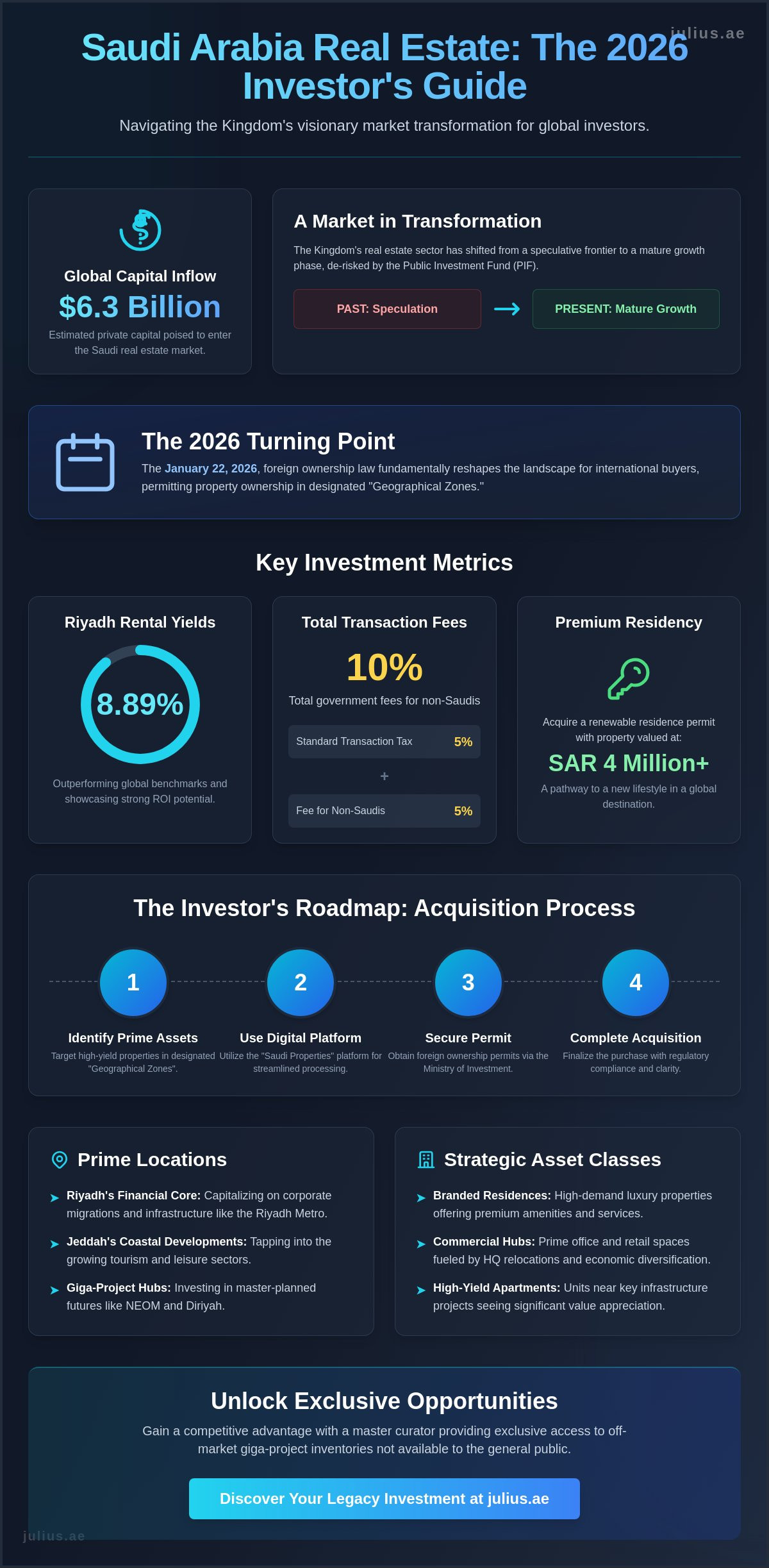
An estimated USD 6.3 billion in private global capital is currently poised to enter the Saudi Arabian real estate market, signaling a tectonic shift in how the world views the Kingdom’s skyline. As a discerning buyer, you understand that timing is the ultimate luxury. Finding the right properties for sale in Saudi Arabia for investors now requires more than just capital; it demands a sophisticated understanding of a market that’s maturing at an unprecedented pace. You’ve likely watched the headlines about Vision 2030 with a mix of fascination and caution, wondering if the reality of the giga-projects truly aligns with your portfolio’s requirements for transparency and long term value.
This strategic guide cuts through the noise to reveal how the January 22, 2026, foreign ownership law has fundamentally transformed the landscape for international buyers. We’ll explore the elite “Geographical Zones” where you can now secure title, the mechanics of the “Saudi Properties” digital platform, and why Riyadh’s 8.89% rental yields are currently outperforming global benchmarks. From the nuances of the 10% total government transaction fees to the path toward premium residency, you’ll gain the clarity needed to navigate this visionary market with the confidence of a seasoned insider. Discover how to identify assets that offer more than just a footprint, but a curated legacy in the heart of the Middle East’s most ambitious transformation.
Key Takeaways
- Understand why the Saudi market’s shifted from speculation to a mature growth phase, backed by the strategic de-risking of the Public Investment Fund.
- Identify prime neighborhoods and luxury properties for sale in Saudi Arabia for investors across Riyadh’s financial core and Jeddah’s coastal developments.
- Evaluate the unique ROI potential of branded residences versus commercial hubs as the Kingdom attracts global corporate migrations and HQ2 relocations.
- Master the updated 2026 acquisition process, including the essential steps for securing foreign ownership permits through the Ministry of Investment.
- Learn how a master curator provides exclusive access to off-market giga-project inventories that aren’t available to the general public.
The Saudi Real Estate Landscape: Why 2026 is the Pivotal Year
The Saudi property market has officially transitioned into a “mature growth” phase. It’s no longer a frontier characterized by speculation; it’s a sophisticated arena where institutional standards have become the norm. The Public Investment Fund (PIF) acts as the ultimate guarantor of this evolution, de-risking high-end developments through massive capital injections that ensure project completion and global quality standards. This deliberate shift away from oil dependency toward a service and tourism-led economy has created a stable, diversified foundation for long term appreciation. Finding the right properties for sale in Saudi Arabia for investors in 2026 requires looking beyond the horizon toward a master-planned future that’s rapidly becoming a reality.
For those seeking properties for sale in Saudi Arabia for investors, 2026 represents a strategic sweet spot in the Kingdom’s timeline. Most giga-projects are moving from concept to delivery, yet the market hasn’t reached the price saturation expected as the 2030 deadline approaches. Regulatory oversight from the Real Estate General Authority has institutionalized the sector, providing the transparency and legal frameworks that global capital demands. With the introduction of a 5% transaction fee for non-Saudis alongside the standard 5% tax, the total 10% entry cost is balanced by some of the most competitive rental yields in the Middle East.
To gain a deeper perspective on the evolving investment climate and specific city dynamics, watch this detailed guide:
The Vision 2030 Impact on Asset Value
Infrastructure is the primary catalyst for value in this cycle. The Riyadh Metro, now fully operational in 2026, has redefined micro-market values, with apartments within walking distance of major stations seeing significant premiums. Giga-projects like Diriyah and NEOM aren’t just isolated developments; they act as “value anchors” that drive up residential land prices in surrounding districts. Urban regeneration initiatives are transforming older neighborhoods into high-yield commercial hubs, creating a ripple effect that benefits visionary investors who enter before the next wave of infrastructure completion.
Foreign Investment Incentives in 2026
The January 22, 2026, ownership law allows non-Saudis to own property in designated “Geographical Zones,” signaling a permanent shift in the Kingdom’s DNA. Saudi Arabia is now viewed as a global lifestyle destination, attracting high-net-worth individuals who seek more than just a workplace. The 2026 Premium Residency program grants international investors a renewable residence permit upon the acquisition of properties valued at SAR 4 million or more.
Prime Locations: Where to Find Properties for Sale in Saudi Arabia
Selecting the right geography is the cornerstone of any successful entry into the Kingdom. While the national Real Estate Price Index saw a slight adjustment of 2.24% in late 2025, specific urban corridors are defying broader trends. Identifying high-performing properties for sale in Saudi Arabia for investors requires a granular look at how the government’s Real Estate Sector Strategy is physically manifesting across different regions. From the high-altitude ambition of Riyadh to the leisure-centric coastlines of the Red Sea, each locale offers a distinct risk-reward profile tailored to specific investment mandates.
The market is no longer a monolith. Growth is increasingly project-based, centered around visionary developments that combine residential, commercial, and leisure components. This shift ensures that capital is protected by high-quality infrastructure and a guaranteed influx of residents and businesses. Whether it is the industrial resilience of Dammam and Al Khobar or the futuristic allure of NEOM, the 2026 landscape offers a diverse portfolio of opportunities for those who value precision in their asset selection.
Riyadh: The Northward Expansion
Riyadh isn’t just the capital; it’s the engine of the nation’s 2026 economic surge. The city’s northern districts have become the primary focus for luxury development, with prices in some neighborhoods reaching SAR 11,000 per square meter. This appreciation is fueled by “HQ2” corporate migrations as global firms establish regional headquarters to satisfy government mandates. The King Abdullah Financial District (KAFD) stands as a testament to this, offering luxury apartments that cater to a growing class of international executives. For a deeper dive into this specific market, explore the definitive guide to buying property in Riyadh. With apartment rents in the city climbing 19.6% year-on-year, the case for capital allocation here is compelling. New Murabba and Diriyah Gate are evolving into elite residential epicenters, blending heritage with ultra-modern living.
The Red Sea Coast: A New Global Riviera
The western coastline represents the Kingdom’s pivot toward high-end tourism and lifestyle-led investment. Jeddah remains the traditional gateway, where apartment rents rose by 2.6% over the past year, yet the real excitement lies in the ultra-luxury villa market on Shura Island. Investors are increasingly drawn to waterfront assets that offer managed exclusivity. Branded hospitality residences in the Amaala region are capturing a significant portion of the USD 3.5 billion global capital targeting this asset class. These managed properties provide a seamless ownership experience, mirroring the high standards found in the luxury UAE market. To ensure your portfolio reflects this level of sophistication, you should consult with a specialist curator who understands the nuances of these micro-markets.
Strategic Asset Classes: From Branded Residences to Commercial Hubs
The sophistication of the 2026 market is best reflected in the diversification of asset classes available to the global elite. While traditional residential units remain a staple, the focus for those seeking properties for sale in Saudi Arabia for investors has pivoted toward managed luxury and high-spec commercial environments. Investors are currently weighing the steady 6.84% average gross rental yields of residential assets against the aggressive capital appreciation seen in the commercial sector. This shift is driven by a critical shortage of Grade A office space in Riyadh, where vacancy rates have plummeted as global firms satisfy the “Regional Headquarters” mandate.
Commercial real estate in the capital is no longer just a functional necessity; it’s a high-yield strategic play. With the influx of international corporations, the demand for premium, tech-enabled workspaces has outpaced supply. This imbalance offers a unique window for investors to capitalize on long term leases with institutional-grade tenants. Simultaneously, the residential market is evolving to meet the lifestyle expectations of these new arrivals, creating a symbiotic relationship between where people work and where they choose to reside.
The Allure of Branded Living
Branded residences have emerged as the premier choice for HNWIs, with approximately USD 3.5 billion of international capital targeting this specific niche. The entry of global icons like the Ritz-Carlton and Four Seasons into the Saudi residential space has introduced a level of service and maintenance previously unseen in the region. These hotel-managed assets command a premium because they offer a “lock-and-leave” lifestyle backed by a global hallmark of quality. You can see a similar trajectory in our insider look at branded residences, where managed luxury consistently delivers higher rental premiums and superior long-term value retention compared to unbranded developments.
Off-Plan Investment Strategy
The “Art of the Acquisition” in 2026 relies on identifying visionary developers who possess a proven track record of delivering giga-project milestones. Off-plan opportunities now come with unprecedented security, making them an attractive entry point for those looking to maximize capital gains before project completion. Payment plans are typically structured around construction milestones, allowing for staggered capital outlays that align with the asset’s physical growth. The Real Estate General Authority (REGA) enforces strict escrow account regulations and mandatory project milestones through the Eltizam platform to ensure that investor capital is protected throughout the construction lifecycle. When selecting an off-plan asset, consider these factors:
- Developer Pedigree: Prioritize entities with direct backing or partnerships with the Public Investment Fund.
- Escrow Verification: Ensure all payments are routed through REGA-approved audited accounts.
- Infrastructure Alignment: Select projects with direct connectivity to the Riyadh Metro or major coastal transit hubs.
The Investor’s Roadmap: Navigating the Acquisition Process
Acquiring properties for sale in Saudi Arabia for investors has evolved into a highly digitized, transparent journey. The process demands a meticulous adherence to a structured timeline to ensure both legal compliance and capital security. It begins with securing a Foreign Ownership Permit through the Ministry of Investment (MISA), a prerequisite that’s been streamlined in 2026 to encourage global participation. Non-resident investors must first obtain a digital ID through Saudi embassies to access the “Saudi Properties” digital platform, which serves as the exclusive gateway for all ownership transactions.
Once the permit is in hand, the focus shifts to identifying the specific asset. Partnering with a “Master Curator” like Julius Property allows you to bypass the noise of the open market and access off-market opportunities that align with your long term goals. After selection, a Memorandum of Understanding (MOU) is signed, and a deposit is typically placed in a secure escrow account. The due diligence phase is critical; it involves a comprehensive verification of the “Saqr,” the digital title deed, through the Real Estate General Authority to ensure the property’s history is clear. Finally, the transfer is finalized through the Ministry of Justice portals, completing a process that mirrors the efficiency of the world’s most advanced real estate markets.
Regulatory Framework and Compliance
Understanding the “Negative List” is essential for any international buyer. While the 2026 laws have opened vast Geographical Zones, property ownership in the holy cities of Makkah and Madinah remains strictly reserved for Muslim individuals and Saudi companies. Navigating these nuances requires a specialized real estate investment consultancy to maintain absolute compliance. Beyond the purchase, the longevity of your investment depends on strategic property management to preserve the asset’s architectural integrity and market value. If you’re ready to secure your position in this market, you can schedule a private consultation with our advisory team to begin your journey.
Financing and Mortgage Advisory
The financial landscape for 2026 has expanded to include robust mortgage products tailored for non-resident investors. While Loan-to-Value (LTV) ratios for international buyers may differ from those offered to Saudi nationals, the availability of competitive financing has made high-value acquisitions more accessible. Many investors find that the integration of bespoke financial advisory into their brokerage experience creates a seamless path from capital allocation to asset handover. It’s a sophisticated ecosystem where investment logic meets lifestyle aspiration, ensuring your entry into the Kingdom is as efficient as it is rewarding.
Julius Property: Your Master Curator for Saudi Real Estate
Julius Property doesn’t just facilitate transactions; we curate legacies. In a market where properties for sale in Saudi Arabia for investors are often presented as mere numbers on a balance sheet, we offer a more refined perspective. We act as a sophisticated bridge between the established luxury of the Dubai skyline and the emerging architectural marvels of Riyadh and the Red Sea. Our role is that of a Master Curator, selecting only the assets that meet our rigorous standards for rarity, quality, and visionary potential.
Access is the ultimate currency for the global elite. Through our deep-rooted connections within the Kingdom’s developing ecosystem, we provide our clients with exclusive entry to off-market giga-project inventories that never reach public portals. Whether it’s a bespoke villa in a secluded corner of NEOM or a high-yield commercial floor in a premier Riyadh tower, our guidance ensures you’re positioned at the forefront of the 2026 value curve. We prioritize transparency and precision, ensuring that every acquisition aligns with a broader strategy of portfolio excellence. Our signature standard is defined by:
- Unrivaled Access: Direct entry to off-market giga-project phases before they reach the general public.
- Strategic Curation: Assets selected specifically for their long term capital appreciation and aesthetic rarity.
- Seamless Stewardship: A concierge-level approach to legal and financial navigation within the 2026 regulatory framework.
The Art of Living, Curated by Julius Property
We apply a bespoke “Luxury Concierge” model to every engagement. This means your journey doesn’t end at the transfer of the title deed; it begins with the stewardship of your lifestyle and investment goals. Our network of elite legal and financial partners works in the background to ensure a frictionless acquisition, navigating the 2026 ownership laws with practiced ease. This standard of excellence is consistent across our global portfolio, as seen in our exclusive property country highlights for the UAE. We believe that real estate is an art form, and our mission is to help you master it.
Secure Your Visionary Asset Today
The opportunity to acquire properties for sale in Saudi Arabia for investors in 2026 is a strategic window that will narrow as we approach the 2030 maturation. We invite you to experience a different kind of consultation: one that is unhurried, thorough, and entirely focused on your aspirations. Our approach is built on trust and a deep understanding of what it means to own a piece of the future. Reach out to our bespoke consultancy services for a private briefing and discover how we can help you secure an unparalleled asset in the heart of the Kingdom’s transformation.
Secure Your Position in the Kingdom’s Visionary Future
The January 22, 2026, foreign ownership law has fundamentally redefined the regional investment landscape, inviting an estimated USD 6.3 billion in private global capital into a market of unprecedented ambition. You’ve seen how Riyadh’s 8.89% rental yields and the rise of branded residences across the Red Sea coast offer more than just financial returns; they represent a seat at the table of the world’s most significant urban transformation. Identifying the most prestigious properties for sale in Saudi Arabia for investors requires a partner who understands that true value lies in the intersection of market data and architectural rarity.
Julius Property provides the bespoke portfolio curation and unparalleled access to giga-project inventories that serious investors demand. Our expertise in Vision 2030 developments ensures your entry is both seamless and strategically aligned with long term growth. It’s time to move beyond the transaction and begin a journey of master-curated acquisition. Consult with a Julius Property Investment Specialist today to explore our exclusive collection of branded residences and high-yield assets. The future of global real estate is taking shape, and your legacy within it starts now.
Frequently Asked Questions
Can foreigners own 100% of a property in Saudi Arabia in 2026?
Yes, the regulatory framework enacted on January 22, 2026, permits non-Saudis to hold 100% ownership of real estate within designated Geographical Zones. This law applies to both resident and non-resident individuals as well as legal entities. All transactions must be executed through the official “Saudi Properties” digital platform to ensure legal compliance and transparency.
What is the minimum investment required for a Saudi Premium Residency?
A minimum real estate investment of SAR 4 million is required to qualify for the property-linked Premium Residency program in 2026. This pathway provides high-net-worth individuals with a renewable residence permit, offering a secure status in the Kingdom alongside their physical asset. It’s a strategic option for those seeking a long term lifestyle and investment foothold in the region.
Which city in Saudi Arabia offers the highest rental yields for investors?
Riyadh currently leads the Kingdom with the highest average gross rental yields, reaching 8.89% in the first quarter of 2026. This performance is largely driven by a 19.6% year-on-year increase in apartment rents within the capital. Jeddah follows with healthy yields of 7.89%, making both cities primary targets when evaluating properties for sale in Saudi Arabia for investors.
Are there property taxes for international investors in KSA?
Saudi Arabia doesn’t impose an annual property tax, but international buyers must account for a combined 10% in government fees at the point of purchase. This total includes the standard 5% Real Estate Transaction Tax (RETT) and a specific 5% transaction fee applied to non-Saudi buyers. This structure ensures a transparent entry cost while maintaining the absence of recurring yearly taxes.
Can I buy property in Mecca or Medina as a non-Muslim investor?
Ownership of real estate in the holy cities of Makkah and Madinah remains strictly restricted to Muslim individuals and Saudi-owned companies. Non-Muslim investors are encouraged to focus their capital on the high-growth Geographical Zones in Riyadh, Jeddah, and the Red Sea giga-projects. These areas provide the most lucrative opportunities for those seeking properties for sale in Saudi Arabia for investors in the luxury segment.
What is the difference between a “Saqr” and a standard title deed?
A “Saqr” is a sophisticated digital title deed issued and verified by the Real Estate General Authority (REGA), replacing traditional paper-based documentation. It provides a secure, immutable record of ownership that can be instantly verified through government portals. This digital transition has significantly reduced the time required for due diligence and increased the overall security of the acquisition process.
How does the Saudi real estate market compare to Dubai for investors?
Saudi Arabia is currently in a “mature growth” phase with significant capital appreciation potential as Vision 2030 projects approach delivery, whereas Dubai is an established global hub for luxury lifestyle. Both markets offer competitive rental yields, but the Saudi market presents a unique opportunity to enter at a pivotal stage of urban transformation. Many investors now view the two markets as complementary components of a diversified Middle Eastern portfolio.
What are the typical closing costs for a property transaction in KSA?
Total closing costs for international investors typically hover around 10% of the property’s total value. This figure is primarily composed of the 5% Real Estate Transaction Tax and the 5% fee for transfers involving non-Saudis. Investors should also set aside a small percentage for administrative processing fees on the “Saudi Properties” platform and any bespoke consultancy services required for the transaction.
Leave a Reply