

The year 2026 marks a definitive shift where the Turkish real estate market transcends mere transaction to become a strategic pillar of a global legacy. For the discerning investor, the steps to buying property in Turkey as a foreigner are no longer just a legal checklist; they represent a curated entry into a Mediterranean lifestyle that blends ancient heritage with visionary growth. You likely recognize that the allure of the Bosphorus is matched only by the complexity of its evolving regulatory framework, where precision is the only currency that truly matters.
We understand that the prospect of bureaucratic delays or the nuances of the 2026 legal amendments can feel like a barrier to your international ambitions. At Julius, we believe that your acquisition should be as seamless as the architecture you seek to own. This guide provides an expert led roadmap to mastering the sophisticated landscape of Turkish investment, ensuring your path to citizenship or portfolio expansion is handled with absolute precision. We’ll examine the essential verification protocols, identify high growth luxury districts, and demystify the updated valuation standards to secure your future in this vibrant market.
Key Takeaways
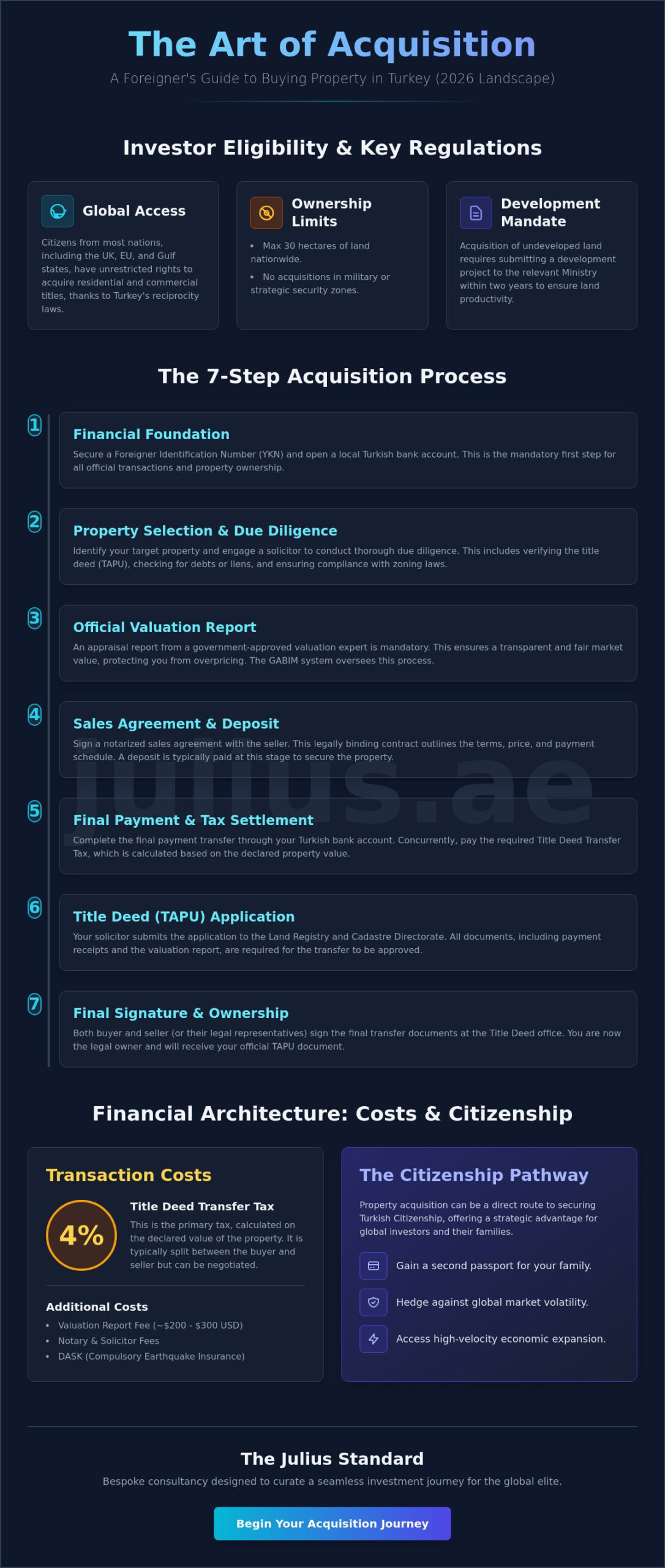
- Navigate the 2026 transcontinental investment landscape with a focus on visionary urban regeneration and the evolving legal framework for elite global investors.
- Master the precise steps to buying property in Turkey as a foreigner, moving from initial acquisition to the final title deed transfer with unparalleled precision.
- Understand the critical role of GABIM and the Real Estate Appraisal Center in securing transparent property valuations and mitigating cross-border transaction risks.
- Gain architectural clarity on transaction costs, including the calculation of the 4% Title Deed Transfer Tax and the strategic pathway to Turkish citizenship.
- Discover the Julius standard of bespoke consultancy, designed to curate a seamless investment journey within Istanbul’s most prestigious branded residences.
The 2026 Landscape: Why Turkey Remains a Visionary Choice for Investors
Turkey’s position as a transcontinental investment hub has reached a new level of sophistication in 2026. The nation doesn’t just sit between Europe and Asia; it acts as a primary conduit for global capital seeking both stability and aggressive growth. For the modern investor, the market has evolved. We’ve moved past the era of mass-market holiday apartments. Today, the focus is on curated luxury assets that offer a refined blend of Mediterranean lifestyle and high-yield potential. The 2026 market rewards those who view real estate as a component of a broader wealth preservation strategy.
Securing a position in this market requires a clear understanding of the regulatory environment. While the process is streamlined, the steps to buying property in Turkey as a foreigner involve navigating specific legal frameworks that protect both the buyer and the state. Current reciprocity laws ensure that citizens from most nations, including the UK, EU, and Gulf states, enjoy unrestricted access to residential and commercial titles. This openness, combined with a maturing legal system, makes Turkey a standout choice for those who demand transparency and prestige in their international portfolios.
To better understand the practical application of these regulations, watch this helpful video:
Eligibility and Restrictions for International Buyers
Most global nationalities possess the right to acquire property in Turkey, but certain boundaries remain firm. Foreigners are limited to a maximum of 30 hectares of land across the country. Additionally, you can’t own property in zones designated as military or strategic security areas. It’s a standard check that your solicitor will handle during the initial due diligence phase. In 2026, the regulations regarding agricultural land are particularly strict. If you acquire undeveloped land, you’re required to submit a development project to the relevant Ministry within two years. This ensures that land isn’t left dormant, maintaining the productivity of the nation’s soil.
Strategic Benefits: Beyond the Physical Asset
The appeal of Turkish real estate extends far beyond the architectural beauty of a Bosphorus villa or an Aegean estate. One of the most compelling drivers remains the synergy between property acquisition and the Turkish Citizenship by Investment program. This initiative allows families to secure a second passport, providing a vital hedge against global market volatility and geopolitical shifts. By 2026, the program has become a benchmark for efficiency, attracting high-net-worth individuals who value mobility as much as they value capital appreciation.
The “Golden Bridge” investment concept defines the strategic advantage of owning assets that bridge the regulatory safety of the West with the high-velocity economic expansion of the East. Following the steps to buying property in Turkey as a foreigner isn’t just a transaction; it’s an entry into a lifestyle defined by exclusivity and foresight.
The Art of Acquisition: 7 Steps to Buying Property in Turkey
Mastering the steps to buying property in Turkey as a foreigner requires a blend of local intelligence and meticulous planning. The 2026 market demands more than just capital; it requires an appreciation for the regulatory nuances that define Turkish real estate. From the initial selection to the final handover, the process is a choreographed sequence designed to protect the investor while ensuring the integrity of the national housing stock. Success lies in the details of the GABIM (Real Estate Appraisal Center) oversight and the precision of your financial documentation.
Phase 1: Due Diligence and Financial Foundation
Your journey begins with securing a Foreigner Identification Number (YKN) and establishing a local banking presence. These aren’t merely administrative hurdles; they’re the pillars of your transaction. You’ll need to obtain a “Değerleme Raporu” or Expertise Report. Since the 2023 regulatory updates, GABIM provides a centralized valuation to ensure the price you pay aligns with the actual market value. This prevents artificial inflation and secures your investment’s future liquidity. Before any funds move, verify the “Iskan” (Habitation Certificate). A property without this document remains technically unfinished in the eyes of the law, regardless of its physical state. For a deeper understanding of these legal frameworks, consult the Official Guide to Acquiring Property provided by the Turkish Presidency.
Phase 2: Formalizing the Commitment
Once the asset is vetted, the transition moves to the Notarized Sales Promise Agreement. This is particularly vital for off-plan or high-end luxury assets where the delivery timeline extends into the future. At this stage, you’ll execute the mandatory “Döviz Alım Belgesi” (Foreign Exchange Document). This 2022 requirement mandates that foreign currency be sold to the Central Bank through a local intermediary before the purchase. It’s a technical maneuver that requires professional oversight to ensure the exchange rates and certificates are filed correctly. This phase is where investors often seek bespoke acquisition strategies to align their portfolios with long-term capital appreciation goals. You must also secure a “No-Debt” certificate from the local municipality to ensure the seller has cleared all previous tax liabilities.
Phase 3: The Tapu Transfer
The culmination of the steps to buying property in Turkey as a foreigner occurs at the Land Registry Directorate (Tapu ve Kadastro Genel Müdürlüğü). By 2026, the process has become increasingly digital, utilizing biometric signatures and cloud-based verification systems. If you aren’t physically present, a robust Power of Attorney (POA) structure, drafted with specific limitations, allows your representative to act with your authority. A sworn translator is legally required to be present during the meeting to explain every clause of the transfer. When the registrar hands over the “Tapu”—the title deed—you aren’t just receiving a document; you’re securing a legacy. It’s the ultimate symbol of your status as a property owner in one of the world’s most dynamic markets. To explore how these assets can integrate into a wider portfolio of excellence, consider a private consultation with Julius.
Curated Destinations: Where to Invest in 2026
The Turkish real estate landscape has evolved into a sophisticated arena where branded residences and visionary urban regeneration projects dictate the market’s pace. Investors no longer seek mere brick and mortar; they demand a lifestyle curated by global standards of excellence. As we approach 2026, the focus has shifted toward high-performance assets that offer both aesthetic brilliance and long-term capital preservation. Understanding the steps to buying property in Turkey as a foreigner requires a keen eye for these emerging architectural hubs.
Istanbul remains the master curator of the national skyline, blending millennia of history with futuristic infrastructure. The city’s recent urban transformation initiatives have birthed exclusive enclaves that rival the world’s most prestigious postcodes. Beyond the city, the Turquoise Coast offers a different kind of prestige, where eco-luxury developments in Bodrum are redefining the Mediterranean summer. These destinations aren’t just locations; they’re strategic entries into a high-yield portfolio.
Istanbul’s Elite Districts: Nişantaşı, Bebek, and Beyond
The Bosphorus remains the ultimate symbol of Turkish prestige. Historic waterfront “Yalis” continue to be the most coveted assets, representing a rare fusion of heritage and privacy. For those seeking modern luxury, the high-rise corridors of Levent and Maslak provide a seamless corporate lifestyle. These districts serve as the pulse of the city’s financial heart, offering amenities that mirror the UAE property insights we frequently share with our global clientele. The integration of smart-home technology and bespoke concierge services in these towers ensures that the investment remains timeless.
Strategic growth is currently concentrated around new infrastructure hubs. The Istanbul Canal project has catalyzed a series of high-end residential clusters designed for the next decade of growth. When researching the steps to buying property in Turkey as a foreigner, investors should prioritize these regeneration zones where the 2026 infrastructure completion dates align with projected value spikes.
The Mediterranean Lifestyle: Bodrum and the Turkish Riviera
Bodrum has solidified its reputation as the “St. Tropez of the East,” attracting a discerning demographic that values exclusivity and architectural innovation. The 2026 luxury rental market in Bodrum is projected to see sustained growth, driven by a limited supply of private gated communities and eco-luxury villas. These properties emphasize the art of living, featuring sustainable materials and visionary designs that blend into the rugged coastline. For a comprehensive overview of legal safeguards during this process, the UK Government Guide to Buying Property in Turkey provides essential due diligence frameworks for international buyers.
Yield seekers often find themselves comparing these coastal returns to other regional giants. While the Turkish Riviera offers a mature leisure market, the capital appreciation seen here provides a fascinating contrast to Riyadh’s emerging luxury sector. Both markets represent the pinnacle of Middle Eastern and Eurasian investment potential, yet Bodrum’s lifestyle appeal remains unparalleled for those who seek a sanctuary by the sea.
- Bodrum: Best for high-end seasonal rentals and boutique villa developments.
- Kalkan: Favored for its elevated topography and unobstructed sea views.
- Istanbul Canal Zone: The primary choice for long-term urban capital growth.
Financial Architecture: Costs, Taxes, and the Citizenship Pathway
Precision in financial planning distinguishes a standard purchase from a visionary investment. Understanding the fiscal landscape is one of the most critical steps to buying property in Turkey as a foreigner. Beyond the sticker price, savvy investors must account for a transaction cost buffer of approximately 7% to 10%. The centerpiece of these costs is the 4% Title Deed Transfer Tax (Tapu Harcı). While Turkish law suggests a 50/50 split between buyer and seller, the prevailing market custom in 2026 often sees the buyer absorbing the full 4% to secure premium assets in competitive districts like Bebek or Bodrum.
Strategic tax optimization remains a hallmark of the sophisticated buyer. First-time foreign investors often qualify for a VAT (KDV) exemption, potentially saving between 1% and 20% on the purchase price. To secure this 0% VAT rate, the capital must enter Turkey in foreign currency through documented bank transfers, and the property must be held for at least one year. This incentive aligns perfectly with the $400,000 Citizenship by Investment threshold, allowing high-net-worth individuals to maximize their purchasing power while securing a powerful second passport.
Mandatory Fees and Ongoing Obligations
Operational excellence requires attention to detail. Buyers should budget for notary fees and official translation costs, which typically range from $500 to $1,500 depending on document volume. The DASK (Earthquake Insurance) is a non-negotiable requirement for utility connections and title transfers. Annual property tax, or Emlak Vergisi, remains remarkably low by global standards, with residential rates set at 0.2% in metropolitan municipalities and commercial assets at 0.4%. Owners selling their Turkish assets within a five-year window in 2026 encounter the Value Increase Tax, a capital gains levy calculated on the inflation-adjusted profit margin of the property.
The Pathway to Turkish Citizenship
The transition from investor to citizen is a curated process defined by strict regulatory milestones. Applicants must register a “No-Sale” restriction on the title deed for a duration of three years, a commitment that ensures the stability of the investment pool. This journey necessitates a Certificate of Conformity, issued by the Ministry of Environment, Urbanization, and Climate Change, which verifies that the investment meets the $400,000 valuation benchmark. Julius Property curates this entire citizenship journey, blending rigorous property search parameters with the technical precision required for a seamless residency application. Mastering these steps to buying property in Turkey as a foreigner ensures your capital remains protected while your lifestyle reaches a global standard.
Ready to curate your international portfolio with expert guidance? Explore bespoke investment opportunities with Julius Property today.
The Julius Standard: Bespoke Consultancy for the Global Elite
At Julius, we believe a property transaction is merely the opening chapter of a lifelong partnership. Our philosophy transcends the traditional brokerage model; we act as the master curators of your international legacy. Acquiring a residence in a foreign jurisdiction involves complexities that demand more than just a legal checklist. Our international real estate experts specialize in mitigating cross-border risks, ensuring that every acquisition aligns with your broader financial objectives. We don’t just help you navigate the steps to buying property in Turkey as a foreigner; we provide a protective shield of expertise that secures your capital against market volatility.
Integrating Turkish assets into a diversified global portfolio requires a visionary approach. We prioritize high-yield opportunities and capital preservation, focusing on the 15% of the market that remains invisible to the public. Our clients enjoy exclusive access to off-market branded residences and visionary developments that set new benchmarks for architectural excellence. These properties aren’t just homes; they’re strategic instruments of wealth designed to appreciate in value as the 2026 market cycle matures.
A Seamless Experience from Dubai to Istanbul
Our “Luxury Concierge” approach bridges the gap between the sophisticated Dubai market and the burgeoning Turkish landscape. We’ve refined a methodology that leverages our Middle Eastern expertise to navigate Turkish market nuances with surgical precision. This ensures your transition into the Istanbul or Bodrum markets is fluid and unhurried. We invite you to a private consultation where we analyze your current holdings and identify how Turkish real estate can serve as a powerful hedge. Our team handles the intricate steps to buying property in Turkey as a foreigner, allowing you to focus on the art of living while we manage the logistics of acquisition.
The Art of Stewardship
The Julius commitment extends far beyond the exchange of keys. Our “Signature Standard” of stewardship encompasses comprehensive post-purchase support, including strategic leasing and meticulous property management. We understand that an elite asset requires constant vigilance to maintain its premium status. Our team ensures your property remains a “Signature Standard” residence, reflecting the quality and prestige associated with the Julius name. We treat your investment with the same rigor as a private equity fund, focusing on long-term value retention and operational excellence.
- Strategic portfolio rebalancing and asset allocation.
- Risk mitigation through rigorous developer due diligence.
- Priority access to pre-launch pricing in emerging luxury districts.
- Personalized residency and citizenship advisory services.
Your journey toward a sophisticated global portfolio begins with a single, informed decision. Experience the difference that bespoke consultancy makes in your investment trajectory. Explore our exclusive international portfolio and discover how we redefine the standards of luxury real estate brokerage.
Secure Your Visionary Legacy in the Turkish Republic
The 2026 Turkish real estate market offers a rare convergence of cultural heritage and sophisticated modern infrastructure. Success in this landscape hinges on mastering the essential steps to buying property in Turkey as a foreigner, from initial site selection in Istanbul’s emerging financial districts to the final title deed transfer at the Land Registry. Investors who prioritize branded residences in Bodrum or luxury penthouses in the capital position themselves within a secure, high-yield asset class.
Julius Property brings a standard of excellence to every transaction. Our expertise in multi-jurisdictional luxury assets means your portfolio benefits from the same precision applied to the Dubai skyline. We provide bespoke investment consultancy for HNWIs, ensuring that every acquisition aligns with your broader financial architecture. With exclusive access to the most sought-after branded residences in Istanbul and Bodrum, we transform complex cross-border transactions into a seamless experience. It’s time to elevate your international footprint with a partner who understands the art of the acquisition.
Begin your curated Turkish acquisition journey with Julius Property
Your future in the Mediterranean awaits.
Frequently Asked Questions
What is the minimum investment for Turkish citizenship in 2026?
The minimum investment for Turkish citizenship in 2026 is $400,000 for real estate acquisitions. You must hold the property for at least three years to remain eligible for the program under the current legislative framework established in June 2022. Our bespoke advisory services ensure your selection meets these precise legal requirements while providing a refined lifestyle in the most prestigious neighborhoods of Istanbul or Bodrum.
Can I buy property in Turkey remotely without visiting the country?
You can purchase property in Turkey remotely by utilizing a Power of Attorney and the official Web-Tapu digital platform. These tools streamline the steps to buying property in Turkey as a foreigner, allowing you to secure assets without leaving your home office. Our team manages these sophisticated workflows to ensure every digital signature carries the weight of a physical presence. It’s a seamless way to expand your global portfolio with absolute confidence.
What are the main pitfalls to avoid when buying property in Turkey as a foreigner?
The most common pitfalls include purchasing property without a Habitation Certificate or failing to check for existing liens at the Land Registry. Reports from 2024 indicate that 12 percent of buyer disputes arise from unverified zoning permissions or outstanding tax debts. You should always secure an independent legal audit to confirm the asset’s title is clean and transferable. Avoiding these oversights is essential for a curated investment experience that prioritizes security and long term value.
Do I need a residence permit to buy property in Turkey?
You don’t need a residence permit to purchase real estate in Turkey. The acquisition process is open to any foreign national with a valid passport and a local tax identification number. However, purchasing a home worth at least $200,000 allows you to apply for a Property Ownership residence permit. This provides a clear path for those who wish to enjoy their Mediterranean retreat for extended periods each year without the constraints of a standard tourist visa.
How long does the title deed transfer process take for foreigners?
The transfer of a title deed usually takes between 3 and 7 business days once the application is filed at the local directorate. Efficiency at the Land Registry has improved by 25 percent since the 2023 administrative reforms, making the process faster for international investors. This swift timeline ensures your transition into ownership is unhurried yet prompt. We oversee every interaction with the authorities to ensure the process remains fluid and aligns with the high standards expected by our elite clientele.
Are there any specific taxes for foreigners selling property in Turkey?
Foreigners must pay Capital Gains Tax if they sell their property within five years of the initial purchase date. The tax applies to the difference between the inflation adjusted purchase price and the final sale price. If you retain the asset for more than 60 months, the tax obligation is waived entirely. This policy encourages a visionary approach to investment, rewarding those who commit to the market’s long term growth and stability rather than short term speculation.
What is the “Expertise Report” and why is it mandatory?
An Expertise Report is a mandatory property valuation document required for all real estate transactions involving foreign buyers. This regulation, implemented in March 2019, ensures that the transaction price reflects the actual market value. It’s a critical part of the steps to buying property in Turkey as a foreigner that protects your capital. This valuation ensures your investment is grounded in reality and reinforces our commitment to a secure, elite brokerage experience.
Is it possible for foreigners to get a mortgage in Turkey in 2026?
It’s possible for foreigners to obtain a mortgage in Turkey in 2026, with most banks offering a loan to value ratio of up to 70 percent. These financial products are typically available in major currencies like the US Dollar or Euro to suit international investors. Interest rates are determined by the prevailing 2025 economic indicators and individual credit profiles. We provide a curated introduction to leading lenders to help you secure the most favorable terms for your luxury acquisition.
Leave a Reply