

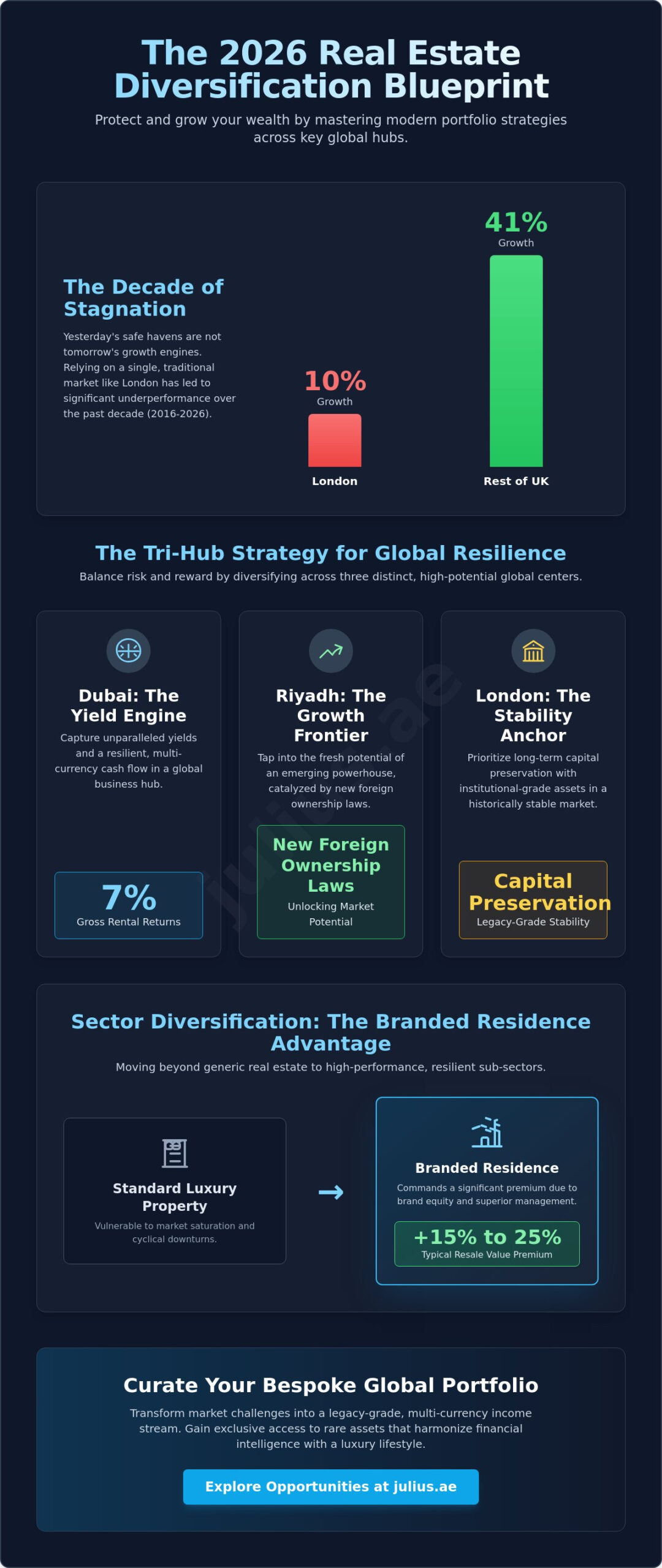
Did you know that between February 2016 and February 2026, London house prices grew by a mere 10 percent while the rest of the UK surged by 41 percent? This decade of stagnation proves that yesterday’s safe havens aren’t always tomorrow’s growth engines. Many sophisticated investors now find themselves over-exposed to single markets, watching yields flatten while missing the 7 percent gross rental returns available in more dynamic hubs. Mastering modern real estate portfolio diversification strategies is no longer a luxury; it’s a fundamental requirement for the visionary investor who demands both resilience and growth.
You’ve likely felt the weight of managing cross-border regulations and the complexity of shifting currency risks. We’ll show you how to transform these challenges into a bespoke, multi-currency income stream that spans the globe. This guide details how to curate a legacy-grade portfolio, balancing the established stability of the UAE with the fresh potential of Riyadh’s foreign ownership laws that took effect on January 21, 2026. We’ll examine the precise metrics you need to insulate your wealth and secure your position in the world’s most elite skylines.
Key Takeaways
- Understand why the shifting economic landscape of 2026 demands sophisticated real estate portfolio diversification strategies to protect and grow your wealth across multiple jurisdictions.
- Identify the shift from generic residential holdings toward high-yield branded residences and essential commercial sectors like logistics and data centers.
- Learn to execute the ‘Tri-Hub Strategy’ by balancing Riyadh’s emerging growth, Dubai’s unparalleled yields, and London’s institutional stability.
- Master the 2026 risk-allocation framework to effectively balance off-plan property investments with core, income-producing legacy assets.
- Discover how bespoke international property sourcing provides exclusive access to rare assets that harmonize financial intelligence with a luxury lifestyle.
The Strategic Imperative of Real Estate Portfolio Diversification Strategies in 2026
Sophisticated wealth management requires more than simple accumulation. True Diversification (finance) is the intentional, artistic spread of capital across sectors, geographies, and investment structures. In 2026, the historical inverse relationship between stocks and bonds has fractured, making a borderless mindset essential for capital protection. Real estate portfolio diversification strategies offer the only reliable decoupling from this public market volatility. For family offices, direct real estate isn’t just an asset; it’s a curated hedge against currency debasement. When inflation erodes the purchasing power of cash, prime property in high-growth jurisdictions maintains its intrinsic value. It’s a legacy-grade pillar that ensures wealth isn’t just stored, but actively insulated from the whims of central bank policies.
To better understand how these strategies function in a practical portfolio, watch this detailed overview:
De-risking Through Low Correlation
Private real estate valuations don’t mirror the daily hysteria of public equities. While stock prices react instantly to geopolitical news, luxury property benefits from a lag effect in price discovery. This delay allows visionary investors to execute tactical entries before the broader market resets. Relying on a single domestic market represents a primary risk for high-net-worth individuals. Consider that between 2016 and 2026, London house prices grew by only 10 percent, while the rest of the UK surged by 41 percent. By looking beyond traditional borders to luxury property in the UAE, investors can capture growth that isn’t tethered to the stagnation of Western European residential sectors.
The Stable Income Component
Rental yields from prime assets act as a sophisticated fixed-income alternative. In early 2026, gross rental yields in Dubai averaged between 6.7 percent and 7 percent for apartments, providing a resilient cash flow that far outpaces traditional bonds. This contrasts sharply with the long-term, institutional stability of commercial leases in London, which prioritize capital preservation over immediate yield. Even as Saudi Arabia’s real estate price index fell by 1.6 percent in the first quarter of 2026, the strategic investor identifies the underlying durable income that persists regardless of temporary price corrections. Durable income is the resilient bedrock of portfolio longevity, providing a consistent, multi-currency stream that fuels a global lifestyle.
Sector Diversification: From Branded Residences to Commercial Assets
Investors often make the mistake of treating real estate as a singular, monolithic asset class. In reality, the 2026 landscape demands a granular approach to sector allocation. While generic residential units in oversaturated markets may suffer from stagnant growth, the “Branded Residences” segment has emerged as a high-performance sub-sector. By integrating these specific assets into your real estate portfolio diversification strategies, you align your capital with global hospitality giants that maintain property values through rigorous, world-class management standards. This shift moves beyond simple square footage toward a “curated lifestyle” that retains its allure across economic cycles.
The Branded Residence Advantage
Brands like Ritz-Carlton, Armani, and Four Seasons don’t just offer luxury; they provide a “valuation floor” that protects against broader market downturns. These properties command a premium because they guarantee a consistent, elite lifestyle experience that generic developments cannot replicate. Historical data shows that resale values for branded units in prime hubs typically outperform non-branded luxury apartments by 15 percent to 25 percent. If you’re exploring these elite opportunities, our Luxury Apartments for Sale in Dubai: The 2026 Investor’s Curated Guide offers a deep dive into the specific developments currently defining the skyline.
Strategic Commercial Exposure
Commercial real estate remains a vital engine for yield, though the focus has shifted significantly in 2026. High-spec office space in Riyadh is seeing unprecedented demand due to regional headquarters mandates, while London’s market offers core stability. Our commercial property brokerage services help investors identify under-valued logistics assets and data centers that drive modern commerce. These assets often utilize triple-net leases, which provide unparalleled stability by shifting maintenance, insurance, and tax burdens directly to the tenant, ensuring a clean and predictable return on investment.
The evolution of “mixed-use” developments has created assets that hold value better during economic shifts. These projects combine residential, office, and leisure, ensuring constant demand and high occupancy rates. A sophisticated portfolio should distinguish between “trophy assets” which offer prestige and long-term capital appreciation, and “yield assets” that prioritize immediate performance. This dual-track approach ensures your wealth is both visible and productive. To begin curating your own mix of high-performance assets, you might consider reviewing our latest luxury property in the UAE listings to see how these sectors intersect in one of the world’s most dynamic markets.
Geographic Borderless Investing: Dubai, Riyadh, and London
True resilience in a globalized economy stems from a “Tri-Hub Strategy” that balances high-velocity growth with institutional stability. By integrating these three distinct markets into your real estate portfolio diversification strategies, you create a portfolio that captures emerging opportunities while maintaining a legacy-grade anchor. Dubai provides the immediate performance engine, Riyadh offers the visionary growth of a G20 transformation, and London remains the ultimate safe haven for capital preservation. This borderless approach allows investors to capitalize on the 2026 economic climate, where traditional domestic boundaries no longer define the limits of a private wealth strategy.
Currency dynamics play a decisive role in this geographic spread. Holding assets in the UAE and Saudi Arabia provides a strategic advantage, as the AED and SAR are pegged to the US Dollar. This provides a robust shield against the fluctuations often seen in the British Pound, allowing for a balanced multi-currency income stream. Navigating these varied regulatory environments requires deep local intelligence. Whether it’s the 4 percent Dubai Land Department fee or the 5 percent Real Estate Transaction Tax in Saudi Arabia, our international sourcing network ensures transparency and access to off-market deals that never reach the public eye.
Dubai: The High-Yield Performance Engine
The UAE property market remains a cornerstone of tax-efficient investing in 2026. With a median apartment price of AED 1.55 million and a 10-year Golden Visa available for investments exceeding AED 2 million, the entry mechanics are remarkably clear. The 2026 outlook for luxury rentals in Marina and Palm Jumeirah remains strong, driven by a global elite seeking the security and lifestyle of the Emirates. Dubai is the global capital of branded living. Here, the focus has shifted from mere speculation to long-term hold strategies in prime waterfront districts where supply remains constrained and demand unparalleled.
Riyadh: The Vision 2030 Growth Catalyst
Sophisticated investors are increasingly buying property in Riyadh to capture a historic first-mover advantage. The implementation of the new foreign ownership law on January 21, 2026, has opened the gates for international capital to participate in Saudi Arabia’s giga-projects. With an average apartment price of SAR 6,700 per square meter in early 2026, the entry point remains attractive compared to more mature global hubs. A massive undersupply of luxury housing exists for the influx of multinational executives, creating a unique opportunity for those who act before the market reaches full maturity. This is the art of identifying value before it becomes common knowledge.
Risk Allocation and the Art of the Acquisition
Mastering the 2026 market requires a rigorous framework for risk allocation that moves beyond simple geography. Sophisticated investors categorize their holdings into three distinct tiers: Core, Value-Add, and Opportunistic assets. Core assets include stabilized properties in prime districts like Mayfair or Palm Jumeirah, designed for capital preservation. Value-Add strategies focus on repositioning underperforming luxury units through bespoke refurbishments. However, the most potent tool for capital appreciation in 2026 involves off-plan property investments. These assets allow you to capture the “developer’s margin” without the operational burden of construction. When integrated into broader real estate portfolio diversification strategies, these tiers ensure your wealth isn’t just static, but actively evolving with market cycles.
Managing the entry point is the most common hurdle for the global elite. With US commercial mortgage rates for multifamily loans over 6 million dollars sitting at 5.33 percent as of May 1, 2026, the cost of debt has stabilized. This creates a window for tactical acquisitions before the next cycle of compression begins. To protect these international yields, professional property management is no longer optional. It is the essential stewardship required to maintain the “legacy-grade” status of your assets, ensuring that cross-border logistics never compromise your net returns.
Off-Plan vs. Ready Property Balance
A resilient portfolio utilizes payment plans to leverage capital effectively. By committing only 10 percent to 20 percent upfront, you control a high-value asset while keeping the remainder of your capital liquid. We recommend a “vintages” approach, spreading acquisitions across different completion years to stagger capital gains and rental entries. This mitigation strategy relies heavily on developer reputation. Only by selecting visionary partners with proven delivery records can you ensure your off-plan exposure remains a sophisticated growth engine rather than a speculative risk.
The Role of an Investment Consultant
A standard broker facilitates a transaction; a master curator builds a legacy. Bespoke consultancy is the only way to uncover exclusive “pocket listings” in London and Dubai that never reach public portals. We provide the transparency in data that leads to unparalleled investment confidence, moving beyond surface-level brochures to deep-dive financial modeling. If you’re ready to refine your acquisition strategy through a curated lens, explore our bespoke UAE property portfolio to identify your next cornerstone asset.
Julius Property: Curating Your Bespoke Global Portfolio
Julius Property stands at the unique intersection of financial intelligence and aesthetic appreciation. We’ve moved beyond the traditional brokerage model to become master curators of the global skyline, ensuring every asset we represent meets a signature standard of excellence. Our approach isn’t merely about facilitating a transaction; it’s about identifying how a specific property fits into your broader real estate portfolio diversification strategies. Through our international sourcing network, we offer our clients exclusive access to off-market branded residences and trophy assets that define the pinnacle of luxury living in 2026.
We provide a “Luxury Concierge” experience that simplifies the complexities of global wealth management for high-net-worth individuals. Whether you’re navigating Golden Visa consultancy to secure residency in the UAE or require bespoke mortgage advisory for a high-value commercial acquisition, our team ensures a seamless journey. We handle the technical friction of cross-border regulations and currency risks, allowing you to focus on the long-term vision for your estate. We invite you to a private consultation where we’ll audit your current real estate holdings and provide a visionary roadmap for your next phase of growth.
A Visionary Standard of Service
Our strategic presence across Dubai, Riyadh, London, and Istanbul provides an unparalleled advantage for the modern global investor. We don’t just observe these markets; we live within them, capturing the first-mover benefits of Saudi Arabia’s Vision 2030 alongside the institutional stability of the UK capital. Our commitment to “The Art of Living” means every asset we recommend has been vetted for its architectural rarity and its potential for durable income. If you’re ready to see how we apply these rigorous standards to our current collection, we invite you to explore our curated Dubai residential listings.
Securing Your Legacy in 2026
True resilience is built through constant portfolio optimization rather than static ownership. As we’ve explored in this guide, real estate portfolio diversification strategies must evolve to meet the shifting stock-bond correlations and currency dynamics of the current year. We provide the transparent, expert-led guidance that international families need to protect their wealth across generations. Our signature standard ensures that your investment logic and your desire for a prestigious lifestyle are always in perfect harmony. Experience the Julius standard of investment consultancy and let us help you curate a legacy that transcends borders.
Secure Your Financial Legacy in 2026
The landscape of 2026 demands a departure from traditional, single-market exposure. Success now rests on the execution of sophisticated real estate portfolio diversification strategies that leverage the 7 percent gross rental yields in Dubai and the historic first-mover advantages found in Riyadh’s January 21, 2026, foreign ownership laws. By balancing these high-growth hubs with the institutional stability of the London market, you create a resilient, multi-currency shield for your wealth.
True curation requires more than just access; it demands the specialized intelligence of a master curator. At Julius Property, we provide our clients with exclusive access to off-market branded residences and a bespoke investment consultancy tailored for the global elite. With an expert presence across Dubai, Riyadh, and London, we bridge the gap between financial logic and the art of living. The era of generic investing is over. It’s time to refine your holdings through a lens of precision and rarity.
Curate your global property portfolio with Julius Property and step into a future of unparalleled asset performance.
Frequently Asked Questions
What are the best real estate portfolio diversification strategies for 2026?
The most effective real estate portfolio diversification strategies in 2026 involve a “Tri-Hub” approach that balances the institutional stability of London with the high-yield performance of Dubai and Riyadh. You should prioritize assets with low correlation to public equities, such as branded residences or logistics centers. This strategy ensures your capital isn’t tied to a single market’s economic cycle, protecting your wealth from regional stagnation.
How many properties do I need to be truly diversified?
True diversification isn’t about the number of units but the spread of risk across different jurisdictions and asset classes. Most sophisticated investors find that five to ten high-quality prime assets across three global hubs provide the necessary resilience. Owning ten identical apartments in one city isn’t diversification; it’s concentration. A curated mix of residential, commercial, and off-plan assets across different currencies is far more effective.
Is it better to invest in Dubai or Riyadh for high growth right now?
The choice between Dubai and Riyadh depends on whether you prioritize immediate yield or long-term capital appreciation. Dubai offers gross rental yields averaging 6.7 percent to 7 percent for apartments, making it the premier choice for income. Riyadh, with a median housing price of SAR 1.30 million in the first half of 2026, offers massive growth potential driven by the new foreign ownership laws effective January 21, 2026.
Can I diversify my real estate portfolio with a smaller budget using REITs?
Real Estate Investment Trusts (REITs) offer exposure to property with lower capital, but they lack the direct control and lifestyle benefits preferred by high-net-worth individuals. Direct ownership in the UAE allows you to access the 10-year Golden Visa with a minimum investment of AED 2 million. While REITs provide liquidity, they don’t offer the same tax-efficient legacy-building opportunities or the bespoke curation found in direct luxury acquisitions.
What is the risk of geographic diversification in international real estate?
The primary risks of geographic diversification include shifting tax regimes and regulatory complexity across borders. For example, the UK’s residential capital gains tax rate for higher rate taxpayers is 24 percent for the 2026/2027 tax year. Navigating these differences requires expert local partners who understand the 5 percent Real Estate Transaction Tax in Saudi Arabia or the 4 percent registration fee in Dubai to prevent unforeseen costs from eroding your net returns.
How does currency fluctuation affect a global property portfolio?
Currency fluctuations can significantly impact your total return, which is why we recommend holding assets in USD-pegged currencies like the UAE Dirham or Saudi Riyal. This provides a stable hedge against the volatility of the British Pound or Euro. A multi-currency income stream ensures that even if one currency devalues, your global purchasing power remains intact. It’s a fundamental pillar of any sophisticated international wealth strategy.
Should I focus on residential or commercial property for better diversification?
A balanced portfolio should ideally include both to capture different phases of the economic cycle. Residential property in prime districts offers higher liquidity and consistent rental demand from the global elite. Commercial assets, such as high-spec offices or data centers, provide long-term stability through triple-net leases. In 2026, diversifying across these sectors protects you against residential market cooling, as seen in Riyadh’s residential price index drop of 3.6 percent in Q1.
What role does off-plan property play in a diversified portfolio?
Off-plan property serves as a powerful engine for capital appreciation by allowing you to capture the developer’s margin before a project reaches completion. By utilizing structured payment plans, you leverage your capital without committing 100 percent equity upfront. This is a sophisticated tactical tool within broader real estate portfolio diversification strategies, provided you partner with reputable developers who have a proven track record of delivering architectural excellence.
Leave a Reply